



Who is liable for stolen packages in an apartment building depends on one thing. Who had custody when the parcel disappeared. Carriers are usually finished at delivery. A building that accepts parcels can take on a duty of care. URBI logs that custody chain so the answer is provable.
This is general information about how these questions are usually analyzed. It is not legal advice. The answer moves with state law, with your lease, and with what your staff actually did.
Who is liable for stolen packages in an apartment building?
Liability follows custody, not sympathy. Three parties can end up holding the loss, and which one depends on where the parcel was when it went missing. The carrier is exposed while the parcel moves. The building becomes exposed once its staff take it in hand. The resident carries the loss when nobody else took custody and nobody was careless. Many of these losses start at the door, so see what to do when delivery drivers ignore the package room.
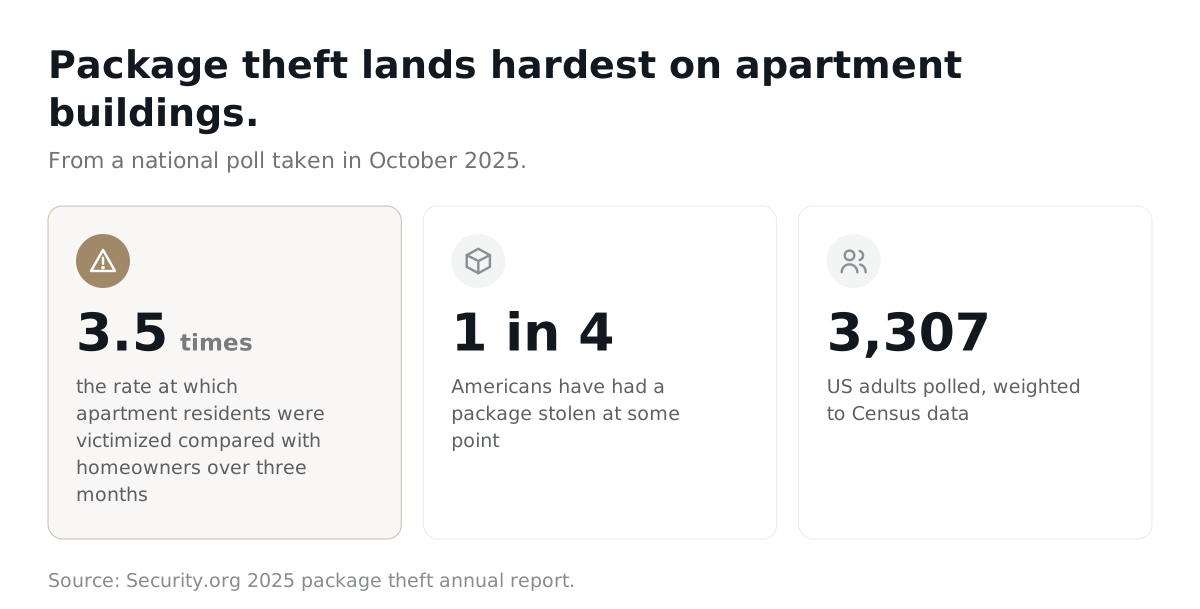
Multifamily is where this argument happens most. In an October 2025 survey of 3,307 adults, Security.org reported that apartment residents were "victimized 3.5 times more often than homeowners" over the preceding three months. One in four Americans has had a package stolen at some point.
Be careful with national totals, though. A May 2025 working paper from the USPS Office of Inspector General sets two private estimates side by side. One counts at least 58 million packages stolen in 2024. The other counts 120 million in 2023. There is no government tally, so name that gap rather than reaching for the biggest number.
Ben Stickle, a criminal justice professor at Middle Tennessee State University, has published peer reviewed work on package theft. He calls it "a major security and loss prevention challenge for retailers, carriers, and law enforcement". Volume turns a nuisance into an operating problem.
When does a carrier stop being responsible for a parcel?
A carrier stops being responsible at the moment its own contract says delivery happened, and every major carrier writes that moment broadly. This is what residents get wrong at the front desk. They see a tracking page that says delivered and assume the carrier still owns the problem.
- USPS. The Domestic Mail Manual rules out indemnity for loss or damage "that occurred after delivery by the USPS", and separately for loss after an item is signed for by the addressee or the addressee's agent. Filing periods vary by service class.
- UPS. The United States terms of carriage define delivery to include "delivery to any person present at such address", delivery to an actual or apparent agent of the consignee, and delivery under the company's own driver release procedures. A concierge who takes the box is an apparent agent.
- FedEx. The FedEx Express terms state that "Shipments to residential addresses may be released without obtaining a signature". Its Indirect Signature Required option lets a driver collect a signature from a building manager or another person at a neighboring address.
The claim windows close faster than most disputes get escalated. UPS requires that "UPS must receive notice of claims within sixty days after Delivery of the Package", with the written claim filed within nine months. FedEx Express wants notice of a damage, delay, or shortage claim within 60 calendar days of delivery, and of a nondelivery or misdelivery claim within nine months of tender.
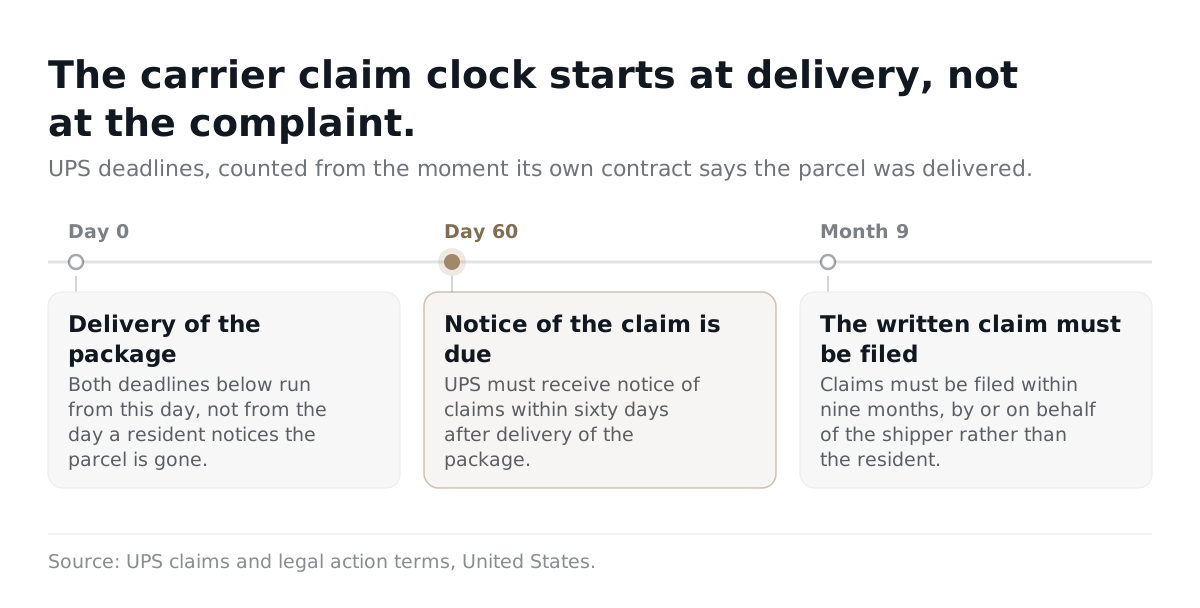
A second wrinkle catches residents. UPS says claims are filed by or on behalf of the shipper, so the person at your desk usually cannot open one. They have to go back to the retailer. The Inspector General paper notes that "the retail industry often bears the direct cost of replacing stolen packages". Knowing that saves a manager an hour of argument.
What is bailment, and why does it decide the building's exposure?
Bailment is the relationship that forms when one party hands property to another for safekeeping and the other accepts it, knowing it has to be given back. Possession moves. Ownership does not. Cornell Law School's Wex legal encyclopedia calls it a transfer of possession without a transfer of ownership. That is what happens when a driver hands a box to a concierge.
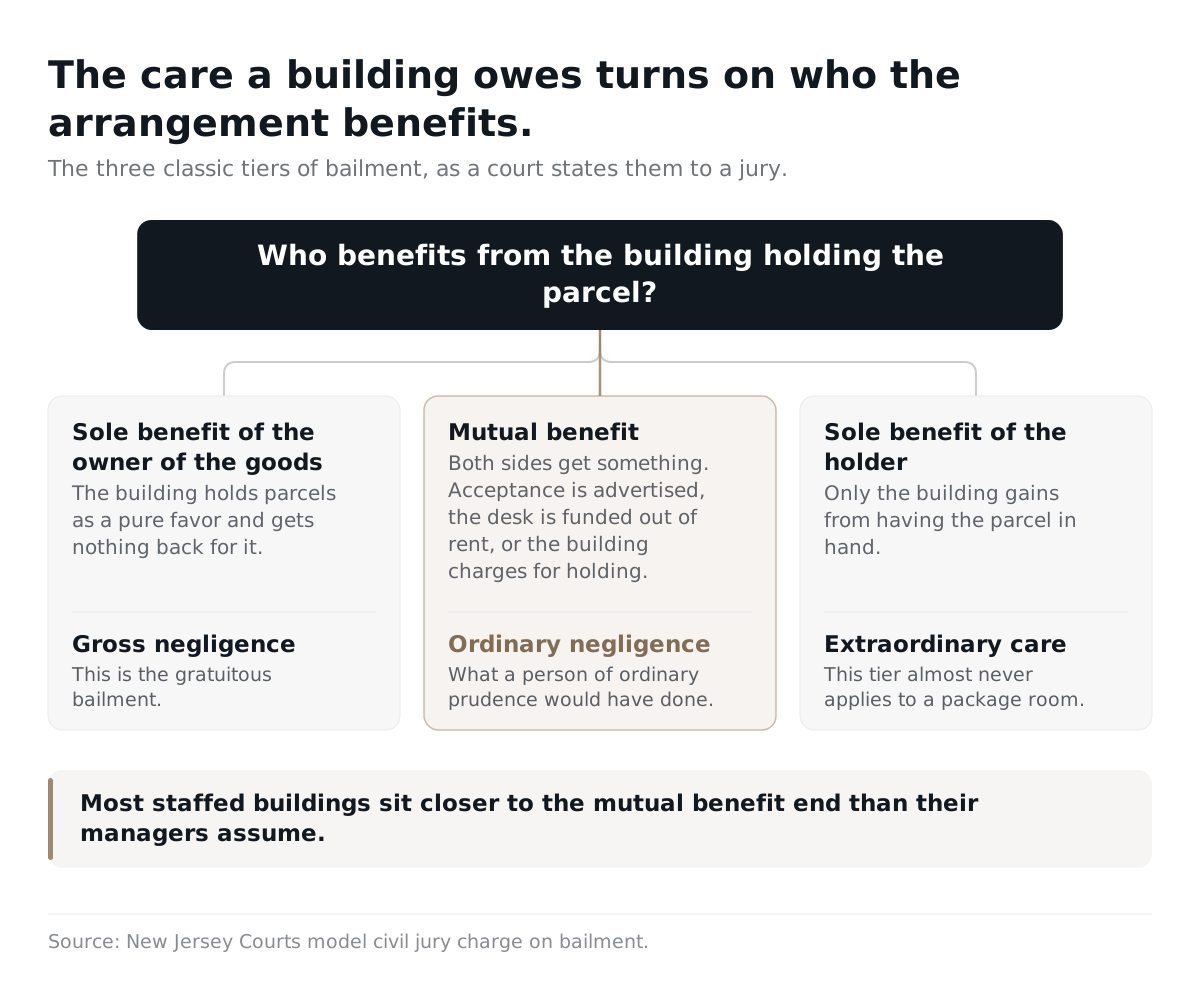
New Jersey's model civil jury charge on bailment puts the operative rule in one line. A bailee is liable for loss "if that damage or loss results from the bailee's negligence". The same charge sets out the three classic tiers of care.
- Sole benefit of the owner of the goods. The holder answers only for gross negligence. This is the gratuitous bailment.
- Mutual benefit. Both sides get something. Ordinary negligence governs, measured by what a person of ordinary prudence would have done.
- Sole benefit of the holder. Extraordinary care is owed. This tier almost never applies to a package room.
So the whole fight in a package dispute usually collapses into one question. Which tier is this building in?
What changes when the building gets a benefit from holding packages?
The standard rises from gross negligence to ordinary negligence, a much easier bar for a resident to clear. A building doing a pure favor is judged loosely. A building that gets something out of the arrangement is judged by what a careful operator would have done. The open textbook treatment used in business law courses lays out the same ladder, from a slight duty of care in a gratuitous bailment to the ordinary negligence standard in a mutual benefit bailment.
Most staffed buildings sit closer to the mutual benefit end than their managers assume. The National Multifamily Housing Council describes parcel handling as something "apartment communities invest staff time, resources and space" in. A building that funds a service is not doing a favor. We add up what that service really takes in package handling costs in apartment buildings. What looks like benefit:
- Package acceptance is advertised in leasing material or listed as a building amenity.
- A staffed lobby or concierge desk is funded out of rent or common element fees.
- The building charges anything at all for holding, oversize handling, or extended storage.
- Accepting parcels cuts down failed deliveries, redelivery attempts, and the lobby traffic that comes with them.
None of that decides a case on its own. It does explain why a manager who says "we are just being nice" often finds a court sees a service the building chose to provide.
Does a sign saying the building accepts no responsibility actually work?
It works less often than managers think, and it gets weaker the moment staff physically take custody. A posted notice or a lease clause can shape expectations. It cannot reliably erase a duty the building created by accepting the parcel.
- A total disclaimer by a business is a bad bet. The standard business law treatment of bailment says an attempt to totally disclaim liability "will probably fail in every American jurisdiction", and that any disclaimer must be brought to the owner's attention and be unambiguous. A sticker behind the desk that nobody reads is not that.
- Printing a clause does not make it enforceable. A 2017 study in the Journal of Legal Analysis reviewed 70 residential leases in the greater Boston area and found that 73 percent contained at least one unenforceable clause, with 23 percent including an invalid exculpatory clause on negligence. Clauses like these survive because they are almost never tested.
In several states the clause is dead on arrival by statute, whatever it says.
| State | What the lease clause cannot do | What the statute is written against |
|---|---|---|
| New York | Exempt the lessor from liability for property damage caused by its own negligence. Such a covenant is "void as against public policy and wholly unenforceable" | Any lease of real property, and anything collateral to one |
| Massachusetts | Exonerate or indemnify the landlord for its own negligence, expressly including elevators, stairways, hallways and other appurtenances | A lease |
| California | Waive the tenant's right to have the landlord exercise "a duty of care to prevent personal injury or personal property damage" where the law imposes one | A lease or rental agreement of a dwelling |
| Delaware | Agree to "the exculpation or limitation of any liability of the landlord arising under law" | A rental agreement |
California is the one to read twice. Its wording reaches personal property damage by name, and a stolen parcel is personal property. Massachusetts reaches hallways, and a lobby is exactly such an appurtenance. Now look down the third column. Every one of these statutes is written against a lease. That is the seam a condominium falls through.
A disclaimer still earns its place. It sets expectations before a dispute starts, and it supports an argument that the building never meant to become a custodian. It will not protect a building whose staff signed for a parcel and then lost track of it. The same logic applies to money the building holds for a resident, which we cover in resident payments, deposits, and liability.
Does the analysis change in a condominium?
Part of it changes and the most important part does not. Bailment law does not care whether a lease exists. It forms when someone accepts property for safekeeping. A concierge employed by a condominium association stands exactly where a landlord's concierge stands.
What changes is the statutory backstop. Every exculpatory clause statute in the table above is keyed to a lease or a rental agreement. A unit owner never signed one. That cuts both ways, and boards usually notice only the half they like:
- An owner cannot use those statutes to knock out a disclaimer in the declaration or the rules, because the owner is not a tenant.
- A board cannot read that silence as safety. The general bailment rule still applies, and a total disclaimer by a business bailee is a bad bet anywhere.
- A rule the board adopted after the owner bought is a weak candidate for a bargained term. Nobody negotiated it and often nobody read it.
The affirmative duty runs in a different channel. Florida's Condominium Act says the "officers and directors of the association have a fiduciary relationship to the unit owners", and requires the care an ordinarily prudent person in a like position would exercise. That is the same ordinary prudence language the bailment standard uses. Your state's act will read differently, but the shape is common. The board owes duties to owners, and the paperwork drafted to protect a landlord was not written with a board in mind.
The practical answer for a board is short. Decide in writing whether staff accept parcels. Put it in the minutes so it is a governance act rather than a habit. If the answer is yes, keep the custody record a well run rental building keeps. Our guide for condo boards choosing building software covers where it lives.
Why is a parcel in the lobby different from one the concierge signed for?
Because custody creates duty and a lobby drop never transfers custody to anyone. When a driver leaves a box on a mail table and walks out, no employee of the building accepted anything. There is no bailment to argue about.
The baseline is lower than most residents assume. In The New York Times in November 2024, New York real estate lawyer David Kaminsky put the landlord's obligation plainly: "They are not required to provide delivery lockers, or concierges". Running a package operation is a choice.
No custody is not the same as no exposure, though. Ordinary premises negligence still sits there: a broken lock, a door propped open for weeks, a work order nobody actioned. In Kline v. 1500 Massachusetts Ave. Apartment Corp., decided by the federal appeals court in Washington in 1970, the court held that a landlord with notice of repeated crimes in a part of the premises under its exclusive control must take the steps within its power "to minimize the predictable risk to his tenants". That same opinion refused to prescribe one set of security measures for every apartment house. The standard is what was reasonable for your building.
Be honest about the state of the law here. No widely reported appellate decision squarely decides who pays when a parcel disappears from an apartment package room. Courts reason across from general bailment law and premises cases like Kline. Nobody predicts these outcomes confidently, which is one more reason the record matters more than the argument.
Once a staff member takes the parcel, the analysis changes completely. Signals a court will read as custody:
- A staff member signed a carrier device or manifest for the parcel.
- The parcel moved to a controlled area such as a locked package room, a cage, or a space behind the desk.
- The building logged it, notified the resident, or held it pending pickup.
- The building has a written policy telling residents staff will accept deliveries.
This is why package liability is a workflow question rather than a legal one. A building that accepts parcels has already chosen the higher standard. The only remaining choice is whether it can prove it met that standard. Our package room workflow covers the intake steps that make it provable.
Who is on the hook at each stage of a delivery?
Each stage has a different answer, and each is settled by a different record. Worth taping inside the concierge desk.
| Stage of the parcel | Who is generally on the hook | The record that settles it |
|---|---|---|
| In transit, not yet delivered | The carrier, under its own contract. The shipper opens the claim | Carrier tracking history and the retailer's claim file |
| Marked delivered at the door or dropped in the lobby, no staff involved | The resident in most cases. The retailer may reship as a customer service decision, not a legal duty | The delivery scan, geolocation, any photo on delivery, lobby camera footage |
| Accepted or signed for by building staff | The building, if it fell short of the care a bailee owes in your state | An intake log: who accepted it, when, and where it was placed |
| Held in a package room or behind the desk | The building, and the standard tightens because access is controlled | Room access records plus the parcel's own status history |
| In a smart locker | Usually the building or the locker provider by contract, until the resident opens the door | The locker event log and the notification sent |
| Collected by the resident | The resident | The pickup event: who released it, to whom, and at what time |
Read down the third column and the pattern shows up. Every row is decided by a record, and in most buildings four of those six records do not exist. Lockers close part of that gap for small parcels and none of it for oversize items, which is the tradeoff we walk through in lockers versus package management software.
Does renters insurance cover a stolen package?
Usually yes, subject to the policy deductible and the limits inside the policy. Theft is a named peril on a standard renters policy, and coverage generally follows the resident's belongings away from the unit. The Insurance Information Institute notes that most renters policies include off premises coverage, meaning "belongings that are outside of your home are also covered".
Two things residents rarely understand until the day they need to. New York's Department of Financial Services states it plainly: "A landlord does not provide insurance for a tenants personal property". And the deductible on a typical renters policy is often larger than the value of one stolen parcel, so most package losses never become claims. That is the quiet reason these disputes land on the manager's desk instead of an adjuster's.
Requiring renters insurance in the lease is still the simplest risk transfer available. It will not resolve a bailment claim where staff were careless. It does end most of the smaller arguments before they start.
What record turns a package dispute into a five minute answer?
A timestamped chain of custody showing arrival, notification, and release, with a named person on each step. A building that can produce that sits in a different position than one with a clipboard and a memory. The clipboard building cannot prove it met the standard of care. It can only assert it. For how shelf location, aging reports, and the audit trail are kept, see our guide to package room inventory software.
URBI was built around that record. Every action on the platform writes to a permanent log, and packages work the same way:
- Intake is captured, not typed. The concierge photographs a stack of parcels, up to 50 images in one batch. The AI label reader pulls addressee, courier, and tracking off each shipping label.
- A human confirms before anything is released. Parses land in a staging table moving through PENDING, PROCESSING, READY, CONFIRMED, and FAILED. Nothing reaches a resident on an AI guess.
- Status is the chain of custody. Package status runs RECEIVED, then READY, then PICKED_UP. That answers when it arrived, when it was available, and when it left.
- Notification is timestamped. A push fires the moment a package is confirmed. For a resident with no push enabled, an acknowledge fallback records that they were told.
- Lockers stay in the same ledger. For buildings using smart lockers for small parcels, URBI integrates so the resident pulls directly. Larger items go through the concierge and the label reader. URBI is the software layer and does not make lockers.
The dispute value is specific. When a resident says nobody told me, the notification record answers it. When they say I never picked that up, the PICKED_UP event and the staff member on it answer it. An attorney gets a log instead of a description of one.
Scope matters too. One operator login spans a portfolio of buildings, and each keeps its own residents, documents, settings, and permissions. A package record belongs to the building it happened in, not to the portfolio.
The policy itself matters as much. It lives in the building document layer, where AI document processing parses uploaded PDFs into a searchable index, so staff find it by content rather than filename. Post it as a news announcement with the audience and urgency level set, and the post keeps its record of what went out, to whom, and when. Showing what was sent beats saying it was posted somewhere.
If you are choosing tooling, we compare the options in the best package management software for buildings, and the broader picture of what a residential operator runs on lives in URBI for residential buildings.
Common questions about package liability in apartment buildings
If our staff never sign for anything, are we safe?
Safer, not safe. Declining parcels avoids creating a bailment, which is the strongest form of exposure. You can still face an ordinary premises argument if a resident shows the building was careless about access, such as a lobby lock left broken for weeks with a work order nobody actioned. The policy only holds if staff follow it every time, including for the resident who asks nicely.
Can we just charge residents a package holding fee?
You can. Understand what it does to the legal posture first. Charging for a service is strong evidence of a mutual benefit bailment, which moves the standard from gross negligence to ordinary negligence. That is a reason to make the record good enough to show reasonable care, not a reason to skip the fee. URBI treats Charge Back as a first class object, so a cost billed to a unit is a record, not a note in a thread.
What should we do the moment a resident reports a missing package?
Establish custody first, before anyone apologizes or promises anything. Check whether the building ever accepted the parcel, and pull the intake and notification records if it did. If no staff member took it, point the resident at the carrier tracking detail and at the retailer, since carriers generally require the shipper to open a claim. Log the report as an incident note so the building has its own contemporaneous record.
Does a locker system move the liability off the building?
Partly, and only for what fits in a locker. A locker creates a custody record and a delivery event without staff involvement, which is genuinely useful. It does not cover oversize parcels or furniture, and the contract with the locker provider decides where responsibility sits while a parcel is inside. New buildings should settle this at design stage, which we cover in package management for new apartment buildings.
Our building is a condominium. Is the board personally exposed?
Usually the association is the defendant rather than the individual director, but directors owe real duties. Florida's statute describes a fiduciary relationship between officers and directors and the unit owners, and asks for the care an ordinarily prudent person would use. Your state's act will differ. A board protects itself the way a landlord does, by deciding the policy deliberately and keeping a record that shows it was followed. The controls that stop the loss in the first place are covered in apartment package theft prevention.
If you want to see what your building's package record would look like as evidence rather than as a promise, we will walk through it with your actual volume and staffing. Email hello@myurbi.co and we will show you the intake, the confirmation step, and the pickup log.


