



Package lockers vs package management software is not a choice between two products. A locker solves where the parcel sits. Software solves who has it, when it arrived, and whether you can prove any of that later. URBI is the software layer. URBI does not sell lockers.
Search for an apartment package management system and almost every result is a hardware vendor. Luxer One, Parcel Pending, Package Concierge, Amazon Hub, Position Imaging, ButterflyMX. They are selling you a capital purchase, and for many buildings that purchase is correct. What almost nobody explains is that the locker and the record are two different problems.
Why is package volume the problem it is now?
Because residents order more, and the building absorbs all of it. Online retail reached 17.1 percent of total US retail sales in the second quarter of 2026, growing 12.2 percent year over year while total retail grew 6.7 percent, according to the US Census Bureau quarterly retail ecommerce report released in August 2026. Online buying is growing at close to twice the rate of retail overall.
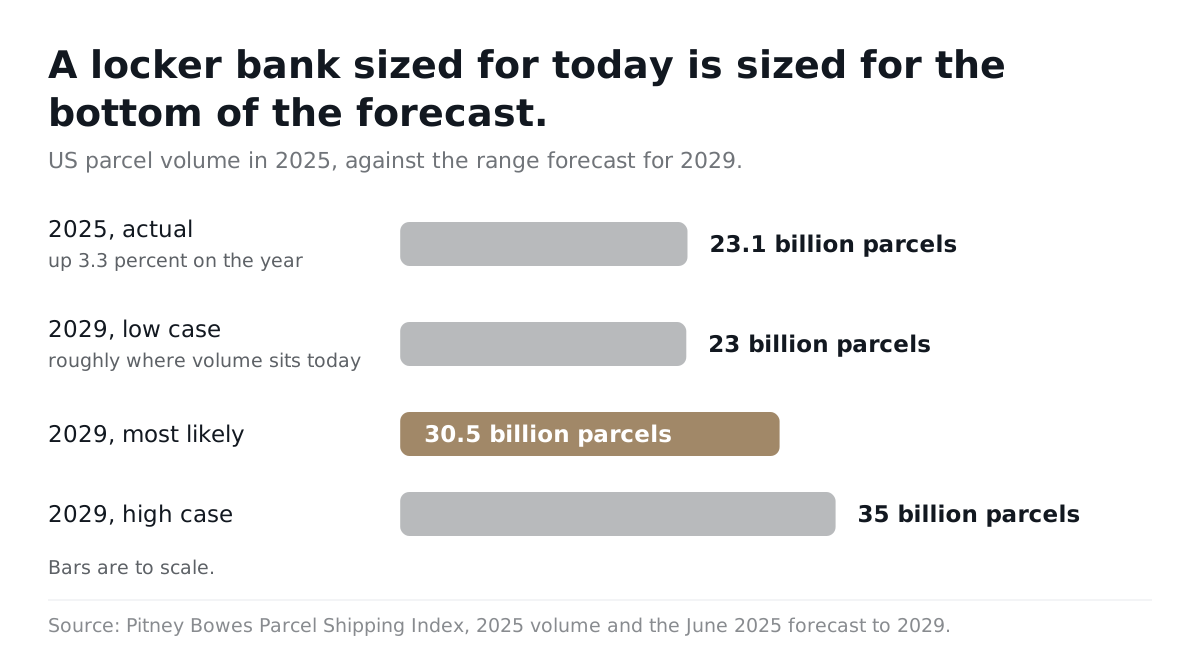
The volume shows up at the front desk. US parcel volume reached 23.1 billion shipments in 2025, up 3.3 percent on the year, according to the Pitney Bowes Parcel Shipping Index. In the 2022 NMHC and Grace Hill Renter Preferences Survey of 221,000 renters, the share receiving three or more packages a month rose from 55 percent in 2019 to 76 percent, NMHC reported.
That is an operations problem, not an amenity. NMHC surveyed 2,098 properties across 44 states for its 2018 package delivery research and summarized the finding this way: "Increasing package volumes are taxing the status quo."
And the risk is concentrated in exactly your building type. The 2025 Security.org package theft report, an October 2025 poll of 3,307 US adults, found apartment residents were victimized 3.5 times more often than homeowners over the preceding three months. One in four Americans has had a package stolen at some point.
What does a package locker actually solve?
A locker solves the handoff. It is a physical place to put a parcel so the resident can retrieve it at midnight without a staff member standing there. That is a real and specific job, and lockers do it well.
Here is what you genuinely buy with a locker bank:
- Unattended retrieval. The resident gets their parcel on their schedule, not on the office hours schedule.
- A locked box instead of a hallway. The parcel is behind a door rather than stacked where anyone walking past can take it.
- Staff removal from the small parcel path. For the envelope and the shoebox, nobody at the building has to touch it at all.
- A leasing story. Prospects ask about package handling on tours. A visible locker bank answers the question before it is asked.
The federal government treats lockers as a real mitigation too. A 2025 working paper from the USPS Office of Inspector General counted more than 500 USPS Smart Locker locations as of summer 2024 and treats secure lockers as an effective response to theft, while noting they "require the customer to trade off some degree of convenience."
A locker bank is also a construction decision. It needs floor space, power, a network drop, and a spot every resident can use. The 2010 ADA Standards set a forward reach range of 15 inches minimum to 48 inches maximum and cap the force to operate a control at 5 pounds, per the US Access Board. Whether that binds a given compartment depends on the building. It still shapes which doors a resident using a wheelchair can reach.
If your building has lobby square footage, a decent power and network run, and mostly small parcels, a locker bank is a good purchase. Buy it. This article is not an argument against lockers.
What does package management software actually solve?
Software solves the record. Who received the parcel, at what time, on behalf of which resident, whether the resident was told, whether they collected it, and whether you can produce that history six weeks later when somebody disputes it.
A locker generates a record for the parcels that go into the locker. It generates nothing for the parcel a driver left on the mailroom floor, the parcel too big for any compartment, the one signed for at the desk, or the one a courier scanned as delivered without ever putting it anywhere. Those parcels are not edge cases. They are most of what the front desk argues about.
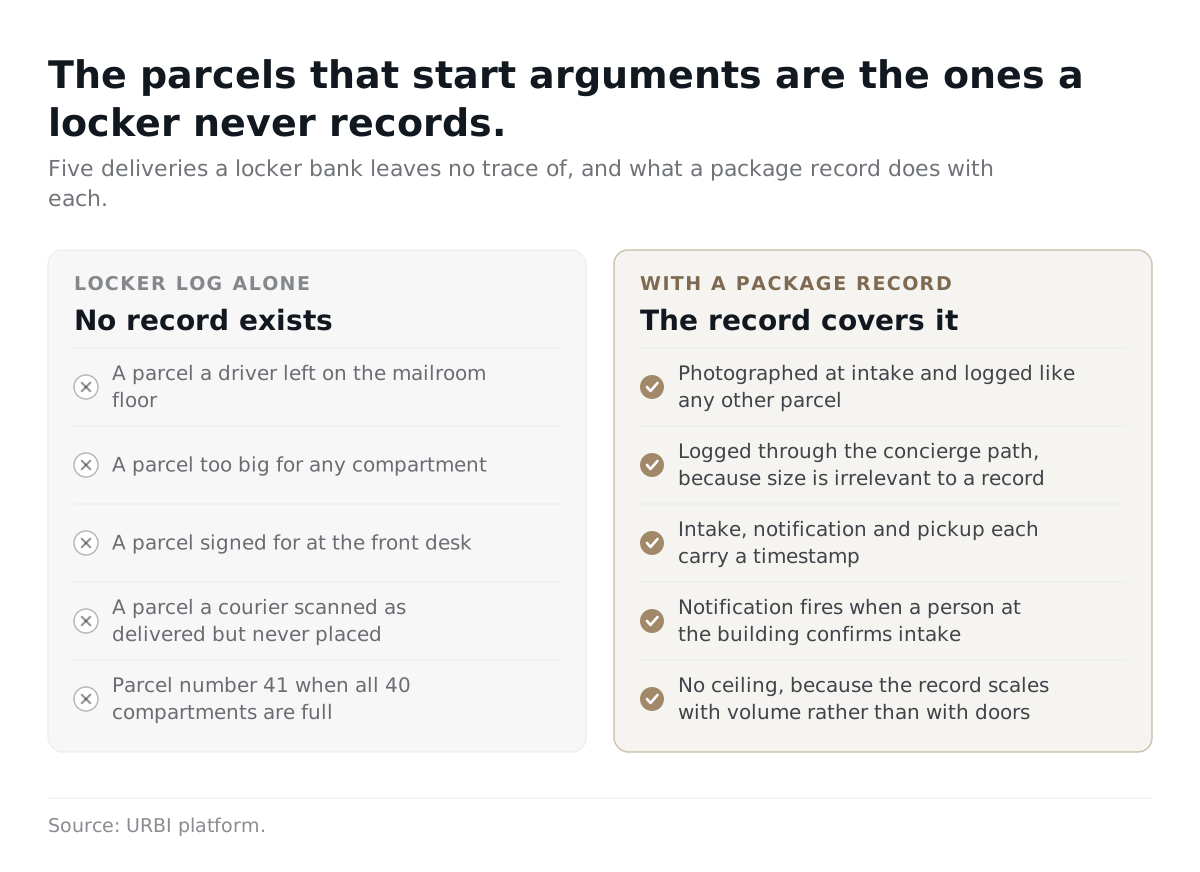
Package management software covers the whole intake path, not one channel of it. That means:
- Intake for every parcel, including the ones the locker could never hold.
- A status trail that moves from received to ready to picked up, with a timestamp on each transition.
- Notification the building controls, so the resident hears from you rather than from a courier app that may be wrong.
- Search and history, so a question about last month is answered in seconds instead of by memory.
More on designing the intake path in the package room workflow guide, and on judging the category in best package management software for buildings.
Package lockers vs package management software: how do they actually compare?
They differ on eight axes that matter operationally. Everything else is marketing.
| Axis | Package lockers (hardware) | Package management software |
|---|---|---|
| What it solves | The handoff. A secure place for the parcel between arrival and pickup. | The record. Who received it, for whom, when, and whether it was collected. |
| When capacity runs out | Hard stop. Compartment 41 does not exist. Parcels go on the floor, in a back room, or back on the truck. | No ceiling. The record scales with volume because it is data, not doors. |
| Chain of custody record | Complete for parcels placed in a compartment. Silent for everything else. | Covers every parcel that enters the building, whichever path it took. |
| Resident notification | Fires when the driver loads a compartment. Depends on the driver doing it correctly. | Fires when a human at the building confirms intake, regardless of courier behavior. |
| Staff time | Removes staff from the small parcel path. Adds staff time on overflow, jams, and misloads. | Cuts the logging, the lookups, and the where is my parcel interruptions. Does not carry boxes. |
| On a dispute | Locker log proves the compartment event. Proves nothing about a parcel that never went in one. | Timestamped intake, notification, and pickup history for the specific parcel and resident. |
| Oversized item | Does not fit. Falls back to a person, a room, or the hallway. | Logged and tracked like any other parcel. Size is irrelevant to a record. |
| Retrofit constraints | Needs floor space, power, network, and an accessible location. Purchase, installation, maintenance, and replacement sit with the property owner. | No construction. Works with the mailroom, closet, or desk you already have. |
Read the columns as complements. The locker column is strong exactly where the software column is weak, and the reverse holds too.
What happens to parcel number 41 when you have 40 compartments?
It goes somewhere with no record attached, which is where buildings actually get hurt. Overflow is the case nobody plans for and everybody experiences, usually in the first week of December.
The arithmetic is unforgiving. Locker capacity is fixed on the day of install. Parcel volume is seasonal and rising. Pitney Bowes forecast in June 2025 that US parcel volume will land somewhere between 23 billion and 35 billion by 2029, with 30.5 billion the most likely case. A bank sized for today is sized for the bottom of that range. Amber Hammond, writing on Multifamily Insiders, makes the point that a locker bank or a package room has a finite ceiling, and that when peak volume passes it, onsite teams absorb the difference and other operations suffer for it.
Practitioners say the same thing more bluntly. In a Multifamily Insiders discussion thread on package lockers, Denise Weems advised buildings sizing an install: "however many you think you need, do more!"
Buying more compartments helps and does not fix it. You size for peak, you pay for peak all year, and peak still moves. Volume is not stable either. Elie Rieder, founder and CEO of Castle Lanterra Properties, told Multifamily Executive in 2024 that "Package delivery volume has doubled since last year."
The honest planning position is that your lockers will overflow. The question is only whether parcel 41 lands in a system or on a shelf. Our guide to package room inventory software covers how that shelf stays findable once it fills.
Why do buildings with lockers still have staff hunting for packages?
Because the locker depends on the courier, and the courier does not work for you. Every failure mode below happens after a locker system is installed and working as designed.
- Drivers skip the system. They are on a route clock. Scanning into a locker takes longer than dropping a stack inside the door.
- Several parcels land in one compartment. Sometimes that is deliberate. Parcel Pending markets a consolidated box feature that puts multiple deliveries from one carrier into a single locker. The trouble is the unplanned version, where a driver combines parcels for different residents and only one of them gets told.
- Drivers mark delivered without delivering. The courier app says complete. The compartment is empty. The building is now in an argument it has no evidence for.
- Residents do not enroll. A resident who never registers cannot be notified, and their parcel occupies a compartment nobody is coming for.
- Residents leave parcels in compartments. Every uncollected parcel is a compartment out of service for the next delivery.
- The network drops. Deliveries continue and codes do not go out.
Every one of those failures is a record failure rather than a hardware failure. The locker did what a locker does. What broke was the knowledge of what arrived and where it went, which is not a problem you can buy a bigger box to solve.
Be honest about what that evidence is. Those are mechanisms, not rates. No public US dataset says how often drivers skip a bank, how often two residents share a compartment by accident, or how many residents never enroll. So ask a vendor's reference properties for their own overflow and misdelivery numbers, because nobody has published them.
Enrollment is the failure managers underestimate most. A package system only works for residents who are in it. That is an adoption problem, and we covered it in the resident app adoption guide.
What is the strongest case for buying the locker first?
A good locker install does take staff out of the parcel path, and operators who have one rarely want to give it back. In the Multifamily Insiders thread, the complaints are aimed at drivers and at December, not at the hardware.
Locker vendors publish case studies claiming tens of staff hours saved a week, climbing during the holiday peak. Those numbers arrive with no baseline and no method. Treat the direction as credible and the figure as unverified. To measure your own baseline, see our breakdown of package handling costs in apartment buildings.
The vendors are also straight about the limit, which is the part worth reading. Parcel Pending says oversized items such as mattresses, tires, and bicycles need a separate package room. Luxer One says many communities settle on a hybrid, lockers for standard parcels and a room for the rest. Both are describing a building with two custody paths.
Two custody paths with one record is a system. Two custody paths with two records is where the disputes come from.
Does the Postal Service require parcel lockers in apartment buildings?
Yes, at a minimum ratio, and the ratio is far below what a modern building needs. The USPS National Delivery Planning Standards handbook states that for centralized delivery installations, "There must be at least 1 parcel locker for every 5 mailbox compartments," with no maximum imposed.
That floor is already the doubled version. USPS said in 2021 that new and remodeled apartment buildings must carry at least one parcel locker for every five customer mail compartments, up from one for every ten, a change made to "better accommodate increases in package volumes."
Three things follow from that rule.
- The minimum is a floor, not a target. One locker per five mailbox compartments, at roughly the size of a shoebox each, does not cover Postal Service volume alone, let alone the private couriers.
- The lockers in a 4C bank are for the mail carrier. They are part of the mail receptacle equipment approved under USPS Standard 4. They are not a resident facing smart locker product.
- You own the equipment. The Postal Service is explicit in the Domestic Mail Manual that purchase, installation, maintenance, and replacement of mail receptacles are the customer's responsibility, not the agency's.
If you are specifying a new building, the STD 4C bank and a smart locker bank are separate decisions with separate budgets. Plan both. We cover the full new construction sequence in package management for new apartment buildings.
How should a building sequence the two purchases?
Start with the record, then buy capacity against what the record shows. The reason is practical rather than ideological. Software tells you how many compartments you actually need.
Most buildings size a locker bank on a vendor's rule of thumb and a guess about resident behavior. A building that has been running a package record for a season knows its real daily intake, its real peak week, its real average dwell time between arrival and pickup, and its real oversized share. That is a specification, not a guess.
The sequence that works:
- Put every parcel into a record first. Even a manual process with software behind it beats a locker with no visibility into the overflow.
- Run it through one peak. December tells you more about your building than any vendor sizing worksheet.
- Read the dwell time. If residents collect within a day, you need fewer compartments than you think. If parcels sit for a week, compartments will not save you.
- Size the locker bank to your small parcel volume only. Oversized items were never going in a compartment. Do not pay for compartments to handle them.
- Keep the concierge path for everything else. Furniture, mattresses, grocery totes, and the cases of wine at the holidays all still need a person and a record.
There is one case where the order flips. A building with an unstaffed lobby has no concierge intake path at all, so the locker is the only handoff mechanism available and has to come first. Even then, buy the record alongside it. That building has nobody standing there to remember what happened.
Where does URBI fit if it does not sell lockers?
URBI is the software layer, and being clear about that is the whole point. URBI does not manufacture or sell lockers, has no hardware to protect, and has no reason to tell you that you need more compartments than you do.
Here is how the package path works in URBI:
- Batch intake by photograph. The concierge photographs a stack of incoming parcels, up to 50 images in a single batch. There is no scanner and no barcode discipline to enforce.
- AI reads the shipping labels. Each label is parsed for addressee, courier, and tracking number.
- A human confirms before release. Parses land in a staging table and move through pending, processing, ready, confirmed, and failed. Nothing reaches a resident until a person has confirmed it, so a misread label does not become a wrong notification.
- Notification fires on confirmation. A push goes to the resident the moment the parcel is confirmed, with an acknowledge fallback for residents who have not enabled push.
- Status is the chain of custody. Every parcel runs received, then ready, then picked up. That sequence is the evidence.
- One workspace across a portfolio. An operator with several buildings works from a single login. Each building keeps its own residents, documents, and permissions, so one property's parcel history stays its own and each bank gets sized on its own numbers. More on that in multi property management software.
- Lockers are supported, not replaced. For buildings running smart lockers for small parcels, URBI integrates so the resident pulls directly. Larger items go through the concierge path with the AI label reader.
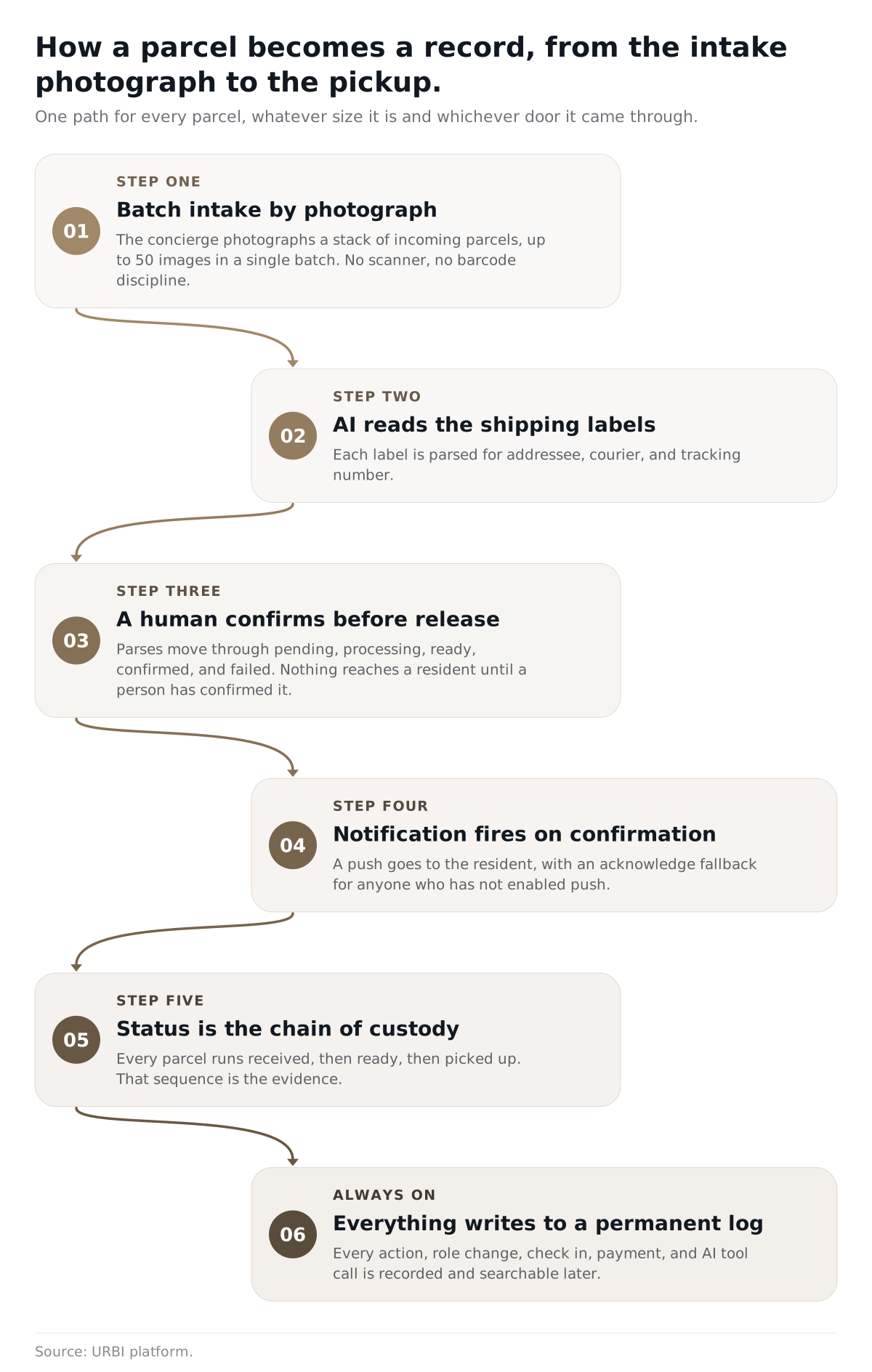
The same audit trail runs under everything else in the platform. Every action, role change, waiver signature, check in, payment, and AI tool call writes to a permanent log, which is what turns a package dispute from a memory contest into a lookup. That matters more than managers expect, and we covered why in who is liable for stolen packages in an apartment.
Residents who would rather call than open an app reach Arthur, the resident facing AI, on the building's own phone number. A question Arthur cannot answer goes to the manager, and the answer is saved to the building's knowledge base so the next person asking is handled without the manager. The wider picture is in URBI for residential buildings.
What else do buildings ask about lockers and package software?
Do I need package management software if I already have lockers?
Most buildings do. Your locker covers the parcels that go into the locker. It has nothing to say about oversized items, overflow during peak weeks, parcels a driver left inside the door, or a courier that marked a delivery complete without completing it. Those are the parcels that generate the complaints, and they are the ones with no record attached.
Can package management software replace lockers entirely?
It can, if the building has a staffed intake point. A concierge or front desk with software behind it produces a complete record and handles any parcel size. The cost is staff time, because a person is doing the handoff instead of a machine. Buildings with no staffed lobby genuinely need the locker, because there is no other way to complete a delivery.
What happens to oversized packages that do not fit in a locker?
A person handles them, which is exactly why the record matters. Furniture, mattresses, appliances, and bulk grocery orders go to a package room, a back office, or a corner of the lobby. In URBI, the concierge photographs them with everything else and the AI label reader logs them, so an item too big for any compartment still carries the same received, ready, and picked up trail.
Does URBI sell lockers?
No. URBI does not manufacture or sell locker hardware, and there is no hardware line to defend. URBI integrates with smart lockers for small parcels so residents pull directly from the compartment, and handles larger items through the concierge intake path with the AI label reader. Choose your locker vendor on the hardware merits and keep the record in one place. To size the bank before you talk to a vendor, work through how many package lockers a building needs.
If you are weighing a locker purchase right now, the useful question is not which vendor. It is what your building's real parcel volume, dwell time, and oversized share look like. That is what sizes the bank and tells you what the concierge path still has to carry. We are happy to walk through it with you and be honest about where a locker beats software, which is more often than most software companies admit. Reach us at hello@myurbi.co.


