



Mixed use building communication software sends one event to residents, retail tenants, and office tenants with different instructions for each, and keeps a record you can produce later. URBI does this from one dashboard across every tower, and this guide uses it as the reference point.
This is a requirements guide for operators of residential over retail and office with a shared garage, a loading dock, and shared amenities. If you run a pure condo or apartment tower, the sibling guide on how to choose building communications software is the better fit. If you run offices only, read tenant communication software for commercial buildings. Here we cover why the mixed use case is harder, what the software must do, the channel math, the law, when separate systems stop making sense, and what to ask on a demo.
Why is communication harder in a mixed use building?
Because one physical event touches three or more audiences with different rights, different statutes, and different instructions. A garage closure is a parking problem for residents, a delivery problem for a restaurant, and a commuter problem for an office tenant with 200 employees.
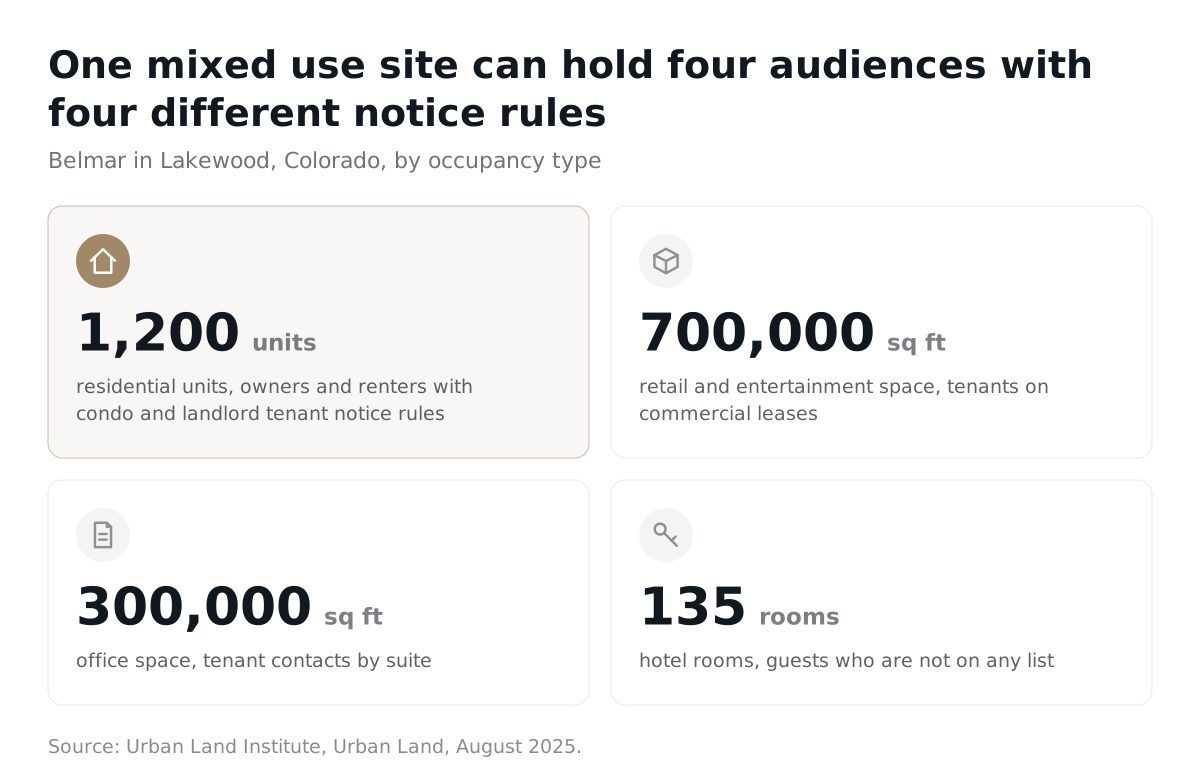
The Urban Land Institute's August 2025 review of mall conversions describes Belmar in Lakewood, Colorado with 1,200 residential units, 700,000 square feet of retail and entertainment, 300,000 square feet of office, and a 135 room hotel on one site. The same article names the hurdles: anchor tenant agreements, multiple property owners, infrastructure deficits, and community buy in. Each is a separate approval chain for a notice.
Bob Northfield, principal and director of architecture at BCT Design Group, told Urban Land of phased redevelopment: "Everything can't shut down and reopen three years later." Construction notices become a standing category.
| Audience | What governs the notice | What they need from a garage closure notice |
|---|---|---|
| Residents (owners) | State condo statute and the declaration | Which levels close and where guest parking moves |
| Residents (renters) | State landlord and tenant law and the lease | Same, plus who to call about an assigned space |
| Retail tenants | The commercial lease, and in some states a commercial tenant statute | Customer parking, delivery windows, dock access |
| Office tenants | The commercial lease | Commuter parking, after hours access, dates in advance |
All four share the garage, and none share a contact list, a consent record, or a notice statute. That is the whole problem.
What should mixed use building communication software do?
The same six jobs as any building communication tool, plus one only mixed use buyers need: segmentation across occupancy types, with each property sending at its own local time.
- Notices. Write once, schedule, publish to app, email, and every lobby screen.
- Emergencies. One action alerts every phone and every lobby, and the same action posts the all clear.
- Two way messages. A retail manager's reply lands in a staff inbox someone owns.
- Targeting. One tower, one floor, owners only, retail only, or one suite, without a spreadsheet.
- Translation. A resident who reads Spanish gets the notice in a form they can act on.
- Proof. Later, show what was sent, to whom, when, and who approved it.
The seventh job is the mixed use one. The recipient record has to hold property, occupancy type, unit or suite, access level, preferred channel, consent status, and language. Then one garage closure produces a resident version, a retail version, an office version, and a script for the desk. If occupancy type is not a field, you rebuild the audience by hand every time.
Local send time matters more than it sounds. A company with a district in Denver and a tower in Miami wants the same holiday hours notice at 9 AM in both, and one blast at one clock time gets one of them wrong. One post should fan out to several properties, each at its own local time, from one login. The wider case is in multi property management software.
Which channels reach each audience?
Residents on their phones, retail managers by store phone and email, and office tenants through a contact who relays to staff, so the software has to run every channel.
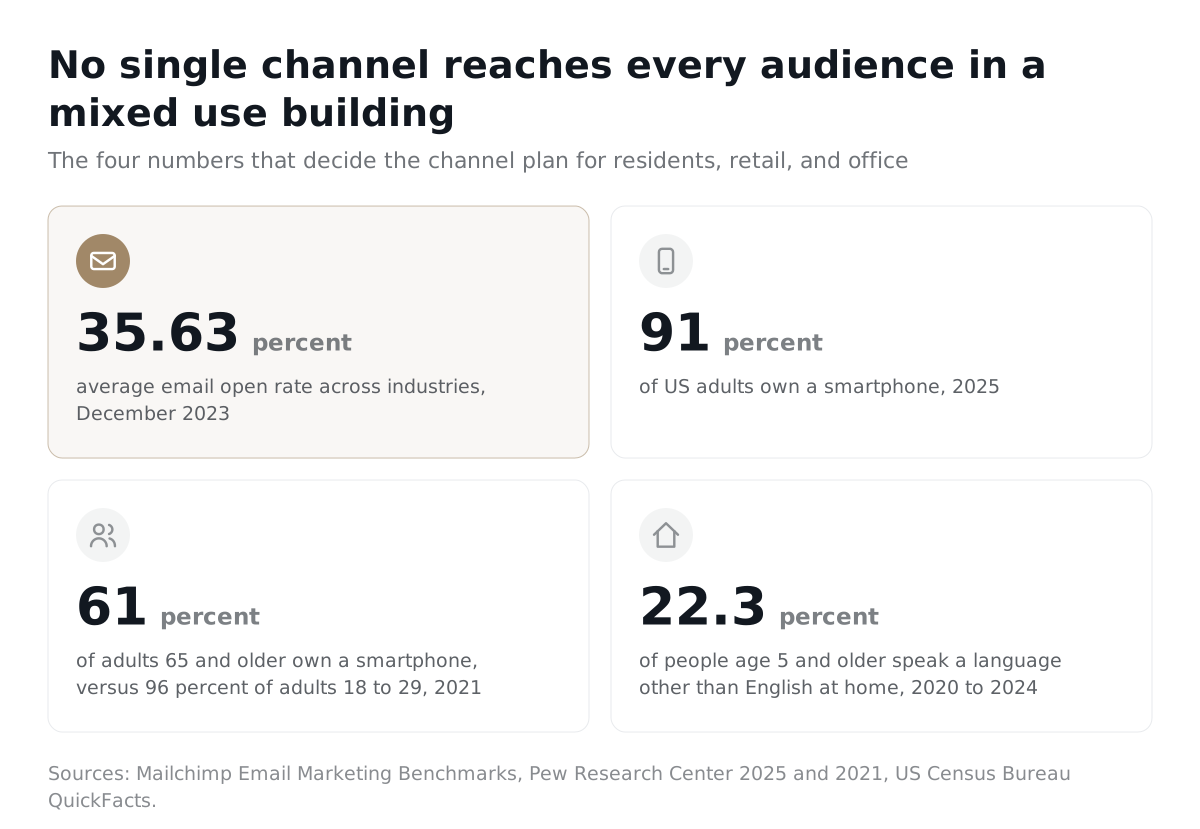
Four numbers frame the plan. Mailchimp's benchmark across all industries put the average email open rate at 35.63 percent as of December 2023. Pew Research Center found in 2025 that 91 percent of US adults own a smartphone, but its 2021 breakdown showed only 61 percent of adults 65 and older. The US Census Bureau reports that 22.3 percent of people age 5 and older spoke a language other than English at home in 2020 to 2024.
| Channel | Residents | Retail tenants | Office tenants |
|---|---|---|---|
| Long notices and agendas; 35.63 percent average open rate (Mailchimp, 2023) | Primary channel, read between shifts | Primary channel to the facilities contact, who may not relay it | |
| SMS | Urgent outages; reaches the 91 percent with a smartphone plus basic phones (Pew, 2025) | Urgent dock and parking changes to the manager on duty | Emergencies only, to the named contacts; consent rules apply |
| App push | Everything, once installed; weaker among adults 65 and older (Pew, 2021) | Works if the manager installs it | Rarely reaches individual employees |
| Voice call | Emergencies and residents without apps | The store landline still works | Reception desk; automated calls need consent or an emergency basis |
| Lobby and elevator screen | Residential lobby, no device needed | Retail corridor and dock entrance | Office lobby and elevator bank; reaches only people who walk past |
The rule: urgent goes to SMS, push, and every lobby screen together. Long form goes to email and the document hub. Anything the lease or statute names goes on that channel plus the app. A district with many older residents or many non English speakers keeps voice, paper, and translation as standing options.
What does the law require when condo owners and commercial leases share one building?
The residential side answers to a condo or landlord and tenant statute, the commercial side to the lease and sometimes a commercial tenant statute, and both to federal texting rules, so one "send all" workflow breaks at least one of them. This is a checklist, not legal advice; confirm your state with counsel.
What do residential notice statutes require?
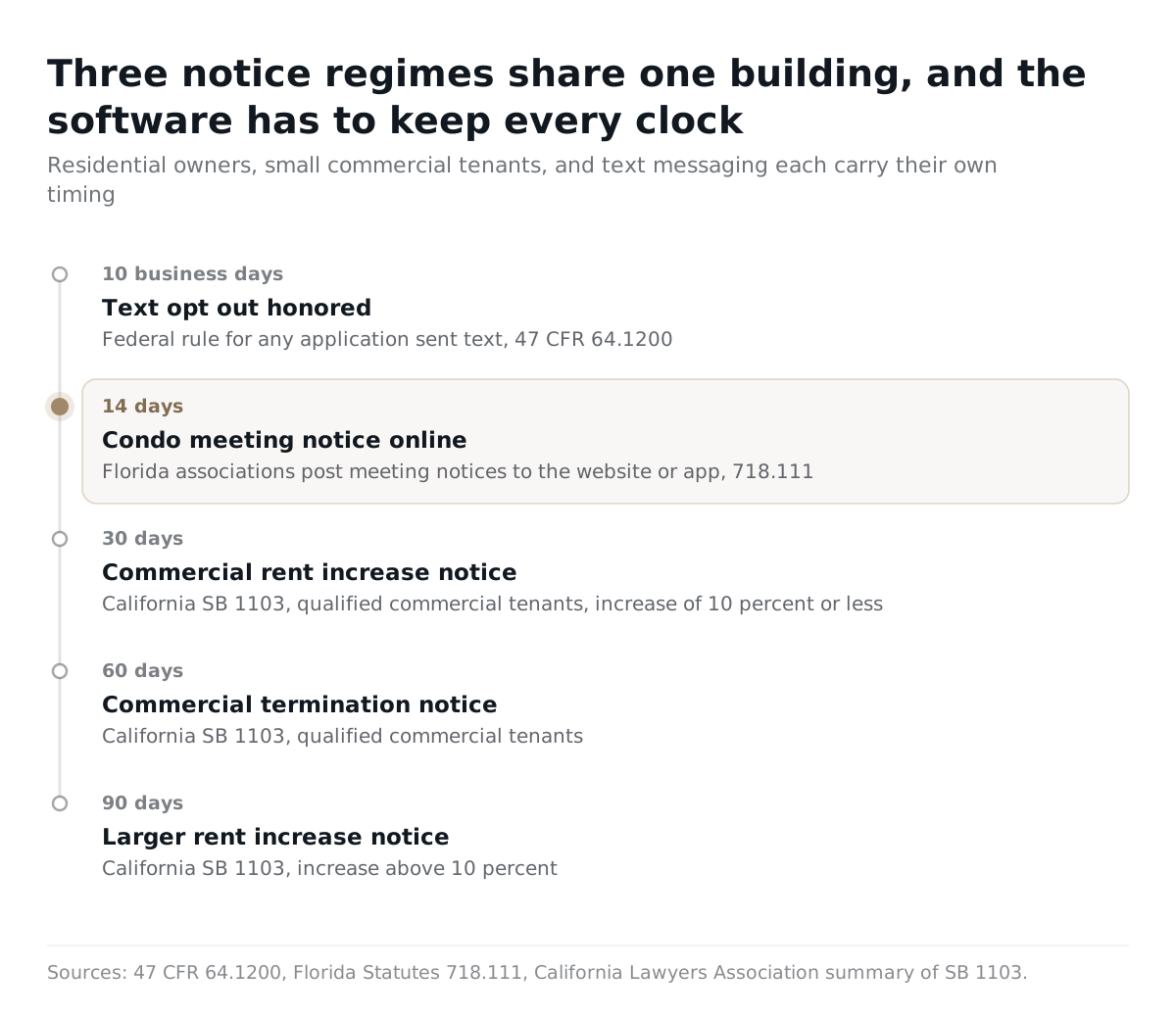
They name the channel, the clock, and the consent. Florida condominium law requires the association to maintain the email addresses of unit owners consenting to receive notice by electronic transmission, puts a 14 day online posting clock on unit owner meeting notices for associations with 25 or more units, and keeps official records for 7 years. Virginia's residential notice statute allows electronic notice only if the rental agreement so provides, lets any tenant elect paper, and requires the sender to keep proof of electronic delivery. Those rules bind the residential tower, not the shop below it.
What do commercial notice rules require?
Usually whatever the lease says. Some states add a statute on top. California's SB 1103, effective January 1, 2025, gives qualified commercial tenants (small businesses, small restaurants, and small nonprofits) a right to 30 days notice for a rent increase of 10 percent or less and 90 days for more than 10 percent, 60 days notice of termination, and a translated lease when the deal was negotiated in Spanish, Chinese, Tagalog, Vietnamese, or Korean. A retail tenant record therefore needs fields a resident record never has: a qualification flag and an occupancy start date.
| Notice regime (2026 text) | Clock or rule | Applies to | What the software must store |
|---|---|---|---|
| Florida condo, unit owner meeting | Posted online 14 days before; voting documents 7 days before (25 or more units) | Residential owners | Scheduled post, posting proof, owner consent flag |
| Florida condo, electronic notice | Only to owners who consented | Residential owners | Consent source and date on the unit record |
| Florida condo, official records | Kept at least 7 years | Residential owners | Exportable send history for the full window |
| Virginia residential rental | Electronic notice only if the lease provides; tenant may elect paper; sender keeps proof of delivery | Residential renters | Channel election per tenant and a delivery receipt |
| California SB 1103, rent increase | 30 days at 10 percent or less; 90 days above 10 percent | Qualified commercial tenants | Qualification flag, occupancy start date, amount sensitive timer |
| Federal TCPA, texts and automated calls | Prior express consent except emergencies; revocation within 10 business days; do not call requests kept 5 years | Every cell number in every audience | Consent record, suppression list shared across all teams |
What does the TCPA require across all three audiences?
The same thing for every audience: federal rules bar autodialed or prerecorded calls and texts to a cell number unless the call is for emergency purposes or made with the prior express consent of the called party, a revocation made in any reasonable manner must be honored within ten business days, and a do not call request must be honored for 5 years. The mixed use trap is separate teams: if residential, retail, and office each keep their own list, a number that opted out with one can be reactivated by another. Suppression has to live in one place.
CTIA's 2023 messaging principles tell senders to keep, for each opt in, the timestamp, the medium, the specific campaign, and the phone number, and to act on plain language opt outs, not only STOP. And your building cannot register its own texting number: The Campaign Registry states that direct registration is not available for brands, so the vendor files the A2P 10DLC campaign for you.
What about emergency notification across occupancy classes?
The app, SMS, and email layer supplements the code required life safety systems, and the office and retail floors carry a workplace rule that residential floors do not. OSHA's employee alarm standard requires that the alarm be "capable of being perceived above ambient noise or light levels by all employees in the affected portions of the workplace," allows tactile devices for employees who cannot recognize an audible or visual alarm, and states that where a communication system also serves as the employee alarm, emergency messages take priority over all non emergency messages. Test whether the alert jumps every queue and reaches every lobby screen at once.
What goes on the mixed use compliance checklist?
Eight items, and a vendor should be able to show where each one lives in the product.
- Occupancy type, unit or suite, and property stored on every recipient record.
- SMS opt in for every number, with timestamp, source, and campaign, in one shared consent store.
- One suppression list across residential, retail, and office teams, honored within ten business days and kept 5 years.
- A2P 10DLC brand and campaign registration filed by the vendor.
- Electronic notice consent per condo owner, and channel election per renter, where the state requires it.
- Lease notice address and method per commercial tenant, plus any statutory qualification flag.
- A posting task on statutory clocks, and delivery proof, not only a sent timestamp, wherever a statute asks for it.
- Retention that meets the longest clock in the building, 7 years in Florida for condo records.
When do separate systems per occupancy type stop making sense?
The day one shared event needs one story told three ways and one audit trail, which is usually the first garage closure or the first fire alarm. Separate systems are defensible while each occupancy runs its own deep transactions: ledgers and packages for residential, employee credentials for office, the lease and a store phone for retail. The cost is duplicated identities, three consent records for one person, contradictory closure notices, and no single history for the shared infrastructure.
| Situation | Three systems (one per occupancy) | One system | Time to consolidate |
|---|---|---|---|
| Garage or dock closure | Three drafts, three versions of the facts | One event, three audience versions, one record | After the first contradictory notice |
| Fire alarm or gas leak | Whichever team is on duty alerts its own audience | One action hits every phone and every lobby screen | Now |
| Shared amenity or parking allowance | Double bookings; no shared capacity view | Capacity aware calendar and live pass counts | When residents and office staff share a room or a garage |
| A person opts out of texts | Removed from one list, still on two | Suppressed everywhere | Before the first complaint |
Do not consolidate to reduce the app count. Consolidate the shared event and audit layer, and keep a specialist system of record only where it handles deeper transactions.
What should you ask on a demo?
Ask the vendor to do each of these live with your real audience structure, and treat a checkmark on a slide as a no.
- Send one garage closure notice with a resident version, a retail version, and an office version. Show me how the three audiences were built.
- Schedule the same holiday hours post for two properties in two time zones. Show me it landing at 9 AM local in both.
- Trigger an emergency alert. What happens on residents' phones and on the residential, retail, and office lobby screens, and how do I post the all clear?
- Show a resident texting STOP. Is that number suppressed for the retail and office teams too?
- Who filed our A2P 10DLC registration, and under which campaign?
- Draft a notice with your AI. Who approves it, and can it send on its own?
- Export one notice: text, version, approver, audience, channel outcomes, and the consent or lease basis for each audience.
If the answer to number six is "it just sends," walk away.
How does URBI handle mixed use communication?
URBI runs communication as part of the building's operating system, so a notice, a booking, a parking pass, and a lobby screen read the same property, unit, and access records. The overview is in what is URBI; the two vertical walkthroughs are URBI for residential buildings and URBI for commercial buildings. Here is how it maps to the mixed use jobs.
- One post, many properties, local time. News and announcements have scheduled publish and home screen banners, and one post fans out across multiple properties, each sending at its own local time. An operator can set up each tower or occupancy group as its own property and still write once.
- Per unit and access level targeting. A notice goes to a unit, a set of units, or an access level, so owners, renters, and commercial contacts are addressed separately.
- One login, per property toggles, per module permissions. Management companies and multi tower communities get a single login and a portfolio roll up, with per property feature toggles from one settings surface, so board voting can be on for the condo tower and off for retail. Teams get create, read, update, and delete permissions per module, so the retail leasing team can be limited to retail announcements.
- Shared amenities and parking. Amenity booking is capacity aware with conflict detection and an atomic collision guard, so a shared conference room cannot be double booked by two audiences. Guest parking QR passes carry a live monthly allowance with automatic timeout handling.
- Emergencies on every screen. URBI Display runs branded lobby and elevator kiosks, and a property wide emergency takeover flips every display to the alert.
- Arthur and HERO. Arthur, URBI's resident facing AI, answers on voice, SMS, email, and in app chat, speaks condo and commercial terminology, verifies identity by PIN before anything sensitive, and escalates unknown questions to the property manager. HERO, the manager facing AI in the staff dashboard, drafts a notice or reply through Inbox Assist and can propose a ticket, a notice, or an emergency display banner. Every action stays a proposal until a person confirms it.
A note on proof: email replies to an announcement thread into the staff inbox, news posts carry their schedule and audience, and onboarding invites capture consent. Read receipts are not part of that record, so pair the platform with the posting, delivery proof, and retention rows above. The feature list is at communication and community features, and the buyer view for management companies is at URBI for property managers.
FAQ
Can one consent record cover residents, retail, and office contacts?
One consent store can, but each record is per person and per purpose. A resident's opt in to building texts does not cover retail marketing, and a store manager's opt in does not transfer to the next manager. Keep the timestamp, medium, and campaign on every record, and one suppression list every team honors.
Does a fire alarm notice need consent under the TCPA?
No. Federal rules exempt calls and texts made for emergency purposes from the consent requirement, so a fire or gas leak alert can go to any cell number in any audience. A planned garage closure does not qualify. And on office and retail floors the code required alarm is primary; the app is supplemental.
Can AI send a mixed use notice on its own?
It should not, and in URBI it cannot. HERO drafts the resident, retail, and office versions and proposes the send; a staff member reads each and confirms before anything goes out. With three audiences and three legal bases in one building, that approval step is where a wrong version gets caught.
Mixed use building communication software comes down to one event told three ways, a channel plan for every audience, one consent store, and a record you can export years later. To see URBI run the demo list on your building, write to hello@myurbi.co or book a demo.
Keep reading


