



Amenity no shows waste the slot another resident wanted. The fairer fix runs in order: remind people, make canceling easy, release unused time fast, offer it to someone waiting, and only then use strikes or deposits. URBI runs the booking, cancellation, and deposit side of that in one app.
This guide is about the empty slot. If your problem is the same three units holding every Saturday, read our piece on amenity booking fairness rules first. That one is about who gets to book. This one is about what happens when the person who booked does not come.
Why do residents miss amenity bookings?
Mostly because plans change and canceling feels like more work than not showing up. Very few residents book the party room to spite their neighbors.
Restaurants live with the same habit at a bigger scale. An OpenTable survey found 30% of Americans said they did not show up for a reservation in the past year, as Restaurant Dive reported in 2021. That counts people, not bookings. It still shows that missing a reservation is common behavior.
The cost lands on everyone else. Chef Tom Colicchio, a founding member of the Independent Restaurant Coalition, put it plainly in the same article: "20 no shows at Vallata restaurant, we only have 50 seats." Swap seats for a squash court with four prime slots a week and the math gets worse.
So treat a no show as two problems. One resident forgot. Another resident lost the slot. A good policy fixes the second problem without making the first resident feel like a suspect.
What should a building try before any penalty?
A reminder. It is the cheapest fix, and the evidence for it is strong.
The best data comes from healthcare, where missed appointments are measured carefully:
- A Kaiser Permanente Colorado trial of 54,066 patients found two reminders beat one. Missed visits ran 4.4% with two reminders versus 5.8% and 5.3% with a single one, per the American Journal of Managed Care (2018). Cancellation rates did not differ between the groups.
- A pediatric clinic trial added a text to the usual voice reminder. No shows were 23.5% in the group that got the text, versus 38.1% in the group that did not, per the study in the International Journal of Pediatrics (2016).
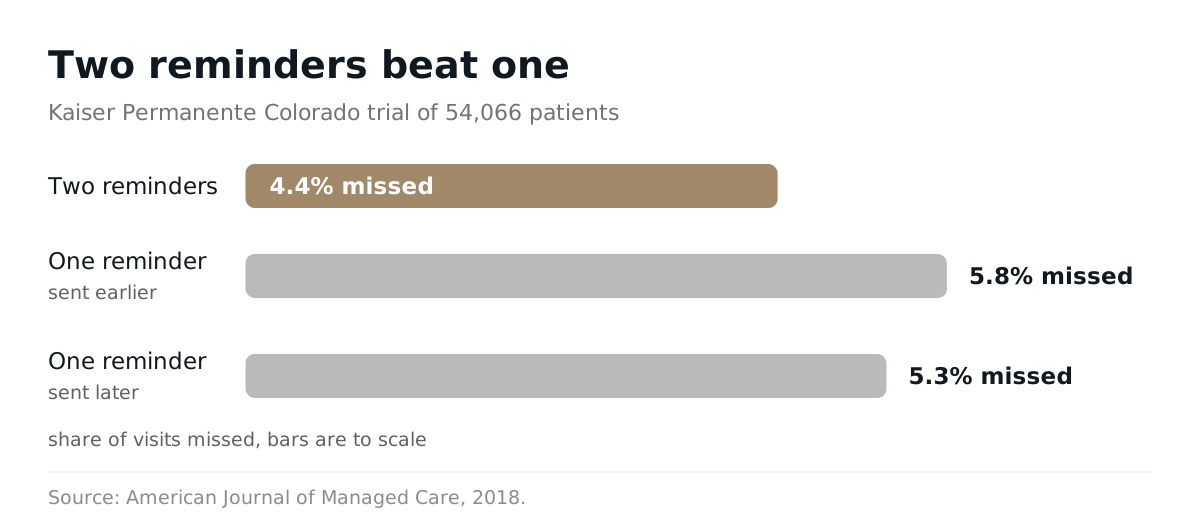
Two lessons carry over to buildings. First, a second nudge closer to the time does real work. Second, the reminder helps people act on a plan they already had, so pair it with an easy way to cancel. A reminder with no cancel option just makes people feel guilty.
Do not assume one channel works for everyone. A 2011 University of Washington pediatric dental study, published in the Journal of the American Dental Association, found voice reminders cut no shows to 8.2% versus 17.7% for text, as DrBicuspid reported. Some residents live in their texts. Others never read them. Let people pick.
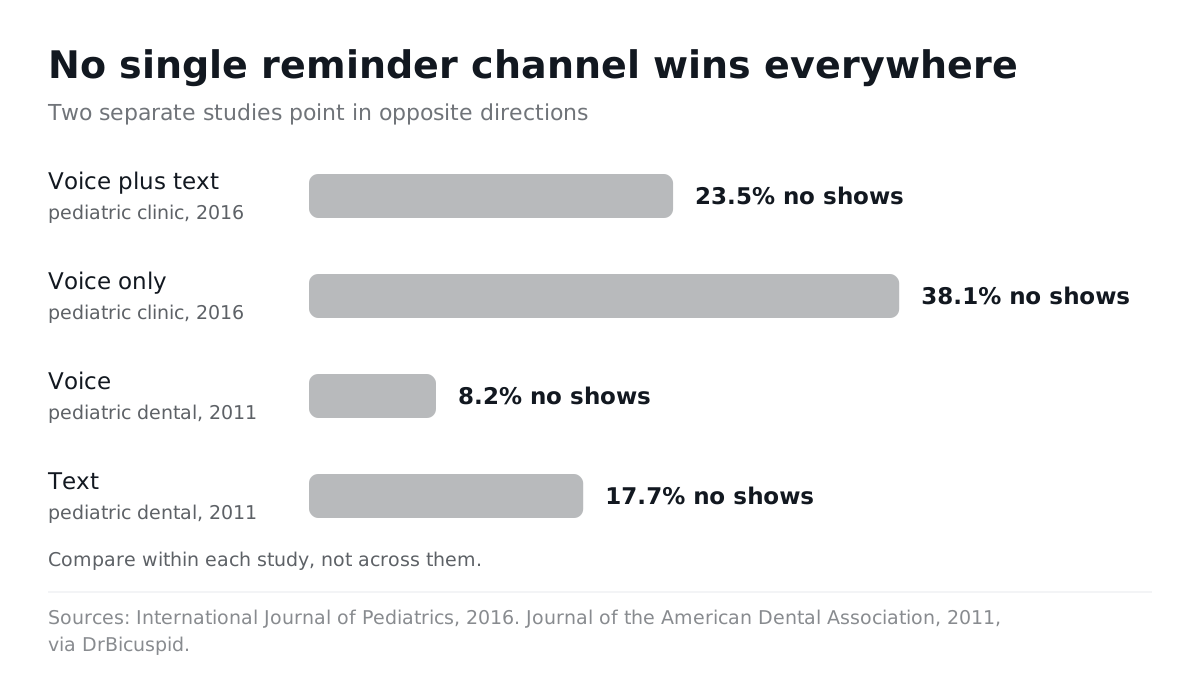
Healthcare is not a building, so do not promise residents a percentage. Use the research to justify trying reminders, then measure your own results.
How easy should canceling an amenity booking be?
Easier than not showing up. If canceling means calling the front desk during office hours, residents will simply not come, and the slot dies quietly.
Three rules make canceling the path of least resistance:
- Cancel where you booked. If the booking happened in an app, the cancel button lives right next to it. No phone call, no email to the manager.
- Short cutoffs for small spaces. San Diego State's recreation center lets members cancel a fitness class until 30 minutes before it starts, per its group fitness policies. A gym slot or a court can work the same way.
- Longer cutoffs only where staff do setup. A party room that needs cleaning, furniture, or a key handover needs more notice. A treadmill does not.
In URBI, residents book and pay inside the app, and the booking confirmation arrives by email automatically. The cancellation and refund flow sits in the same place, and the cancellation rules the building sets are enforced by the system, not by memory.
What is a release window, and how long should it be?
A release window is the grace period after a booking starts. If the resident has not arrived by the end of it, the slot goes back to everyone else. It recovers the time without punishing anyone.
Public facilities already do this:
- San Francisco Recreation and Parks voids a tennis or pickleball reservation if the holder does not show within 15 minutes of the start, per its court terms and conditions.
- The YMCA of Central Ohio says a reserved class spot opens to the waitlist and walk ins if the member is not there by start time, per its reservation policies.
Match the window to the amenity. Short sessions need short windows. Long bookings deserve patience. Here is a starting point to adapt, not a rule anyone has tested:
| Amenity | Typical session | Suggested release window | Why |
|---|---|---|---|
| Gym or fitness studio slot | 30 to 60 minutes | 10 minutes | Every minute lost is a big share of the session |
| Tennis, squash, or pickleball court | 1 hour | 15 minutes | Matches public park practice |
| Work pod or meeting room | 1 to 2 hours | 15 minutes | Someone in the lobby often wants it now |
| Party room or rooftop | 3 to 6 hours | No release, use a cancellation cutoff | Setup and access make late reuse impractical |
| Guest suite | Overnight | No release, use a cancellation cutoff | Cleaning and keys need notice |
Write the window into the amenity rules and publish it. A resident who loses a court at minute 16 should have read that rule before booking, not heard it at the door.
Who should get a slot when it opens up?
Someone who said they want it. A released slot is only useful if a resident hears about it in time and chooses to take it.
Keep it gentle. Offer the opening and let the resident accept. Never drop a late opening onto a resident's calendar and then count it as a no show when they cannot make it. The YMCA of Metro Denver announced a policy, now on hold, that would protect people added from the waitlist within the final hour from any penalty, per its reservation policy notice. That is the right instinct.
For most buildings the simplest version works fine. The front desk keeps a short standby list for the busiest amenity. When a slot frees up, staff tell the next person on it. In URBI, a canceled booking frees the slot on the capacity aware calendar, so the next resident can book it from the app straight away. On the Premium plan, a resident who calls, texts, or emails can also ask Arthur, URBI's resident facing AI, to book it for them.
Does a missed check in prove a no show?
No. It proves nobody checked in. Those are different things.
Residents forget to scan. A friend arrives first. The door was propped open. If your building uses any kind of check in, treat a missing one as a question, not a verdict. Before anything goes on a resident's record, a person should confirm it.
Define a no show in writing so staff apply it the same way every time:
- The booking was not canceled before the cutoff.
- The resident did not arrive inside the release window.
- Staff confirmed the space was empty, or the resident confirmed they did not come.
Then give the resident a way to say "I was there" or "my kid was in the hospital." A quick, kind reply to that message does more for the building's reputation than any rule.
Keep the paper trail simple. In URBI, staff can log a typed note against the unit, and the unit profile shows that unit's bookings in one tab. The next manager sees the history without asking around.
When are strikes or deposits fair?
After reminders, easy canceling, and release windows are in place, and only for repeated, confirmed misses. A strike system on top of a hard cancel process punishes residents for the building's own friction.
Good strike rules are proportionate and temporary. San Diego State's recreation center is a clean example. Members who no show three times in one semester "will lose group fitness registration privileges for one month," per its group fitness policies. Late arrivals past five minutes count too. The penalty ends, and the slate clears each term.
Borrow that shape:
- Warn first. The first miss gets a friendly message, not a mark.
- Count over a window. Misses in the last month or quarter, not forever.
- Pause, do not ban. A short pause on advance booking for that one amenity, then a clean start.
- Same rule for the board. A board member with three misses gets the same pause as anyone.
Build an exception route in from day one. Under federal fair housing guidance, a reasonable accommodation is "a change, exception, or adjustment to a rule, policy, practice, or service" that a person with a disability may need. The same joint HUD and Justice Department statement says housing providers may not charge extra fees or deposits as a condition of granting one, per the joint statement. A resident whose condition makes timing unpredictable needs a path around your strike rule. This is general information, not legal advice. Check your governing documents and your counsel before adopting any penalty.
Deposits belong on the spaces where a no show or damage is genuinely costly, such as the party room or guest suite. They are a poor tool for a gym slot. URBI can take the deposit at checkout as part of the booking. Our guide to amenity booking deposits covers how residents experience that, and party room deposits covers the board's side.
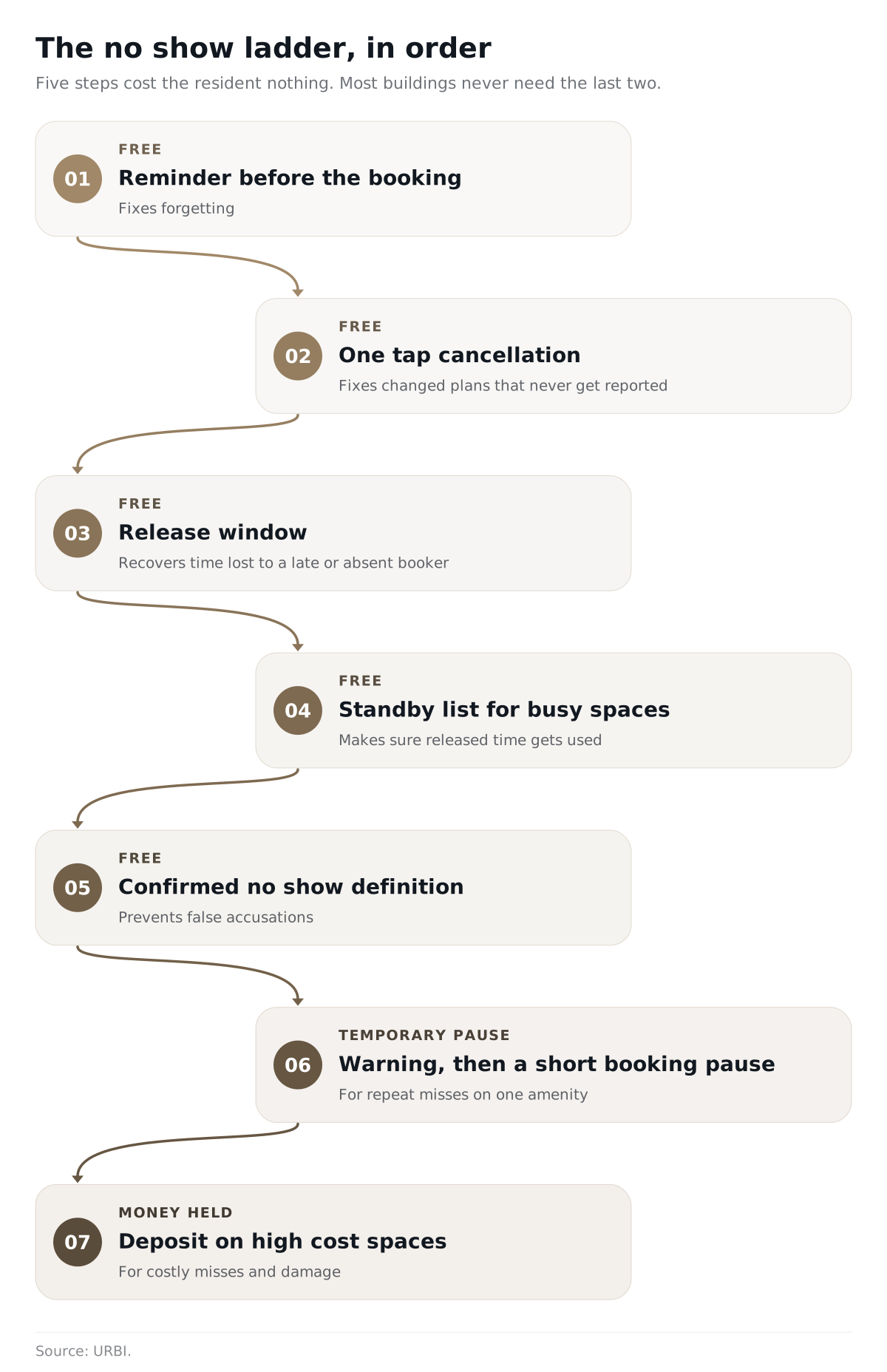
What does the whole no show ladder look like?
Five steps that cost the resident nothing, then two that do. Most buildings never need the last two for most amenities.
| Step | What it fixes | Cost to the resident |
|---|---|---|
| 1. Reminder before the booking | Forgetting | None |
| 2. One tap cancellation | Changed plans that never get reported | None |
| 3. Release window | Time lost to a late or absent booker | None if they cancel or arrive on time |
| 4. Standby list for busy spaces | Released time that nobody hears about | None |
| 5. Confirmed no show definition | False accusations | None |
| 6. Warning, then a short booking pause | Repeat misses on one amenity | A temporary pause |
| 7. Deposit on high cost spaces | Costly misses and damage | Money held, then returned or kept |
How do you know the policy is working?
Count what happens to the slot as well as to the resident. A strict policy can produce lots of strikes and still leave the court empty.
Track four numbers per amenity for one quarter:
- Bookings canceled before the cutoff (this should go up, and that is good).
- Confirmed no shows.
- Released or canceled slots that someone else then used.
- Disputed no shows, and how many were overturned.
If cancellations rise and no shows fall, the early steps are working. Leave penalties alone. If overturned disputes are high, your check in signal is weak and your definition needs work. URBI's amenity analytics on the calendar and list views give managers a running picture of how each space is used. For the bigger question of whether a space earns its place at all, see amenity utilization.
Frequently asked questions
Should a building fine residents for amenity no shows?
Not as a first step. Reminders, easy canceling, and a release window recover most of the lost time and cost residents nothing. Keep money for high cost spaces like the party room or guest suite, where a deposit is common practice. Check your governing documents and local law before you adopt any fee, and build in an exception for residents who need an accommodation.
How long should the grace period be for an amenity booking?
Match it to the session length. Ten minutes suits a short gym slot. Fifteen minutes suits a court or a meeting room, and San Francisco's public courts use exactly that. Long bookings like a party room or guest suite should not release at all. Use a cancellation cutoff instead, because setup and keys make late reuse impractical.
What counts as an amenity no show?
Write it down so staff apply it the same way. A sensible definition has three parts: the booking was not canceled before the cutoff, the resident did not arrive inside the release window, and a person confirmed the space was empty. A missed check in on its own is not enough, because residents forget to scan or arrive with someone who did.
Are booking strikes fair to residents?
They can be, when they are proportionate and temporary. Warn on the first miss. Count misses over a set window, such as a month or a quarter. Pause advance booking for that one amenity for a short time, then clear the record. Apply the same rule to board members, and keep an exception route for residents with a disability related need.
Amenity no shows are mostly a friction problem, and friction is something a building can remove. If you want to see how booking, cancellation, and deposits run in one resident app, read URBI for residential buildings or compare options in our guide to the best amenity booking software. Then write to hello@myurbi.co with your current amenity rules, and we will show you how they would run in URBI.


