



Winter building notices are the six messages a manager sends residents between the first freeze and the spring thaw: freeze prep, storms, cold snaps, heating outages, snow and parking, and heater safety. With URBI, HERO drafts each notice, a manager approves it, and URBI delivers it by push, in the app and by email.
What winter building notices should a manager send residents?
A manager should plan six winter notices, each tied to a trigger, not one long letter in November. A single seasonal email gets read once and forgotten. A notice that lands the day before a storm gets acted on.
- Before the first freeze: heat rules, who to call, pipe care, and travel steps.
- Before a storm: what the building is doing, what residents should do, and how to report problems.
- During a cold snap: short, specific steps for the next 48 hours.
- Heating or hot water outage: what is out, what is being fixed, and when the next update comes.
- Snow removal and parking moves: who clears what, by when, and where cars must go.
- Space heater and carbon monoxide safety: the rules that keep a cold night from becoming a fire.
Each notice pairs a resident request with a building action. That pairing is the difference between a notice that helps and one that reads like blame. It also follows the same logic as a good water shutoff notice: say what is happening, when, and what to do.
When should each winter notice go out?
Send the first notice before your local heat season starts, then send the rest when the forecast or an outage triggers them. The table below is a working schedule. Adjust the dates to your city.
| Notice | When to send | What it must say | Who acts |
|---|---|---|---|
| Before the first freeze | One to two weeks before your local heat season or first forecast freeze | Heat standards that apply, maintenance contact, pipe care, travel steps | Residents prepare units; building checks boilers, insulation, outdoor taps |
| Before a storm | 24 to 48 hours before forecast snow or ice | Building plan, supplies, how to report leaks or no heat | Building staff and snow contractor; residents prepare |
| During a cold snap | The day the forecast drops well below freezing | Drip faucets on exposed pipes, open cabinets, keep heat steady | Residents, with staff checking vulnerable spots |
| Heating outage | As soon as the building confirms the outage | What is out, which units, what is being done, next update time | Building staff and heating vendor |
| Snow removal and parking | When the storm is confirmed, then when it ends | Clearing order, local deadlines, where to move cars | Snow contractor, staff, and residents with cars |
| Space heater and CO safety | With the first freeze notice, and again in the first deep cold | Heater rules, alarm steps, local bans | Residents |
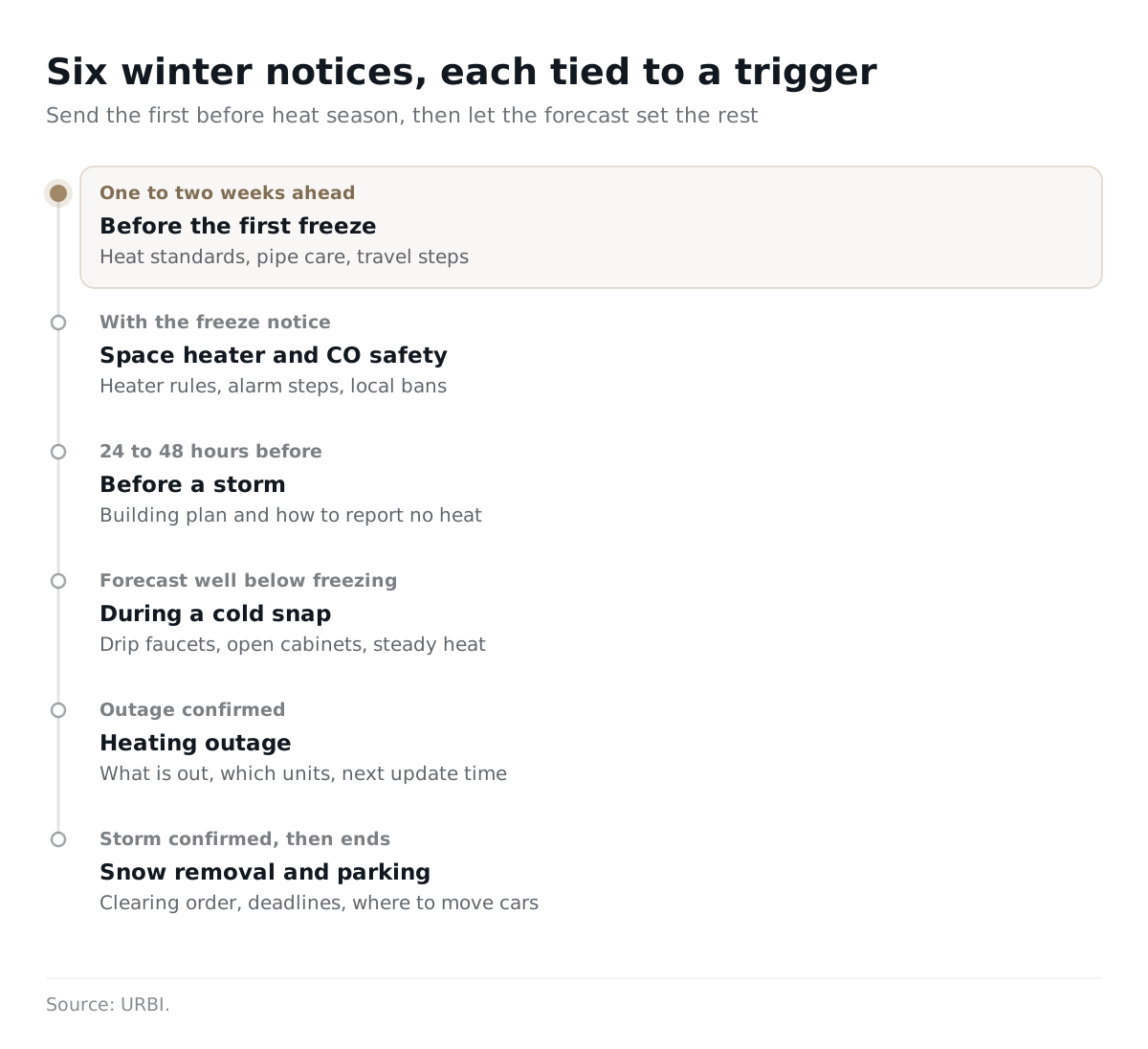
Winter notices are part of the same calendar as your preventive maintenance checklist. The boiler service and the freeze notice should land in the same weeks.
What goes in the notice before the first freeze?
The first winter notice tells residents what the building owes them, what the building is doing, and what each resident should do before cold weather arrives. Send it early. Insurance researchers make the same point about timing.
"This is the ideal time to take actions around the house." Dr. Ian Giammanco, Lead Research Meteorologist, IBHS
Put these items in the first notice:
- The heat standard that applies in your city, with the dates (see the next section).
- The one number or channel residents should use for no heat, no hot water, or a leak.
- Pipe care for units with exposed plumbing, such as sinks on outside walls.
- Travel steps. The American Red Cross says to leave the heat on, set no lower than 55°F, when you go away in cold weather.
- What the building is doing: boiler service, draining outdoor hose taps, insulating exposed pipes, and checking vacant units.
That 55°F figure is pipe protection advice for an empty home. It is not a legal heat standard. Never let a travel tip read as the temperature the building promises.
What should the heat notice say, and whose rule applies?
The heat notice should quote your own city's rule, because there is no single national heat standard. Heat rules are set city by city, and they differ in dates, hours and temperatures. Two large cities show how far apart they are.
| City | Heat season | Daytime | Night |
|---|---|---|---|
| New York City (HPD) | October 1 to May 31 | At least 68°F from 6 a.m. to 10 p.m. when it is below 55°F outside | At least 62°F from 10 p.m. to 6 a.m., whatever the outside temperature |
| Chicago (Department of Buildings) | September 15 to June 1 | At least 68°F from 8:30 a.m. to 10:30 p.m. | At least 66°F from 10:30 p.m. to 8:30 a.m. |
The Chicago figures above apply to buildings with central heat and no central cooling. Chicago sets different rules for other heating systems, so read the full ordinance for your building type. New York City also requires hot water at a constant minimum of 120°F every day of the year.
A notice is not heat. Chicago says portable space heaters cannot be used to meet its minimum temperatures, and that keeping heating equipment working is the building owner's job. A reminder to residents never replaces a working boiler. This is general information, not legal advice. Confirm the rules for your building with local counsel or your city housing agency.
What goes in a storm notice before the snow?
A storm notice tells residents what the building will do during the storm, what they should do now, and how to reach staff if something breaks. Send it 24 to 48 hours ahead, while people can still act.
- The building plan: when the snow contractor starts, which entrances get cleared first, and whether any amenity or garage area will close.
- Resident steps: keep heat on, keep a flashlight ready, and move anything stored near exterior pipes.
- How to report: one channel for no heat, leaks, and ice at doors.
- The next update: tell residents when they will hear from you again.
Keep the promises inside your snow contract. If the contract only starts work at a set snow depth, do not promise residents clear walks before that point.
What should residents hear during a cold snap?
During a cold snap, residents need two or three short steps for the next day or two, not a repeat of the full winter letter. Long notices get skimmed, which is why residents do not read building notices in the first place.
Use the Red Cross guidance on frozen pipes:
- Let cold water drip from faucets served by exposed pipes.
- Open kitchen and bathroom cabinet doors so warm air reaches the plumbing.
- Keep the thermostat at the same setting day and night.
- If only a trickle comes out of a faucet, report it right away. It may be a frozen pipe.
- Never thaw a pipe with an open flame. The Red Cross says to call a licensed plumber when a frozen section cannot be reached or thawed.
Tell residents exactly which units or stacks are at risk if you know. "Units on the north wall, please drip your kitchen tap tonight" works better than a general request.
How should a heating outage notice work?
A heating outage notice should go out as soon as the outage is confirmed and repeat at a stated time until heat is back. Silence is what drives residents to call the city. In New York City, HPD tells tenants without heat to contact the landlord first, then file a complaint through 311 if the landlord does not respond.
Every outage notice should answer four questions:
- What is out: heat, hot water, or both.
- Who is affected: the whole building, a riser, or specific floors.
- What is being done: vendor called, part ordered, repair underway.
- When the next update comes, with a real time, even if the update is "still working on it".
Add a safety line to every outage notice. Tell residents not to use ovens or stoves for heat, and repeat the space heater rules from the safety notice below.
What do snow removal and parking move notices need?
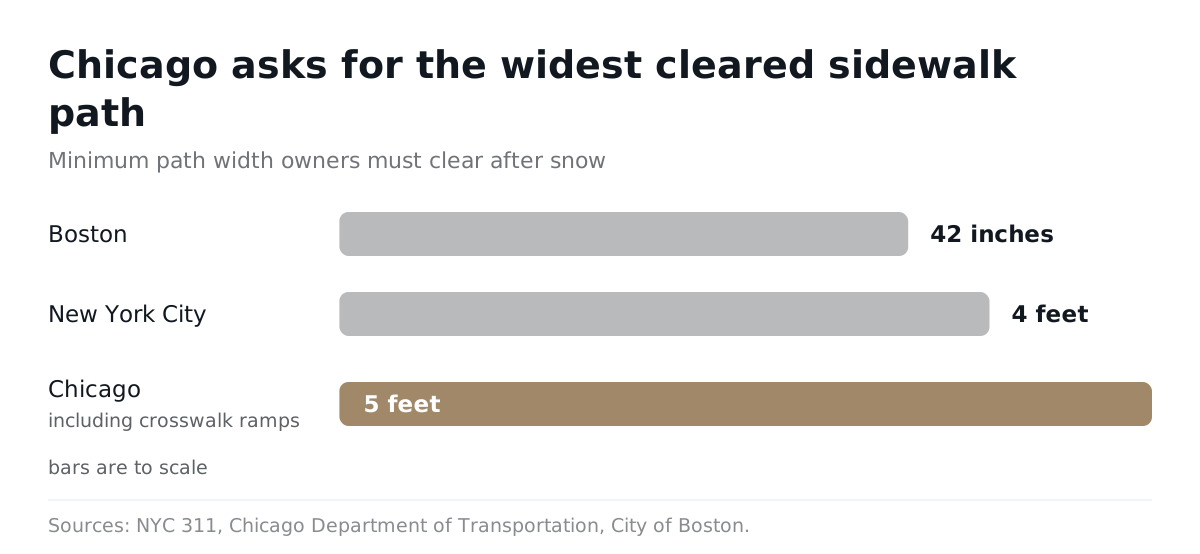
A snow removal notice needs the local deadline, the path width, and a clear answer to who clears what. Sidewalk rules vary sharply by city, so quote your own.
| City | Clearing deadline | Path width |
|---|---|---|
| New York City | Snow stops 7 a.m. to 5 p.m.: within 4 hours. Snow stops 5 p.m. to 9 p.m.: within 14 hours. Snow stops 9 p.m. to 7 a.m.: by 11 a.m. | At least 4 feet |
| Chicago | Snow from 7 a.m. to 7 p.m.: removed by 10 p.m. Snow from 7 p.m. to 7 a.m.: removed by 10 a.m. Seven days a week. | At least 5 feet, including crosswalk ramps |
| Boston | Within three hours of snowfall ending, or three hours after sunrise for overnight snow | At least 42 inches |
Say plainly who shovels. Chicago notes that some leases make tenants responsible for snow clearing and some do not. If your building uses a contractor, say so, and tell residents how to report a missed or refrozen spot.
Parking moves need their own short notice. In Boston, the city says cars on a posted snow emergency artery during a declared snow emergency will be ticketed and towed. When your city declares an emergency, tell residents which streets or garage areas to clear, by when, and where they can park instead. If plows need a lot emptied, give a start time and an end time.
What space heater and carbon monoxide safety notice should residents get?
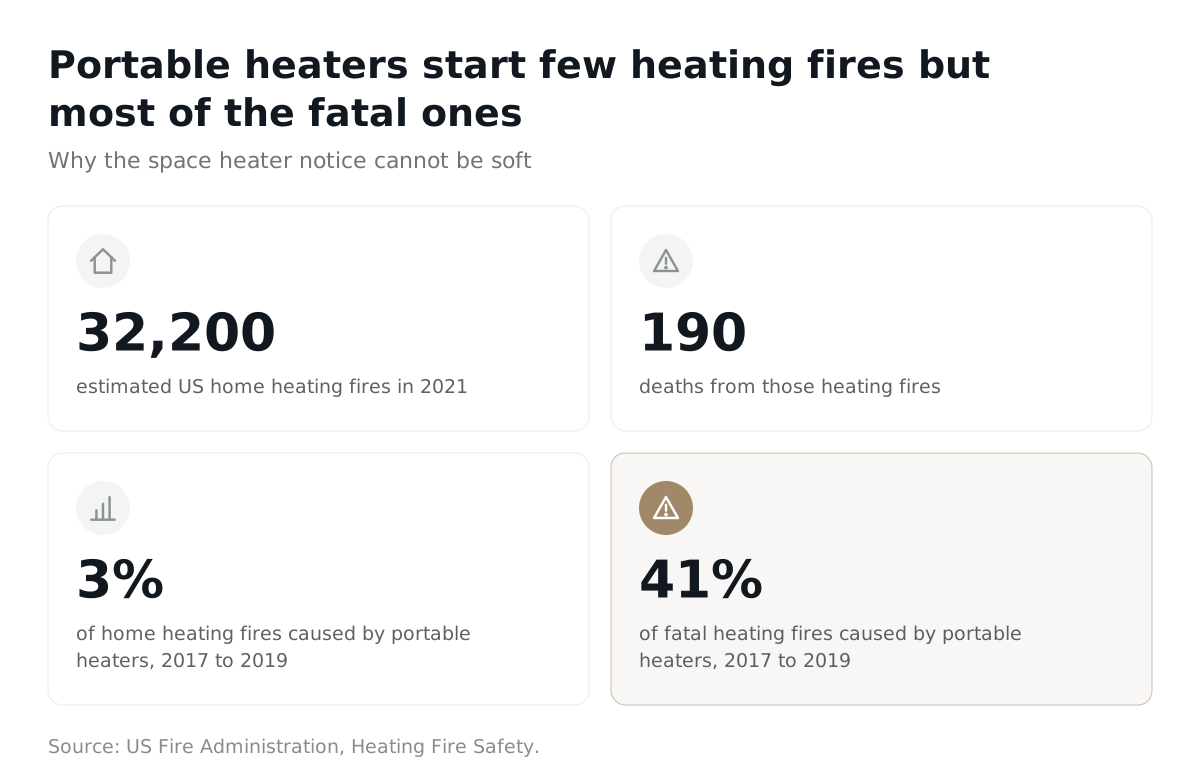
Residents should get a heater and carbon monoxide notice with the first freeze, and again when the deep cold hits. Heating fires are common and portable heaters are the deadliest part of the problem.
- Heating fires were the second leading cause of home fires in the US in 2021, with an estimated 32,200 fires and 190 deaths, according to the US Fire Administration.
- From 2017 to 2019, portable heaters caused only 3% of home heating fires but 41% of fatal heating fires, the same source reports.
Put these rules in the notice:
- Keep anything that can burn at least 3 feet from a space heater.
- Plug heaters straight into a wall outlet, never an extension cord.
- Turn heaters off and unplug them when leaving the room or going to sleep.
- Never heat a unit with an oven or stove.
- Check local bans. In New York City, HPD says kerosene and propane space heaters are illegal.
The carbon monoxide line must be blunt. The NFPA says that when a CO alarm sounds, everyone should move to fresh air outdoors or by an open window, then call for help from there. NFPA also advises CO alarms outside each sleeping area and on every level. New York City HPD gives the same order: go outside, then call 911. A message to the building can wait.
How does URBI send winter notices?
In URBI, HERO drafts the notice and a manager approves it before anything goes out. HERO can propose a news post or notice from a plain request, such as "draft a cold snap notice for the north stack." Nothing sends until a person confirms.
- Every channel at once: each post goes out in the app, by push notification, and by email at the same time.
- Urgency that reaches people: posts carry one of three urgency levels. Urgent posts reach residents who turned off news notifications or email.
- The right audience: send to the whole building, specific units, or groups, so a riser outage only reaches the floors it affects.
- Follow up updates: add an update to the same post and push it, which fits the "next update at 3 p.m." rhythm of an outage.
- Lobby screens: a team member can put a post on the URBI Display lobby and elevator screens as a separate step.
- Many buildings, one post: a manager with several properties can send one storm notice that reaches each building at its local send time.
Each post keeps its urgency level, publish date, and audience on the record. That helps when an owner or board asks what went out and when. For more on showing residents were told, see proof of notice for residents. For the wider platform, see URBI for residential buildings.
FAQ
How far ahead should a building send its first winter notice?
Send the first winter notice one to two weeks before your local heat season or first forecast freeze. That gives residents time to prepare units and plan travel, and gives staff time to finish boiler service and pipe insulation. In New York City, heat season starts October 1. In Chicago it starts September 15. Check your own city, then work back from that date.
Does a winter notice protect the building if the heat fails?
No. A notice tells residents what is happening, but it does not meet a heat requirement. Cities such as Chicago put the duty to keep heating equipment working on the building owner, and Chicago says portable space heaters cannot be used to meet its minimum temperatures. Treat notices as communication, and fix the heat. This is general information, not legal advice.
Who is responsible for shoveling sidewalks at an apartment building?
It depends on the city and the lease. New York City, Chicago, and Boston all set clearing deadlines for property owners. Chicago notes that some leases make tenants responsible for snow clearing. Your snow notice should name who clears each area, whether that is staff, a contractor, or residents, and how to report a spot that was missed.
What temperature should residents leave the heat at when they travel?
The American Red Cross advises leaving the heat on, set no lower than 55°F, when you go away during cold weather. That protects pipes in an empty unit. It is not the same as the legal heat standard the building must provide, which in cities like New York City and Chicago is higher.
Winter notices work best when each one is short, timed to a trigger, and paired with what the building is doing. To have HERO draft them for your approval and URBI deliver them across every building you manage, write to us at hello@myurbi.co.


