



NYC Local Law 97 compliance in October 2026 comes down to one date: the emissions report for calendar year 2026 is due May 1, 2027. This checklist walks managers through each year of the 2024 to 2029 period. URBI runs the people side: resident and tenant notices, contractor tickets, and the records.
Where does the 2024 to 2029 period stand in October 2026?
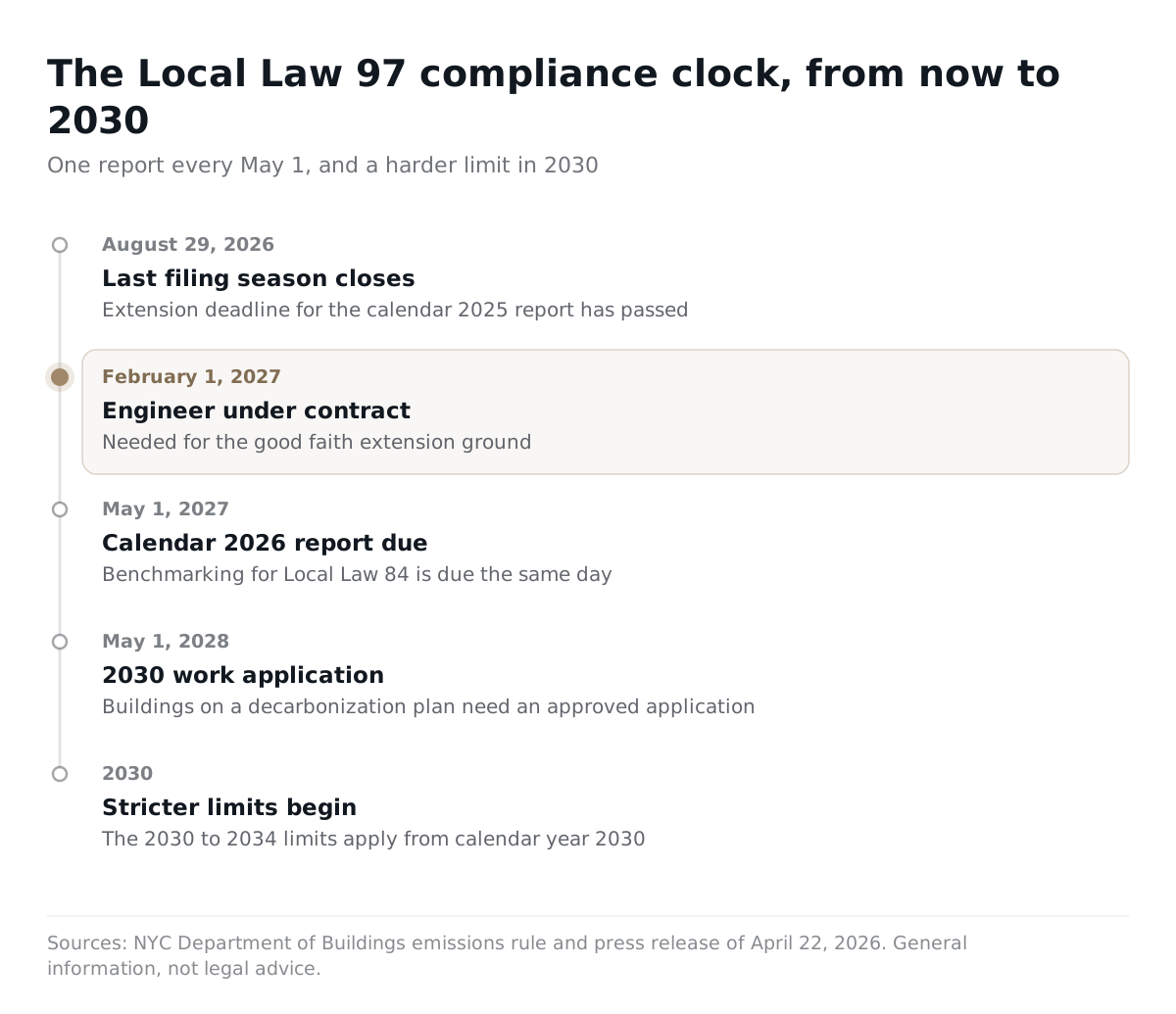
The period is about halfway through, and the 2026 filing season is closed. Reports covering calendar year 2025 were due May 1, 2026, with a grace period through June 30 and an extension option through August 29, 2026, according to the Department of Buildings press release of April 22, 2026. All three of those dates have passed.
DOB also made clear that last year's relief did not roll forward. Its February 2026 service notice says extensions issued by service notice in 2025 do not apply to filing year 2026. Plan as if the same will be true for 2027.
- Now: your building is producing its calendar year 2026 emissions, the numbers in the next report.
- Next deadline: May 1, 2027, for the calendar year 2026 report. The rule at 1 RCNY 103-14 sets a report due by May 1 of each year.
- Next big change: stricter limits for 2030 to 2034, which start with calendar year 2030.
Is your building covered by Local Law 97?
Your building is likely covered if it is larger than 25,000 gross square feet, and the DOB Covered Buildings List is where you confirm it. The DOB Local Law 97 page lists three ways a property becomes covered:
- A single building over 25,000 gross square feet.
- Two or more buildings on the same tax lot that together exceed 50,000 gross square feet.
- Two or more condo buildings governed by the same board of managers.
DOB published the 2026 list in March. Its service notice of March 30, 2026 says to dispute wrong data through Ticket #1 in the LL97 Reporting Portal, called BEAM. The same notice says some buildings whose compliance path changed now have their next report due in 2027.
Some buildings follow a different track. Article 321 covers certain affordable housing and houses of worship. Those buildings filed a one time report due May 1, 2025, and the Article 321 filing guide says they must keep filing annual benchmarking. The rest of this checklist is about Article 320, the annual track most large buildings follow.
One trap: the related laws use different size rules. Benchmarking under Local Law 84 and lighting under Local Law 88 group buildings at 100,000 gross square feet, not 50,000. Check each law on its own.
What goes into the annual report, and who signs it?
The report states the building's emissions for the previous calendar year, and a registered design professional must certify it. DOB's Article 320 guide defines that professional as a licensed professional engineer or registered architect. The guide also says owners must keep the documents used to prepare the report for six years.
The numbers start with benchmarking. Local Law 84 requires annual energy data in ENERGY STAR Portfolio Manager by May 1st of every year. So the manager's real job is getting complete utility and fuel records to the engineer early.
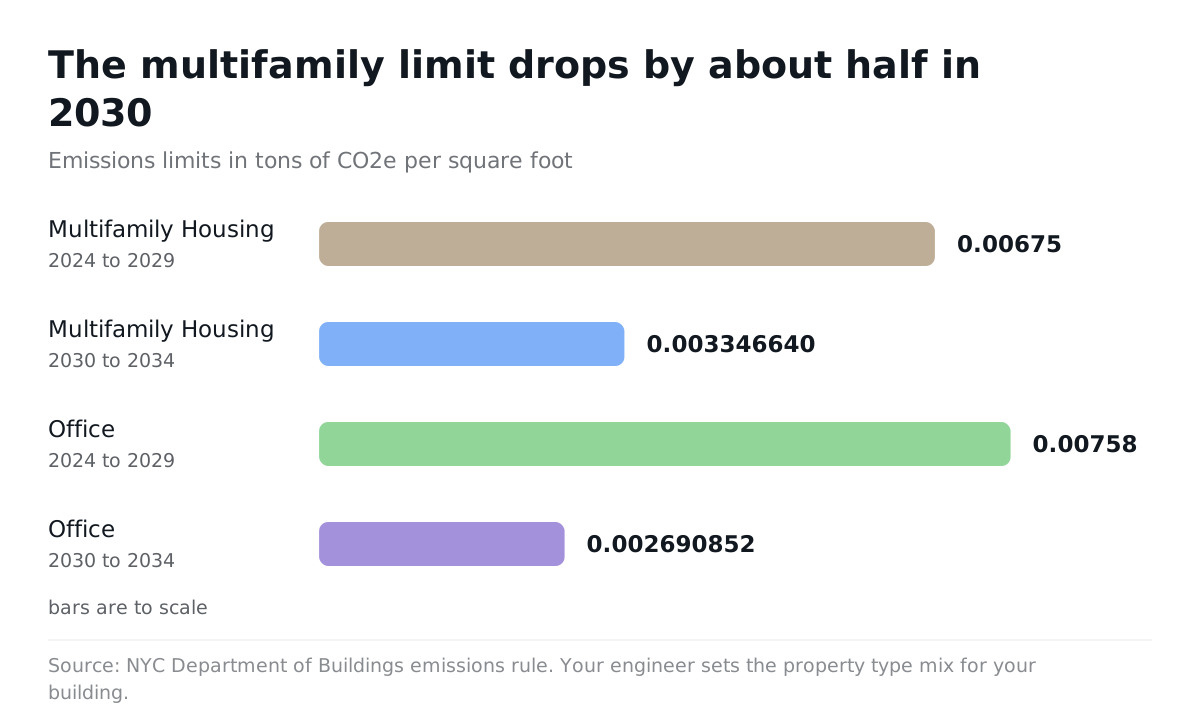
Each building's limit depends on how its space is used, measured in tons of carbon dioxide equivalent per square foot. Here are two common property types from the rule:
| Property type | Limit, 2024 to 2029 | Limit, 2030 to 2034 |
|---|---|---|
| Multifamily Housing | 0.00675 | 0.003346640 |
| Office | 0.00758 | 0.002690852 |
Source: 1 RCNY 103-14. The multifamily limit for 2030 is about half of today's. Your engineer decides the property type mix for your building. Do not guess it from this table.
What happens if a report is late or a building goes over its limit?
Two separate fines can apply: one for filing late, and one for emitting more than the limit. The rule sets both, and the DOB violations page shows how they are calculated.
- Late or missing report: a monthly fine based on the building's floor area. It applies when a report is not filed within 60 days of the deadline or by an approved extended deadline.
- Over the limit: a fine for every ton of emissions above the limit, charged for each year the building is over.
- Article 321 buildings: a flat fine set by the rule for missing the report or failing to show compliance.
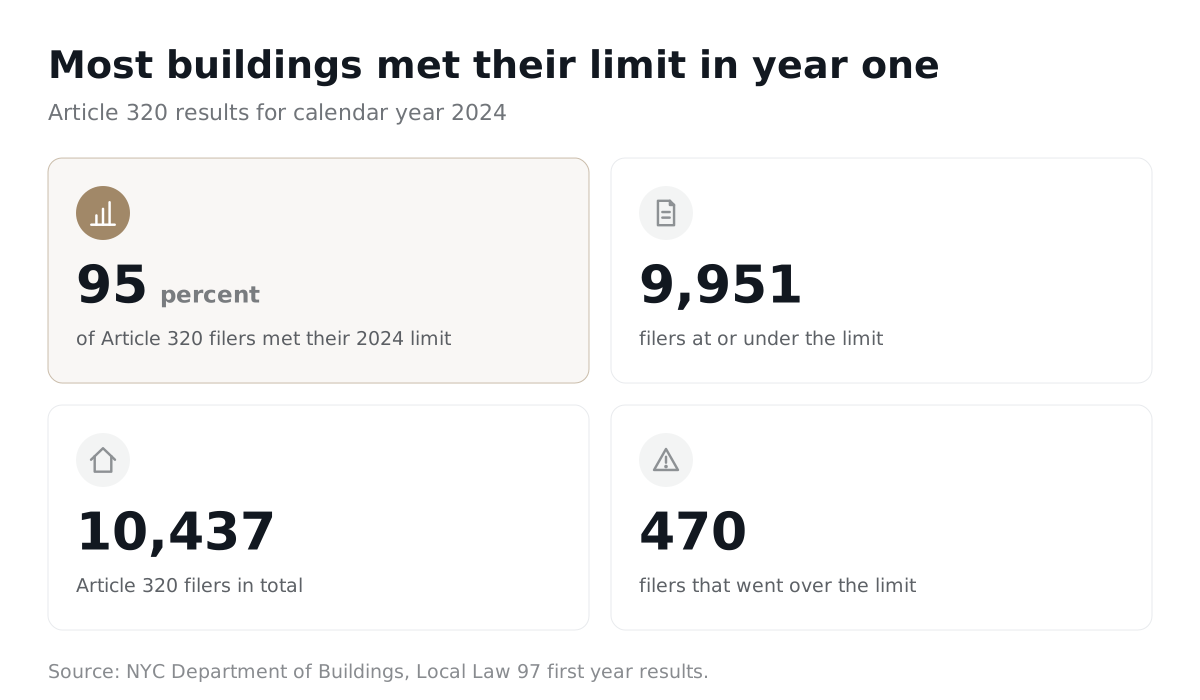
Most buildings cleared the first year. DOB's first year results show 9,951 of 10,437 Article 320 filers, or 95 percent, met their limit for 2024. Another 470 went over. For most buildings, the nearest risk is a late report, not the emissions.
What does the year by year Local Law 97 checklist look like?
Each year has one report, one deadline, and a short list of manager tasks. The dates below come from the rule and DOB notices linked above.
| Year | What the law requires | Manager tasks | Who signs off |
|---|---|---|---|
| 2024 | First year measured against the 2024 to 2029 limits. | Confirm the building is covered and which path it follows. | Owner and engineer |
| 2025 | Report on calendar 2024 due May 1, 2025. Article 321 one time report due the same day. Decarbonization plans were due by May 1, 2025. | File the report, calculations and portal confirmation where you can find them. | Registered design professional |
| 2026 (now) | Report on calendar 2025 was due May 1, 2026. The extension deadline of August 29, 2026 has passed. | Check the 2026 Covered Buildings List. Start collecting calendar 2026 utility and fuel data. Sign the engineer's contract by February 1, 2027. | Manager and owner |
| 2027 | Report on calendar 2026 due May 1, 2027. Benchmarking also due May 1. | Deliver data early. If you need more time, apply in the window from 30 days before to 60 days after May 1. | Engineer certifies, owner files |
| 2028 | Report on calendar 2027 due May 1, 2028. Buildings on a decarbonization plan must show an approved application for their 2030 work by May 1, 2028. | Lock contractor schedules and resident or tenant notices for retrofit work. | Owner and engineer |
| 2029 | Report on calendar 2028 due May 1, 2029. Last year under the current limits. | Model calendar 2030 against the new limit. Finish the work that has to be done before it. | Engineer |
| 2030 | Stricter 2030 to 2034 limits begin. Report on calendar 2029 due May 1, 2030. | Treat this as the first year measured against the lower limit. | Owner |
What should a manager do between now and May 1, 2027?
Lock down the data and the engineer now, so the spring becomes paperwork instead of a scramble. Work through this list in order:
- Confirm coverage and the compliance path on the 2026 Covered Buildings List. Dispute wrong data through Ticket #1 in BEAM.
- Ask every utility and fuel supplier for complete calendar 2026 records in January.
- Sign the registered design professional's contract by February 1, 2027. The rule's good faith extension ground requires a contract signed by February 1 and a report filed within 120 days of the deadline.
- Update ENERGY STAR Portfolio Manager for Local Law 84, also due May 1.
- Have the engineer certify and file the report by May 1, 2027.
- If you need an extension, apply in the window the rule allows: no earlier than 30 days before May 1 and no later than 60 days after it.
- Save the filed report, the calculations and the confirmation, and keep them for six years.
- Get free help if you need it. NYC Accelerator offers free support to building owners and property managers on laws such as Local Law 97.
How should you tell residents and tenants about retrofit work?
Tell them what work is happening, where, when, and which services will stop, before the work starts. For occupied apartment buildings where work needs a Tenant Protection Plan, the DOB tenant protection materials list what notices under Local Law 159 of 2017 must cover:
- A description of the work and the locations where it will take place.
- The hours of construction work.
- A projected timeline for completion.
- Amenities or essential services that will be unavailable or interrupted, and how the owner will keep the disruption small.
The same materials say notices go up in the lobby and on each floor, and are served on each occupied unit. Follow those posting rules exactly. In office buildings these residential rules may not apply, but the same four facts help tenants plan around boiler work or a shutdown.
URBI handles the sending. A news post can go to the whole building, specific units, or groups, and it reaches people in the app, by push notification and by email at the same time. You can schedule it ahead of the work. An urgent post still reaches people who turned off news notifications. A team member can put the same post on the lobby screens as a separate step. Each post keeps its publish date, urgency and audience on record. URBI posts add to the required lobby postings and unit service. They never replace them.
Questions come next. On the Premium plan, Arthur, URBI's resident facing AI, answers in ten languages across phone, text, email and chat. When Arthur does not know an answer, it sends the question to the manager with a summary.
Where does URBI fit in Local Law 97 work, and where does it not?
URBI is not an energy benchmarking or emissions reporting tool. Your engineer and Portfolio Manager handle the numbers. URBI handles the work around them:
| Job | Who handles it | Where URBI helps |
|---|---|---|
| Emissions calculation and certification | Registered design professional | Not URBI |
| Benchmarking data | Owner, manager, utilities | Not URBI |
| Retrofit and tune up work | Contractors | Service tickets with subtasks, recurrence and attachments. Vendors schedule work from an emailed link without a login. |
| Unit access for contractors | Manager and residents | Access requests tied to tickets. Amenity closures scheduled straight from a ticket. |
| Resident and tenant notices | Manager | Targeted news posts in the app, by push and by email, plus lobby screens. |
| Board approval of capital work | Condo board | Board decisions with approve, reject or abstain votes and a PDF for the board package. |
| A record of what happened | Manager | Typed notes (incident, action, report) tagged to units, with full text search. |
HERO, URBI's manager facing AI, can draft a ticket, a notice or an access request from a plain request. Every action stays a proposal until a person confirms it. For more on routing contractor work, see vendor management for property managers. For the yearly tune ups that keep equipment efficient, see the preventive maintenance checklist. For a full picture of the platform, start with what URBI is, then the guides for residential buildings and commercial buildings. If notices are your weak spot, read proof of notice for residents.
Is it cheaper to pay the fine than to fix the building?
It can look that way for a single year, but the comparison changes in 2030, when the multifamily limit drops to about half. The over the limit fine repeats every year a building stays over. A building that barely misses today can miss by much more under the next limit.
Waiting for the law to go away is also a weak plan. In May 2025, the New York Court of Appeals held in Glen Oaks Village Owners v City of New York that the state Climate Act does not preempt the field of regulating greenhouse gas emissions. Local Law 97 stands.
The fair version of the objection is about money and timing. Capital work strains a tight budget, and residents may carry the cost. Chris Halfnight, named as the incoming CEO of Urban Green Council in the DOB release, put the upside this way: "Local Law 97 is mobilizing the market toward efficient, healthy and resilient buildings." Boards should ask the engineer for a side by side view: the actual gap, the filing risk, operating savings, the capital schedule, and the 2030 limit.
Frequently asked questions
When is the next Local Law 97 report due?
The next report is due May 1, 2027, and it covers calendar year 2026 emissions. The rule requires a report by May 1 of each year. DOB allowed a 60 day grace period in 2026, and the rule lets owners apply for an extension in a window around May 1. Do not count on 2025 or 2026 relief carrying into 2027. DOB said the 2025 extensions did not apply to 2026.
Does Local Law 97 mean every building must retrofit now?
No. DOB reported that 95 percent of Article 320 filers met their limit for 2024. Many buildings are under today's limit and only need to file on time. The pressure rises with the 2030 limits, which are much lower. Ask your engineer to model calendar 2030 now, so any work can be planned, approved by the board and scheduled before the new limit starts.
Who can certify a Local Law 97 report?
A registered design professional must certify it. DOB's Article 320 guide defines this as a licensed professional engineer or registered architect. The manager's job is to deliver complete utility, fuel and benchmarking data early. Owners must also keep the documents behind the report for six years.
Does URBI file Local Law 97 reports?
No. URBI is not an energy benchmarking or emissions reporting tool, and it does not calculate or file reports. It handles the people side of compliance work. That means notices to residents and tenants, service tickets for contractors, unit access, board votes on capital work, and searchable notes that show what happened and when.
Local Law 97 compliance is a yearly routine with a harder deadline in 2030. Get the engineer signed by February 1 and the data lined up, file by May 1, 2027, and keep residents and tenants told at every step. To see how URBI runs notices, contractor tickets and records across your buildings, contact us at hello@myurbi.co.
This article is general information, not legal advice. Confirm your building's obligations with your registered design professional or counsel.


