



A condo board AI policy is a short document that says where AI may help, where it may not, and who must approve before anything happens. Use the free template below, ask every vendor eight plain questions, and choose software like URBI, where AI proposes and people approve.
Why does a condo board need an AI policy now?
Your building is probably using AI already, whether or not the board ever voted on it. Managers draft emails with it, vendors build it into their software, and directors paste documents into free chat tools at night.
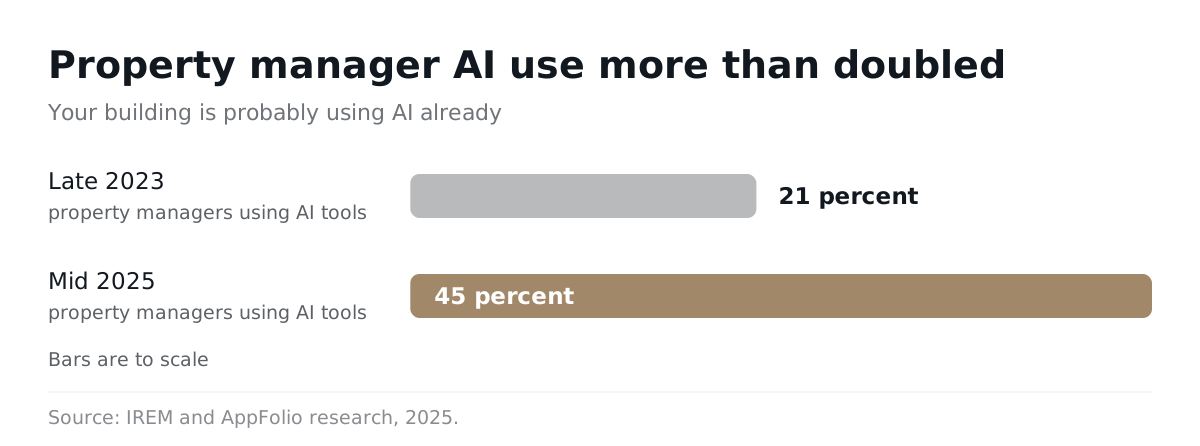
- The share of property managers using AI tools climbed from 21% to 45% between late 2023 and mid 2025, according to research from IREM and AppFolio.
- In Florida, directors of a condo association "have a fiduciary relationship to the unit owners" under section 718.111(1)(a). Approving a tool that touches owner data without asking basic questions is hard to defend.
- Nicholas Bartzen, a community association attorney in Chicago, told the Community Associations Institute that AI should be "a tool in the toolbox of each community association."
A tool is fine. An unwritten rule about the tool is the problem. The policy is how the board shows it did its homework.
What should a condo board AI policy cover?
A good policy fits on one to three pages and answers ten questions: why, who, what is allowed, what is banned, who approves, how data and records are handled, what residents are told, how vendors are checked, when it is reviewed, and how the board adopts it. The template below follows that order.
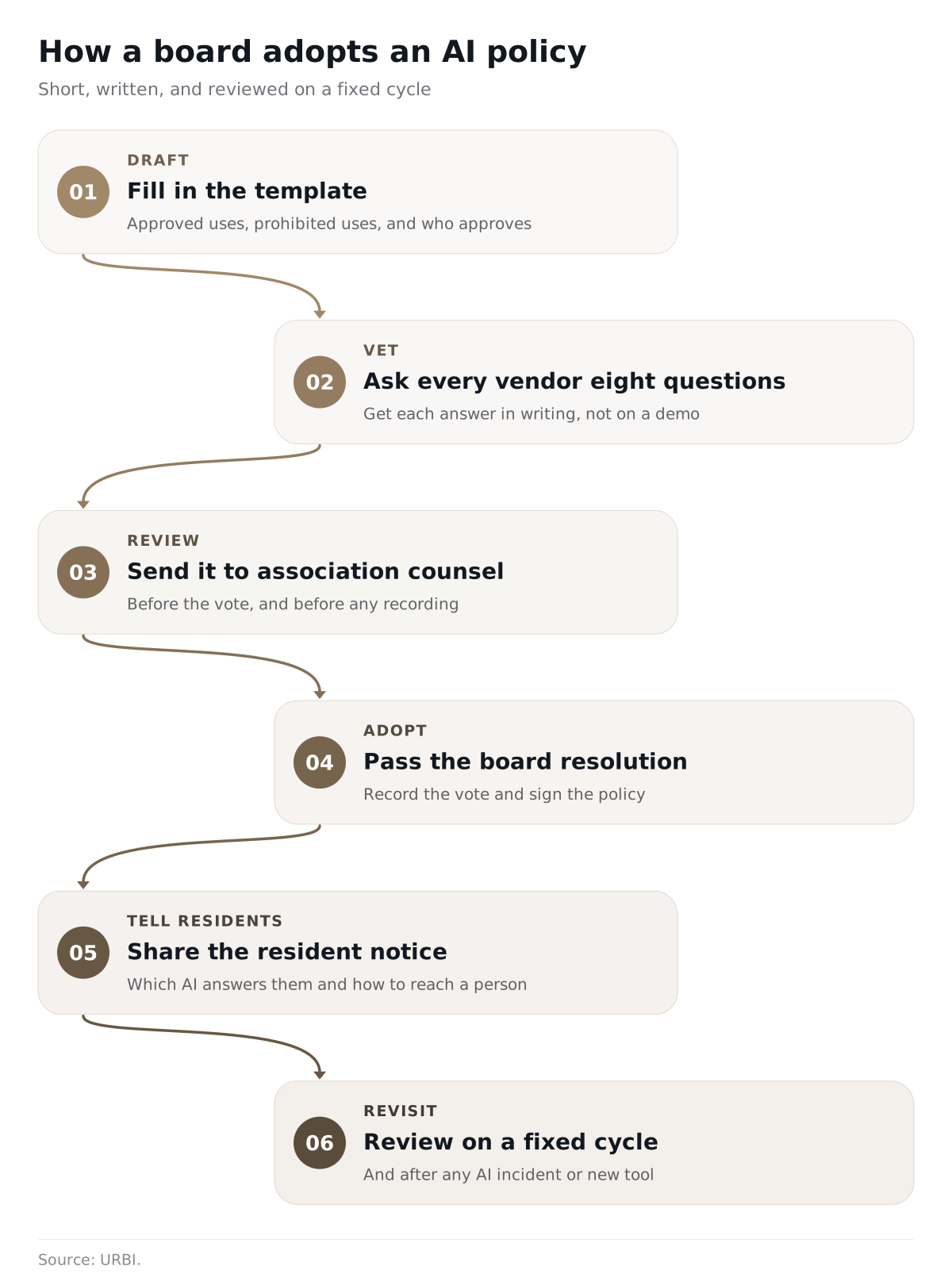
Do not make every AI use a board vote. Rewriting a pool notice is not a governance event. Do make every high risk use a board decision. This table sorts common uses by risk.
| Risk | Condo example | What the policy requires |
|---|---|---|
| Low | Rewriting a general notice that contains no resident data | An approved tool and a person who reads it before it goes out |
| Medium | Summarizing the reserve study, budget, or a vendor contract | An approved tool, a check against the source, and telling the board when a director relies on the summary |
| High | Recording meetings, answering resident calls, handling complaints, fines, or building access | Board approval, counsel review, resident notice, consent where the law requires it, and a person making every final decision |
The frontier AI labs are racing toward general intelligence, and lately they talk about slowing that race down. A condo board does not need that race. It needs AI that knows the building's records, asks a person before acting, and leaves a trail. We cover that difference in property management AI vs frontier AI and in what the frontier AI slowdown means for property managers.
What questions should the board ask an AI vendor?
Ask eight questions, and ask for every answer in writing. A demo that sounds reassuring is not a contract term.
| Question | Why it matters | A good answer sounds like |
|---|---|---|
| 1. Where does resident data live? | You need to know the country, the hosting setup, and which subcontractors can reach it. | A named location and a written list of who processes the data. |
| 2. Who can see it? | A concierge at one tower should not see another tower's residents. | Access limited by property and by role, set by your manager. |
| 3. Is it used to train AI models? | Resident questions can include health, money, and family details. | A contract clause saying no, not a sentence on a sales call. |
| 4. Does a person approve actions? | An AI that books, refunds, or sends on its own can make a mistake at scale. | The AI proposes, a named person confirms. |
| 5. Is there a record of every AI conversation? | When a resident says "the AI told me," you need to check. | Transcripts and summaries your manager can pull up. |
| 6. How is call recording consent handled? | Some states require every party to agree before a call is recorded. | A disclosed greeting and a consent step you can review with counsel. |
| 7. How are wrong answers corrected? | An AI that repeats a wrong answer creates a pattern, not a slip. | Staff can edit what the AI knows, and the fix sticks. |
| 8. Can we export and delete our data? | You may change vendors, managers, or both. | A usable export format and written deletion on exit. |
Question 3 is not paranoia. In January 2024 the Federal Trade Commission's technology staff warned AI companies that promises not to use customer data to train models must be kept, and that what a company fails to disclose "may be just as significant as what it promises." A written promise gives the board something to point to.
For a deeper look at the privacy side, read AI and data privacy in property management. For the wider software decision, see the condo board guide to building software.
How does URBI answer these eight questions?
URBI answers most of them with product design, and a few need to be confirmed in your contract. Here is the honest version.
| Question | URBI's answer |
|---|---|
| Where does resident data live? | URBI encrypts data in transit, runs on independently audited infrastructure providers, and never sells or shares resident data. Ask us to put the hosting location in your contract. |
| Who can see it? | Visibility is scoped to each property. Managers set permissions for each team member, module by module, down to who can create, read, update, or delete. Residents never see HERO, the team's AI. Arthur, the resident AI, checks a PIN before anything sensitive. |
| Is it used to train AI models? | A building's data never trains outside models. It stays with that building. |
| Does a person approve actions? | Yes. AI proposes, people approve. HERO can read records instantly, but every action it drafts (a ticket, a notice, a booking, an email) waits for a person to confirm. Arthur requests refunds only with manager approval. |
| Is there a record of every AI conversation? | Arthur's calls, texts, emails, and in app chats feed one dashboard. Every call leaves a transcript, a summary, and a manager notification, even when the caller hangs up early. URBI keeps a permanent audit trail on every action. |
| How is call recording consent handled? | Arthur tells callers it is URBI's AI assistant, hands off to a person when asked, and transfers calls only with the caller's consent. Confirm the exact recording announcement for your state with URBI and your counsel before you turn on voice. |
| How are wrong answers corrected? | When Arthur does not know, it sends the question to the manager with a summary. The manager's answer is saved to that property's knowledge base, and managers can view, edit, or delete any entry. HERO shows which sources it checked, and says so when it cannot find an answer. |
| Can we export and delete our data? | User deletion is supported, and HERO can export a full result list as a spreadsheet file. Ask us to write full data export and deletion on exit into your agreement. |
The approval rule is the one to press every vendor on. We explain how to set those limits in AI agents in property management: what AI can do alone and what a person must approve. For how this works across a whole building, see AI for condo management and URBI for residential buildings.
Can AI record or transcribe calls and meetings in your state?
Only if you follow your state's consent rules, and some states require every party to agree. Recording is the fastest way for a helpful AI feature to become a legal problem.
- California makes it a crime to record a confidential communication "without the consent of all parties" under Penal Code section 632.
- Florida allows interception only when all parties "have given prior consent," under section 934.03(2)(d).
Rules differ from state to state, and this post does not list them all. That is why the template keeps recording off until counsel signs off on the notice and consent steps for your state.
Are AI transcripts and summaries official records?
They can be, so the board should decide before the tool goes live. Minutes are official records in the two states below, and a transcript or AI summary may end up treated the same way.
- In California, minutes of member and board meetings are open to owner inspection permanently under Civil Code section 5210.
- In Florida, section 718.111(12) makes minutes permanent records, requires recordings of video conference meetings, and keeps most other official records for at least 7 years.
The template includes a small table where the board marks each AI item (raw recordings, transcripts, resident chat logs, prompts, drafts) as a record or not, and how long it is kept. Our guide to condo records request deadlines by state covers the owner inspection side.
Does privacy law apply to a nonprofit condo association?
Often not directly, but it still reaches the people and vendors around you. The California Privacy Protection Agency says the CCPA "does not generally apply to nonprofit organizations" in its official FAQ. The same page notes the law places separate duties on service providers and contractors.
So a management company or software vendor serving your building may be covered even when the association is not. The practical answer is the same either way: collect less, share less, and get the vendor's promises in writing. The NIST AI Risk Management Framework, released on January 26, 2023 for voluntary use, is a sound reference if a director wants a deeper checklist.
What is in the condo board AI policy template?
The template has ten short sections, a vendor checklist with boxes to tick, a records table, a sample resident notice, and a board resolution with signature lines. Fill in the blanks, remove what does not fit, and ask association counsel to review it before the vote. This is general information, not legal advice.
1. Purpose
This policy sets how ______ (the association), its board, its committees, its manager, and its vendors may use artificial intelligence (AI) tools. The goal is to save volunteer and staff time while protecting owner and resident privacy, keeping accurate records, and keeping every decision with people who answer to the owners.
2. Scope
This policy applies to:
- ☐ Directors and officers
- ☐ Committee members
- ☐ The management company and its staff: ______
- ☐ Front desk and concierge staff
- ☐ Vendors that handle resident information: ______
It covers any tool that writes, summarizes, answers, transcribes, translates, or recommends, including AI built into software the association already uses.
3. Approved uses (a person reviews every output)
- Drafting notices, newsletters, and emails that a person reads before they are sent.
- Summarizing documents the board already has the right to see, such as the reserve study, budget, or contracts. A person checks the summary against the source before relying on it.
- Answering routine resident questions from building records (amenity hours, move rules, package pickup) through a tool approved in Section 8.
- Translating building notices. A fluent reader checks important notices where possible.
- Proposing work orders, bookings, and replies that staff confirm before anything goes out.
- Other approved uses: ______
4. Prohibited uses
- Making or announcing a final decision on fines, violations, rule enforcement, collections, or building access.
- Giving legal advice, or drafting governing documents, amendments, or resolutions without association counsel review.
- Entering executive session material, legal advice, owner bank or card details, health or accommodation information, or security codes into any tool not approved in Section 8.
- Recording or transcribing any meeting or call without the notice and consent that state law requires.
- Facial recognition, or tracking where individual residents go.
- Using a personal or free AI account for association business.
- Other: ______
5. Human approval rule
AI may read, draft, and propose. A person must approve before any AI output is sent to owners, spent, booked, refunded, posted, or recorded as an association decision.
| Who approves | What they may approve |
|---|---|
| Front desk or staff | ______ (for example: standard replies, amenity bookings) |
| Manager | ______ (for example: work orders up to your approval limit) |
| Board | ______ (for example: anything above the manager's approval limit, any new AI use) |
Named owner of this policy (director or manager): ______
6. Privacy and records
- Share only the resident information a task actually needs.
- Resident data may not be sold, shared with third parties, or used to train AI models outside the building. The vendor confirms this in writing.
- Report any AI mistake or data exposure to ______ within ______ hours, and log it in the AI incident log.
- Classify AI material before the tool goes live:
| Item | Official record? | Keep for | Stored where |
|---|---|---|---|
| Minutes drafted with AI, after board approval | Yes | Per state law: ______ | ______ |
| Raw meeting recording or transcript | ______ | ______ | ______ |
| AI call, text, and chat transcripts with residents | ______ | ______ | ______ |
| Prompts and working drafts | ______ | ______ | ______ |
| AI incident log | Yes | ______ | ______ |
7. Resident disclosure
- Residents are told in writing which AI tools answer them, what those tools can and cannot do, and how to reach a person.
- Any AI assistant that talks to residents says it is an AI and hands off to a person when asked.
- Recorded or transcribed calls and meetings are announced at the start, with consent collected where state law requires it.
Sample notice: "______ uses an AI assistant to answer routine building questions and log requests. It will tell you it is an AI. Staff review its actions before anything is done, and you can ask for a person at any time by ______."
8. Vendor review checklist
Tool: ______ Vendor: ______ Reviewed by: ______ Date: ______
- ☐ The vendor states in writing where resident data is stored and which subcontractors can reach it.
- ☐ Access is limited by property and by role, and we can see who has access.
- ☐ The contract says our data is not sold, not shared, and not used to train models outside our building.
- ☐ Every action the AI takes waits for a person to approve it.
- ☐ Every AI conversation with a resident is saved with a transcript we can review.
- ☐ Voice calls announce recording and collect consent where our state requires it.
- ☐ Staff can correct a wrong answer so it is not repeated.
- ☐ We can export our data in a usable format and have it deleted when we leave.
- ☐ The vendor tells us about a data incident within ______ days.
- ☐ Association counsel reviewed the contract on ______.
| Approved tool | Approved uses | Approved on | Next review |
|---|---|---|---|
| ______ | ______ | ______ | ______ |
| ______ | ______ | ______ | ______ |
9. Review cadence
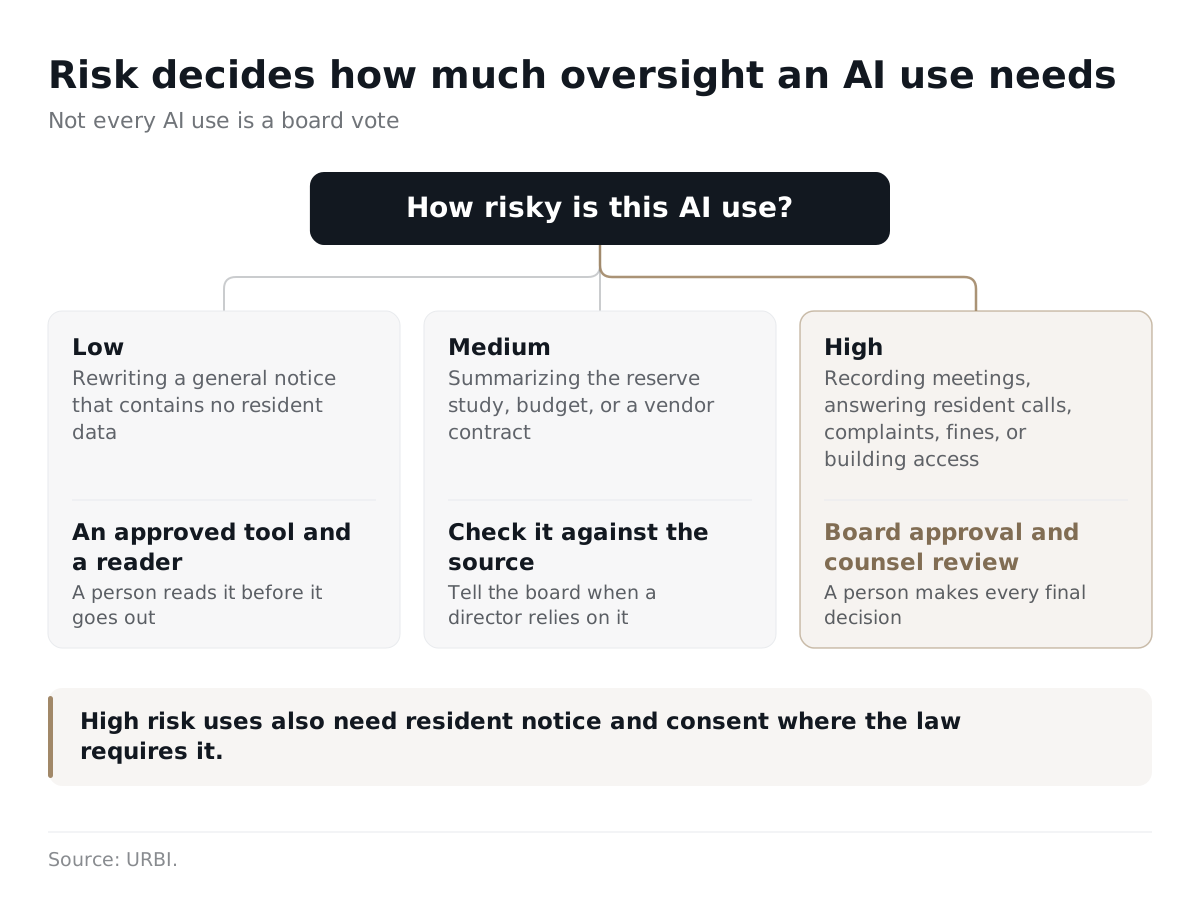
- The board reviews this policy and the approved tools register at least every ______ months, and after any AI incident.
- A new tool, or a new use of an approved tool, needs a board vote before use.
- Directors and staff confirm each year that they have read this policy.
10. Board resolution and sign off
RESOLVED, that the Board of Directors of ______ adopts this AI policy effective ______, and directs the manager to share the resident notice in Section 7 within ______ days.
Vote: For ______ Against ______ Abstain ______
| Name | Title | Signature | Date |
|---|---|---|---|
| ______ | ______ | ______ | ______ |
| ______ | ______ | ______ | ______ |
General information, not legal advice. Confirm with your association's attorney before the board adopts this policy.
Frequently asked questions
Does a small self managed condo board really need an AI policy?
Yes, but it can be short. A small board faces the same recording, records, and privacy questions as a large one, with fewer people to catch a mistake. Start with three sections: prohibited uses, the human approval rule, and the vendor checklist. Add the rest when you adopt a tool that talks to residents or handles their data. One page that directors read is better than ten pages nobody opens.
Can directors paste board documents into ChatGPT or another free AI tool?
Not under this template. Free and personal accounts are prohibited for association business because the board cannot control where that data goes or how it is used. Directors may use an approved tool for documents they already have the right to see, and must check any summary against the source. Executive session material, legal advice, and owner financial details stay out of every tool the board has not approved.
Do we have to tell residents the building uses AI?
This template says yes for any AI that talks to residents or handles their information. Residents should know it is an AI, what it can do, and how to reach a person. Low risk drafting, like a manager polishing a notice before sending it, does not need a public announcement. Recording is different: announce it every time, and collect consent where your state requires it. Confirm the wording with association counsel.
How often should the board review its AI policy?
Set a fixed cycle, such as once a year, and review early after any AI incident or before adding a new tool. AI products change fast, and a vendor can add features between renewals. At each review, walk the approved tools register, reread the vendor checklist answers, and ask the manager for any wrong answers or complaints the AI produced. Record the review in the minutes.
URBI was built for boards that want AI help without giving up control: HERO for your team, Arthur for residents, and a person approving every action. Learn more in what is URBI, or email hello@myurbi.co to walk your board through the eight questions on a demo.


