



AI property management data privacy comes down to written answers on five things: what data the AI touches, who else receives it, whether it trains a model, how long it stays, and how access is limited and logged. URBI is built to pass that test in a live demo.
This guide is for condo boards, management company principals, and operators in the United States. It turns generic privacy talk into a procurement checklist you can hand to any vendor, including us. It is not legal advice. Your counsel should review the contract.
What data does an AI property management vendor actually collect?
An AI vendor collects far more than a resident name and unit number. Once an assistant can read your records, it can touch everything those records hold, plus new data the AI creates on its own.
Build a data map before you sign. Ask the vendor to fill it in field by field. The typical surface looks like this:
- Identity and contact data: names, phone numbers, emails, unit numbers, household members, and sometimes government IDs.
- Financial records: payment history, receipts, refunds, arrears, and bank details.
- Communications: messages, emails, call recordings, voice transcripts, and complaints.
- Operations records: service tickets, photos, maintenance history, packages, visitors, and amenity bookings.
- Access and occupancy events: fob logs, guest passes, parking registrations, and move dates.
- Governance records: bylaws, board minutes, budgets, votes, and legal correspondence.
- AI artifacts: the prompts people type, the records the AI retrieves, its outputs, its logs, and any scores or labels it infers.
That last group is the one buyers forget. A prompt that says "summarize the noise complaints about unit 1204" is personal data. So is the summary. Treat both as records with an owner, a purpose, and a deletion date.
For each field, the data map should record six things: where it came from, why it is used, which model or provider sees it, which subprocessors receive it, how long it is kept, and how it gets deleted. If a vendor cannot fill in that table, you have your first answer.
Which US laws and standards apply to AI and resident data?
No single federal AI privacy law covers property management, but several existing laws already reach AI workflows. Which ones apply depends on where your residents live, what data the tool touches, and what decisions it informs.
How many state privacy laws could apply to your buildings?
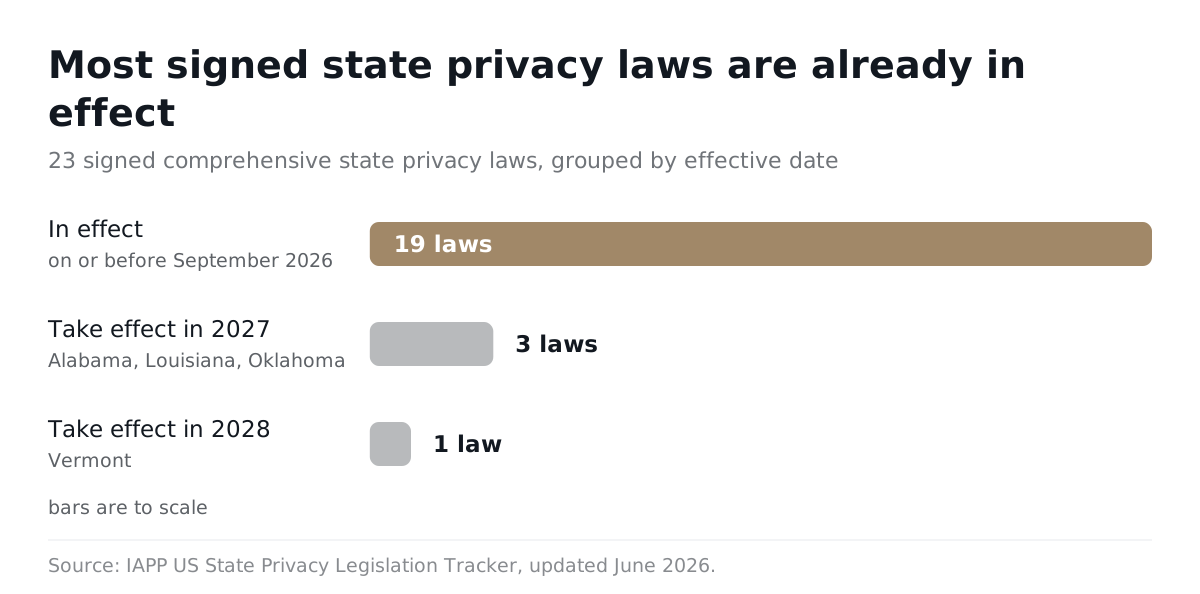
Nineteen states have comprehensive consumer privacy laws in effect as of September 2026. The IAPP state privacy legislation tracker, last updated June 2026, lists 23 signed laws. Four more are signed but not yet in effect: three in 2027 (Alabama, Louisiana, and Oklahoma) and one in 2028 (Vermont). The chart tracks rights such as access, correction, and deletion, plus opt outs for some automated decisions.
Each law has its own thresholds and exemptions. A small condo association may fall outside some of them. Your vendor, which holds data from many buildings, may not. Scope the contract to the strictest law that could plausibly apply, not the loosest.
What do federal regulators already enforce?
Federal regulators already police AI through existing consumer protection, fair housing, and credit reporting law. Three examples matter most for buildings:
- The FTC Act. In December 2023 the FTC banned Rite Aid from using facial recognition for surveillance for five years. The agency said the system generated thousands of false positive matches. The lesson for buildings is simple: an AI tool you deploy is your responsibility, even if a vendor built it.
- The Fair Housing Act. In May 2024 HUD issued guidance on how the Act applies to AI in tenant screening and ad targeting. The archived HUD release recommends tenant screening policies that are fair, transparent, and nondiscriminatory. Acting Secretary Adrianne Todman said, "HUD is committed to fully enforcing the Fair Housing Act." Our guide to AI leasing and fair housing compliance covers the screening side in depth.
- The Fair Credit Reporting Act. If a consumer report affects a leasing decision, the landlord owes the applicant an adverse action notice. The FTC's guidance for landlords says that notice is required even when the report was not the main reason for the decision. An AI score built on a report does not remove that duty.
Where do NIST and CISA fit?
NIST and CISA publish voluntary frameworks, not laws, but they give you a shared vocabulary for vendor questions. NIST's Generative AI Profile (July 2024), a companion to the AI Risk Management Framework, defines data privacy risk as leakage and unauthorized use or disclosure of "biometric, health, location, or other personally identifiable information." It also tells organizations to add data privacy and security to vendor assessments when they buy generative AI. And it calls for diligence on whether sensitive training data use is consistent with applicable laws.
A May 2025 joint AI data security guide from CISA, the NSA, the FBI, and allied agencies adds practical controls. It recommends provenance tracking to trace where data came from, strict access controls, and incident response planning. Those three ideas map directly to the product demo later in this guide.
Does resident data train the vendor's AI model?
You only know if the contract says so in writing. A sales rep saying "we don't train on your data" is not an answer. The contract should cover both the vendor's own models and every upstream model provider it sends data to.
Ask for three commitments:
- No training, model improvement, or benchmarking with identifiable customer data unless you opt in separately.
- The same restriction flows down to every model provider and subprocessor.
- Advance written notice before the vendor changes its data use terms, with a right to terminate if you object.
A general purpose chatbot is a different risk from a property platform. If staff paste leases or bylaws into a consumer AI tool, those terms are set by that tool, not by your management agreement. We cover that risk in using ChatGPT for leases and bylaws.
URBI does not name the vendors behind its underlying models in marketing. That choice does not excuse us, or anyone, from answering your training and subprocessor questions in writing during procurement. Ask us the same questions you ask everyone else.
Which contract and SLA terms should you require?
Require terms that limit purpose, name subprocessors, fix retention, and set a clock on breach notice. California already writes several of these into law. Section 1798.100(d) of the California Consumer Privacy Act requires contracts with service providers to specify "limited and specified purposes," to require the same level of privacy protection the law demands, and to make the vendor notify the business if it can no longer meet its obligations. The business also gets the right to stop and remediate unauthorized use.
Use those terms as your baseline in every state. Here is the full list to put in front of your counsel:
| Term | What to require | Red flag |
|---|---|---|
| Data ownership | You own source records and outputs specific to your buildings. | Vendor claims a broad license to "improve services." |
| Permitted purpose | Use limited to named services and documented purposes. | Open ended "business purposes" language. |
| Model training | No training on identifiable data without separate opt in. | Silence, or a clause buried in the privacy policy. |
| Subprocessors | Named list, advance change notice, flow down duties. | "We use industry standard providers." |
| Retention and deletion | Periods for records, prompts, outputs, logs, and backups; deletion certificate at exit. | "Retained as long as reasonably necessary." |
| Incident notice | Notice within a fixed number of hours, with scope, affected records, and updates. | "Promptly," with no number. |
| Audit rights | Access to current independent reports and remediation plans. | No audit clause at all. |
| Human review | A named person can inspect, correct, or reject consequential outputs. | AI decisions with no appeal path. |
| SLA and exit | Uptime, support response, recovery targets, data export, termination help. | Export only in a format no other system reads. |
Push hardest on the incident notice clock. "Promptly" means whatever the vendor's lawyer says it means after a breach. Negotiate a number and write it down.
Which product controls should a vendor prove in a live demo?
The vendor should show permissions, household boundaries, audit logs, and human approval working in the product while you watch. Policies describe intent. A demo shows behavior.
What should you test during the demo?
Test whether the AI respects the same boundaries as the underlying records. Bring a script. Ask the vendor to log in as different users and try these:
- Permission scope. Can a staff member at one property see another property's records through the AI? Can a front desk role see board documents?
- Household scope. Can a resident ask the assistant about a neighbor's tickets, packages, or balance? The right answer is no, every time.
- Audit trail. Does every AI action show who asked, what was retrieved, and what was done? Are denied attempts logged?
- Human approval. When the AI proposes an action, does a person confirm it before anything is sent or created?
- Source visibility. Can staff see which records the AI checked to reach its answer?
- Knowledge base control. Can managers view, edit, and delete what the AI has learned?
- Usage limits. Is there a visible cap on AI usage, so nobody runs bulk queries across your data unnoticed?
A knowledge base is also a privacy asset. Every answer the AI stores becomes a record somebody must be able to review and remove. Our guide to building an AI knowledge base for property management explains how to keep one clean.
How does URBI handle these controls?
URBI answers the demo script with controls you can click through yourself. Here is what the product does today:
- Per module permissions. You decide which staff and board roles can use each module, with multi property support for portfolios.
- Arthur, the resident facing AI, answers only about the caller's own household. It asks for PIN verification before anything sensitive. It never claims to be the property manager.
- Arthur leaves a record every time. Each call produces a guaranteed transcript, summary, and manager notification, even if the caller hangs up mid call.
- Unknown questions go to a person. Arthur escalates to the manager with a summary. The answer is saved to a property scoped knowledge base that managers can view, edit, and delete.
- HERO, the manager facing AI inside the Kore dashboard, shows a "what I checked" panel. Staff see which records, documents, and procedures it used.
- HERO proposes, people approve. Tickets, tasks, notices, emails, and push messages are created only as proposals a person confirms. Multi step work arrives as a numbered plan approved step by step.
- HERO says so when it cannot find an answer. It does not guess.
- A weekly AI usage allowance per property comes with a visible meter.
- Conversations are logged. Staff to resident messages are searchable and reviewable by management. Board votes carry an audit trail.
You can see how HERO works on the HERO AI intelligence page. What we will not claim matters as much. This post makes no certification claims for URBI. Ask us for our current security documentation in writing, and hold us to it in the contract like any other vendor.
What should your due diligence checklist include?
Your checklist should pair each vendor question with the evidence that counts as a pass. A verbal yes is not evidence. Use this table in your next vendor review:
| Ask the vendor | Passing evidence |
|---|---|
| What exact fields enter the AI? | A field level data map covering prompts, retrieved records, outputs, logs, and inferences. |
| Who owns each data category and who may reuse it? | Contract grants only a narrow service license. No silent secondary use. |
| Does customer data train or improve any model? | A written yes or no for the vendor and every upstream provider. Opt in if yes. |
| Which subprocessors receive data? | A named list with purpose, data categories, change notice, and an exit right. |
| How long is every artifact kept? | A schedule for records, prompts, outputs, logs, and backups, plus a deletion certificate. |
| What happens after a security incident? | A notice deadline in hours, ongoing updates, and support for resident notifications. |
| Can permissions and household boundaries be tested? | A live demo with users from different properties and households. Denied attempts appear in logs. |
| Who reviews consequential output? | A named person who can inspect inputs, correct errors, and reject the result. |
Most failed AI rollouts trace back to skipping one of these rows. We list the common ones in property management AI mistakes.
Should privacy concerns stop you from buying AI at all?
No. Privacy concerns should shape how you buy AI, not whether you buy it. Heavy diligence on low risk tools can leave real problems unsolved.
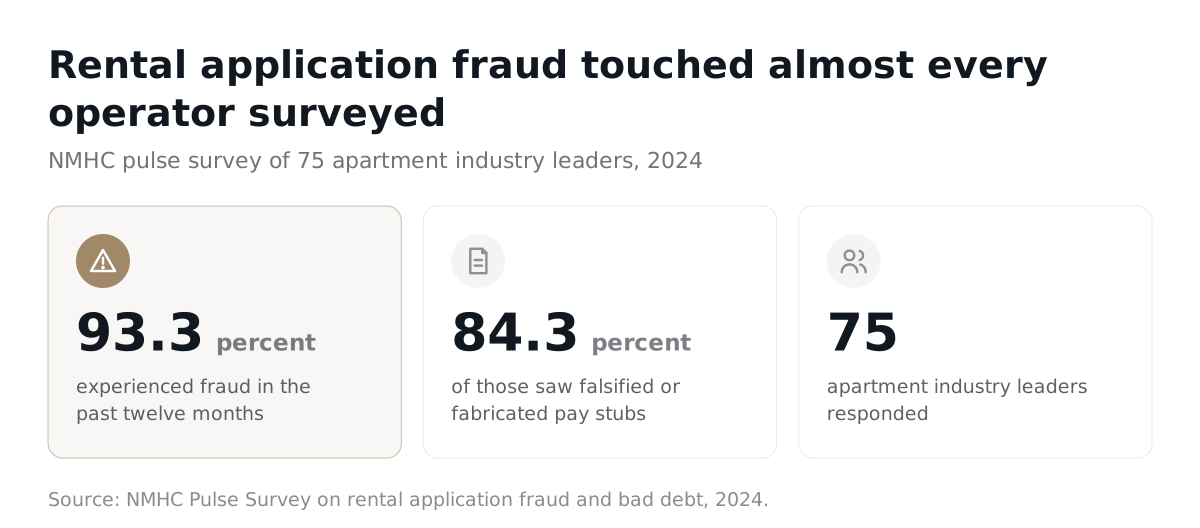
Screening fraud is a good example. In a 2024 NMHC pulse survey of 75 apartment industry leaders, 93.3 percent reported experiencing fraud in the past twelve months. Among those, 84.3 percent had seen applicants falsify or fabricate pay stubs. Operators have good reasons to want automated checks.
The answer is proportional review. Match the depth of diligence to the data and the consequence:
- Lower risk: AI that summarizes equipment manuals or drafts a building notice for staff review.
- Medium risk: AI that answers resident questions from building records, or reads resident messages.
- Higher risk: AI that scores applicants, identifies faces, interprets complaints about specific people, or controls building access.
Raise testing, human review, and contract protection as you move down that list. For condo boards weighing where to start, AI for condo management walks through the lower risk jobs first. For rental operators, our guide to an AI chatbot for apartment residents covers the resident facing tier.
Frequently asked questions
Is AI property management software covered by HIPAA?
Usually not. HHS defines covered entities as health care providers, health plans, and clearinghouses, plus the business associates they hire. Most condo associations and apartment operators are none of these. Senior living operators should check with counsel, because HHS lists nursing homes among covered providers. Even where HIPAA does not apply, state privacy laws and the FTC Act still do, so the same contract and demo checklist applies.
Can a condo board be responsible for a vendor's AI mistake?
It can be exposed. The FTC's Rite Aid action shows regulators hold the business that deploys an AI tool accountable for how it performs. A board that approves a vendor without asking how data is used, limited, and logged has less to point to if something goes wrong. Written answers, a tested demo, and a signed contract are your record of reasonable care.
What is the single most important question to ask an AI vendor?
Ask whether your residents' data trains or improves any model, and ask for the answer in the contract. That one question forces the vendor to disclose its upstream providers, its data use terms, and whether it can change them later. A vendor that answers clearly in writing will usually answer the rest of the checklist too. A vendor that hedges on this one will hedge everywhere.
Do small buildings need the full checklist?
Yes, though the review can be faster. A small building has fewer staff to catch an AI error and less bargaining power after a breach. Use the eight question table as written. Skip the deep security audit for low risk tools, but never skip the training question, the subprocessor list, the household scoping test, or the incident notice clock.
Privacy review is how a board or principal says yes to AI with a clear conscience. URBI is built around permissions, household scoping, visible sources, and human approval, which is why we welcome the checklist. To learn more about the platform, start with what URBI is or our guide to URBI for residential buildings. Then send us your vendor questionnaire at hello@myurbi.co and we will answer it in writing.
Keep reading


