



Proof of notice for residents is a saved record that shows the right people got the right notice, on time, by a method the law allows. URBI keeps every notice on the record with its audience and publish date. Your own file adds the delivery evidence the law asks for.
This guide is about proof, not wording. If you need help writing the notice itself, start with our water shutoff notice templates. This is general information, not legal advice. Confirm the rules for your state and building with your attorney.
Which resident notices legally need proof?
Any notice the law makes a condition for acting needs proof. That means notice before entering a home, before cutting a required service for repairs, and before a condo meeting that changes unit use rules. If someone can later ask "did you tell them?", you need a file that answers yes.
The rules change by state, so look at real examples, not a national average:
| Notice | Example rule | What the rule asks for |
|---|---|---|
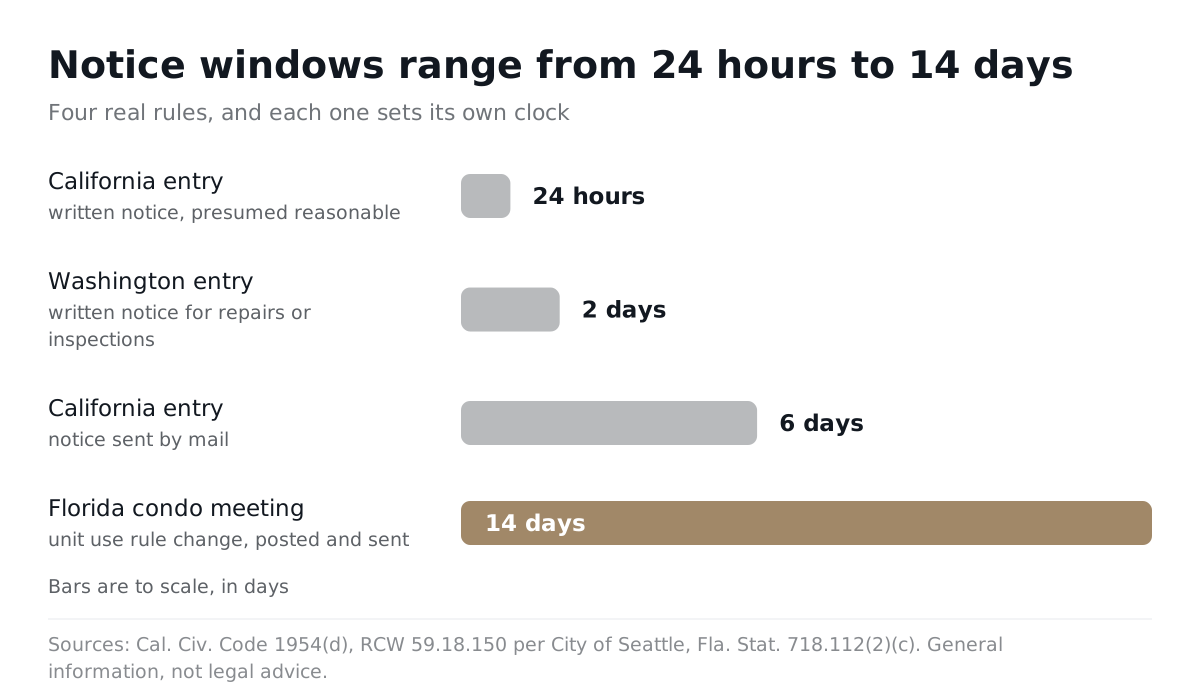
| Entry into a home | California Civil Code 1954 | Written notice with the date, approximate time, and purpose. 24 hours is presumed reasonable. A mailed notice is presumed reasonable if sent at least six days before entry. |
| Entry into a home | Washington, RCW 59.18.150, as explained by the City of Seattle | At least two days of written notice for repairs, services, or inspections. The notice states the reason, the planned time, and a name and phone number for rescheduling. |
| Service cut for repairs | Massachusetts 105 CMR 410.003(C) | A required service can stop only briefly during actual repairs, and only with reasonable notice to the occupant. |
| Condo unit use rule change | Florida Statutes 718.112 | Meeting notice mailed, delivered, or sent electronically to owners and posted conspicuously at least 14 days before the meeting. Compliance is proven by an affidavit. |
Notice who the law names in each row. California names the tenant. Massachusetts names the occupant. Florida names the unit owner. A post sent to everyone with the app may not match the list the law cares about. So your proof starts with the right recipient list, not the send button.
What counts as proof that a notice was delivered?
Proof is a stack of records: a copy of the exact notice, who it went to, how it went, when it went, and evidence the delivery method finished. Each piece proves something different. None of them proves everything alone.
| Evidence | What it shows | What it does not show |
|---|---|---|
| Signed certificate of service from the person who delivered | Who delivered what, when, and how | That the method was allowed for this notice |
| USPS Certificate of Mailing | The mail was handed to the Postal Service | Delivery. USPS says it does not provide a record of delivery. |
| Timestamped photo of a posted or door notice | The notice was posted at that place and time | That anyone read it |
| Email send record and bounce history | The email left your system and did or did not come back | That a person opened it |
| Electronic acknowledgment or receipt | The record was received | That the content received matches what you sent |
That last row comes straight from law. Virginia's Uniform Electronic Transactions Act says an electronic acknowledgment shows a record was received. By itself, it does not show the content sent matches the content received. That is why your file keeps the exact notice, not just a "sent" checkmark.
Does a resident have to read a notice for it to count?
Usually not. Most notice rules ask whether you delivered properly, not whether someone read it. Virginia's electronic transactions law says an electronic record is received "even if no individual is aware of its receipt." Florida's rental email law treats a notice as delivered when it is sent, unless it bounces back as undeliverable.
Reading still matters for safety and goodwill. Our guide on why residents do not read building notices covers how to get attention. Proof answers a different question: did you do what the rule required?
When can a building send legal notices by email or app?
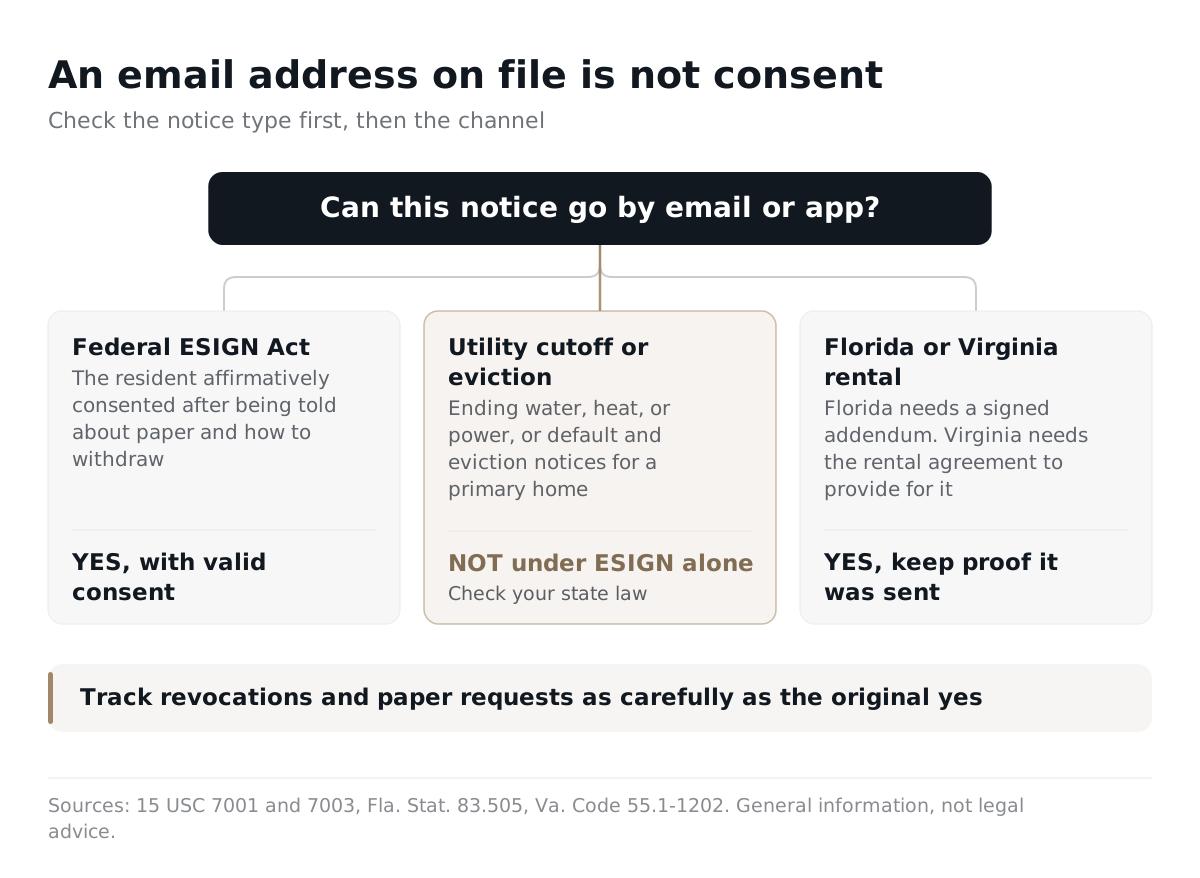
Only when a law or signed agreement allows it, and the resident agreed in the way that law requires. An email address on file is not consent. Check the notice type first, then the channel.
Here is how the main rules work:
- Federal E-SIGN Act. Where its consumer rules apply, the person must have affirmatively consented to electronic records. They must first be told about any right to paper and how to withdraw consent. Their consent must show they can actually open the electronic format.
- E-SIGN exceptions. The same law's general rule does not cover notices ending utility services, including water, heat, and power. It also does not cover default, eviction, or right to cure notices under a rental agreement for a primary residence. E-SIGN alone will not carry those notices by email. A state law might still allow it, so check.
- Florida rentals. Under Florida Statutes 83.505, email notice needs a signed addendum to the rental agreement. Either party can revoke it in writing. The sender must keep a copy of each notice and evidence it was sent.
- Virginia rentals. Under Virginia Code 55.1-1202, electronic notice works if the rental agreement provides for it. A tenant can ask for paper instead. The sender must keep proof, such as an electronic receipt, a fax confirmation, or a certificate of service.
- Florida condos. Florida Statutes 718.112 lets an association send notice electronically to owners who consent to it.
Consent is not a one time checkbox. Joe Adams, an attorney with Becker and Poliakoff, wrote on the Florida Condo and HOA Law Blog: "Such consent must be made revocable at will by the owner." He also lists Florida notices that cannot go by email even with consent, such as notices used to collect overdue assessments and certain violation demands. Track revocations and paper requests as carefully as the original yes.
What should a proof of notice file contain?
One file per notice, holding everything you would hand a judge, a board, or an angry owner. Build it when you send, not when someone complains. Use this checklist:
- The notice. The final text exactly as sent, with attachments and every update.
- The recipient list. Units and names as of the send time, with each person's legal role: tenant, occupant, or owner.
- The method. How each recipient got it, and the rule or lease clause that allows that method.
- Consent records. Electronic notice addenda or consents, revocations, and paper requests.
- Timestamps. When it was published, mailed, delivered by hand, or posted.
- Delivery evidence. Mailing receipts, certificates of mailing, bounce notices, returned mail, and photos of posted notices with the staff member's name.
- Signed statements. A certificate of service or affidavit where the rule calls for one. Florida, for example, requires one for the 14 day notice of a condo meeting on unit use rules.
- Follow up. Second attempts for bounced email or returned mail, resident replies, and questions answered.
- Retention. Keep the file as long as your state requires.
Retention rules vary, so look yours up. Florida is a clear example. Its condo law lists copies of all required affidavits as official records, and most other official records must be kept at least 7 years. Our condo document retention schedule template helps you set your own schedule.
How does URBI help you keep proof of notice?
URBI keeps the notice side of the record and gives you one place to file the delivery evidence: what was sent, to which units, on which channels, and when.
Here is what URBI records and holds:
- The notice and its audience. Each news post keeps its urgency level, publish date, and audience on the record. Audience can be the whole building, specific units, or groups.
- Every channel at once. Each post goes out in the app, by push notification, and by email at the same time. Urgent posts also reach residents who turned off notifications or email for news.
- Scheduled publish. Write the notice early and schedule it so it goes out inside the window your rule sets.
- Replies on file. Email replies to a post land in the staff inbox as a threaded conversation. Concierge chats are logged and searchable.
- Delivery evidence in one place. Staff file typed notes, including incident notes, on a unit or the property. Attach photos of posted notices, mailing receipts, and signed certificates. Notes are full text searchable.
- Documents. The Document Hub holds the final notice, community rules, and meeting minutes.
- Lobby screens. A team member can put a notice on URBI Display lobby and elevator screens as a separate step. An emergency takeover flips every screen to the alert.
- Drafts with approval. HERO, the manager facing AI, can draft a notice. Nothing goes out until a person confirms it.
- Audit trail. URBI keeps a permanent audit trail on every action.
URBI does not record who opened a post. Where a rule needs proof of delivery to each person, send by the method the rule names, such as a signed certificate of service or mailing, and file that evidence on the unit in URBI so the notice and its proof sit together.
Not sure whether you need a broadcast tool or a resident app for this? Our comparison of a mass notification system vs a resident app walks through it. For the season ahead, see our winter building notices checklist. For the full picture, read URBI for residential buildings or what URBI is.
What do managers ask most about proof of notice?
Is a read receipt proof of notice?
A read receipt is helpful, but it is rarely what the law asks for. Most rules focus on proper delivery by an allowed method, to the right person, on time. Virginia's electronic transactions law says an electronic record is received even if nobody is aware of it. Keep the exact notice, the recipient list, the method, and delivery evidence. Treat any read data as a bonus, not your main proof.
Can I post a notice on the door instead of emailing it?
Often yes, if the rule lists it. California's entry rule, for example, allows a notice left on, near, or under the usual entry door. Take a timestamped photo of each posted notice and record the staff member's name. Door posting does not fit every notice, so check your state's rule and your lease for the methods allowed for that notice type.
Does a certificate of mailing prove the resident got the notice?
No. A USPS Certificate of Mailing shows the mail was handed to the Postal Service. USPS says it does not provide a record of delivery. It can still be strong evidence where a rule accepts mailing, such as California's six day mailing presumption for entry. Keep it with the notice copy and any returned mail.
How long should a building keep proof of notice?
As long as your state requires, and longer if a dispute about that notice is still possible. Florida condo law treats required affidavits as official records, and most other official records must be kept at least 7 years. Other states set different periods. Pick the longest period that applies to the notice type, write it into your retention schedule, and store the file where staff can find it.
Sending a notice takes a minute. Proving it months later takes a file you built on the day you sent it. URBI keeps the notice, its audience, its publish date, the replies, and your delivery evidence in one place. To see how it would work in your building, email hello@myurbi.co.


