



Short term rental rules for condo buildings hold up when the right document allows the restriction, guest registration stays within the law, and every fine follows notice and a hearing. URBI gives boards and managers the guest registration, front desk log and notice record that prove it.
This article is general information, not legal advice. Rules differ by state, city and building, so confirm your plan with your association's attorney.
Can a condo association restrict or ban short term rentals?
Often yes, but only through the document that actually has that power, and sometimes not for every owner. A board rule passed at a meeting is usually not enough. The restriction normally lives in the declaration, and changing the declaration takes an owner vote under the amendment rules in your documents and your state statute.
Two state examples show why the details matter.
- Florida. Under section 718.110(13) of the 2025 Florida Statutes, an amendment that bans rentals, changes the rental term, or limits how often owners may rent "applies only to unit owners who consent to the amendment" and to owners who take title after it becomes effective. An owner who voted no keeps the old rights until the unit sells.
- Arizona. Section 33-1260.01 of the Arizona condominium statute lets an owner use the unit as a rental unless the declaration prohibits it. Silence in the declaration means rentals are allowed.
The practical lesson: before you write a single violation letter, build a unit by unit list of who is bound. In Florida, that means recording which owners consented and which bought after the amendment took effect.
Rule or amendment: which one does your building need?
| Goal | Usually handled by | Why |
|---|---|---|
| Ban rentals or set a minimum stay | Declaration amendment (owner vote) | It changes an owner's property rights, so the documents and the statute control it |
| Require guests to register at the front desk | Rules adopted under the board's rule power | It governs use of the common elements, not the right to rent |
| Set quiet hours, amenity limits and move in procedures | Rules | Conduct rules apply to everyone, residents and guests alike |
| Set fines for violations | The declaration, bylaws and state statute | Many states cap fines and require a hearing first |
How do city rules like NYC Local Law 18 change what a condo can do?
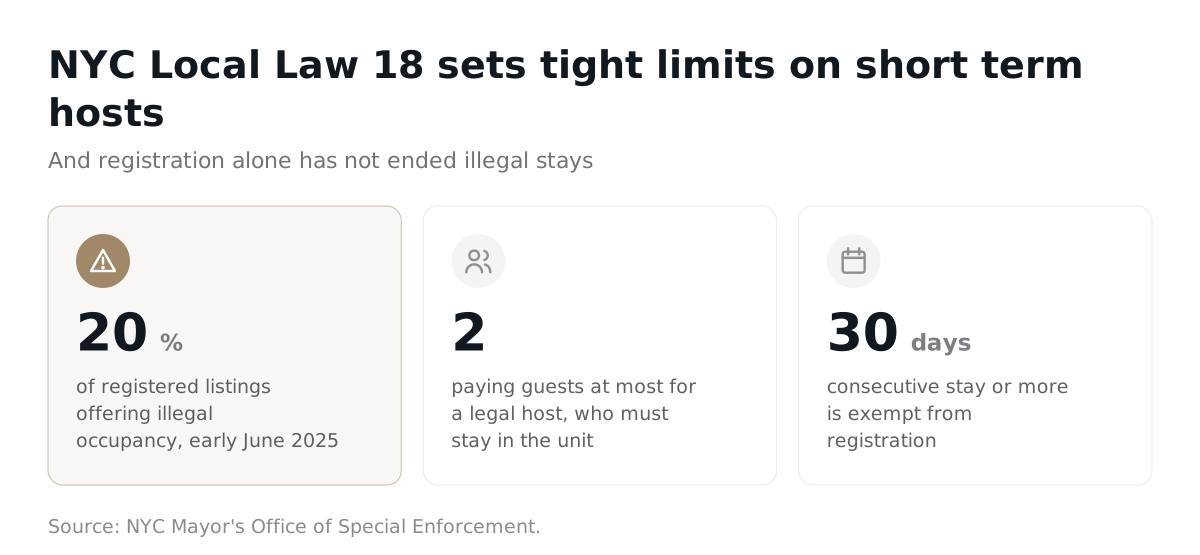
City law sits on top of your documents, and a short stay that your building allows can still be illegal under city law. New York City is the clearest case. The city adopted Local Law 18 on January 9, 2022, and it requires short term rental hosts to register with the Mayor's Office of Special Enforcement. Booking platforms may not process bookings for unregistered rentals. Rentals of 30 consecutive days or more are exempt from registration.
Even a registered host faces tight limits. Under the city's rules for legal hosting, the host must stay in the same unit as the guests, keep a common household with them, and have no more than two paying guests at a time.
New York also gives condo boards a direct tool. The Prohibited Buildings List is open to building owners, including the board of a condominium, and to managers acting for the board. The applicant certifies that the leases and occupancy agreements for every unit in the building prohibit short term rentals. The city then denies new registrations in that building. You cannot list only some floors or units.
Registration does not end the problem. In early June 2025, the city estimated that approximately 20% of registered listings were offering illegal occupancy. Christian Klossner, executive director of the Office of Special Enforcement, said in a June 2025 city release: "we are moving on to a new stage of enforcement."
Other cities draw the line differently. Miami Beach defines vacation and short term rentals as stays of less than six months and one day, and prohibits them in many multifamily buildings in certain zoning districts. So never copy another city's definition into your rules. Check your own city, your zoning district and your building.
What should a condo guest registration process collect?
Collect what you need to run the building and what your state allows, and nothing more. Start by separating two kinds of people. A visitor comes to see a resident. A paying occupant stays in the unit while the owner is away. They need different forms.
Arizona shows what a statute can allow and forbid. When a unit is rented, the Arizona statute lets the association ask for the names and contact information of adults living in the unit, the start and end dates of the tenancy, and a description and plate numbers of the tenants' vehicles. It forbids requiring a copy of the rental application, credit report, lease agreement or rental contract.
| Field | Visitor | Paying occupant |
|---|---|---|
| Host unit and resident | Yes | Yes, plus the owner or authorized agent |
| Guest name | Yes | Adult occupants, as your state allows |
| Arrival and departure dates | Arrival time | Yes, both dates |
| Vehicle and plate | Only if parking on site | Yes, if parking on site |
| Rules acknowledgment | Not usually | Yes, a signed or checked receipt of the rules |
| Lease, credit report, ID copies | No | Only if your state and documents allow it |
In URBI, residents register visitors from the app and the front desk sees live available pass counts. A verification desk handles check in at the front of house. Guest parking runs on QR passes with a monthly allowance per unit, and passes time out on their own. On the Premium plan, Arthur, URBI's resident facing AI, can pre schedule a visitor when a resident calls or texts, once a person confirms it. For more on the parking side, see visitor and guest parking management for condos.
What does a fair short term rental enforcement process look like?
A fair process tells the owner exactly what rule was broken, shows the evidence, gives a chance to fix it, and offers a hearing before any penalty. Owners who feel ambushed fight back, and a skipped step can sink a fine that was otherwise justified.
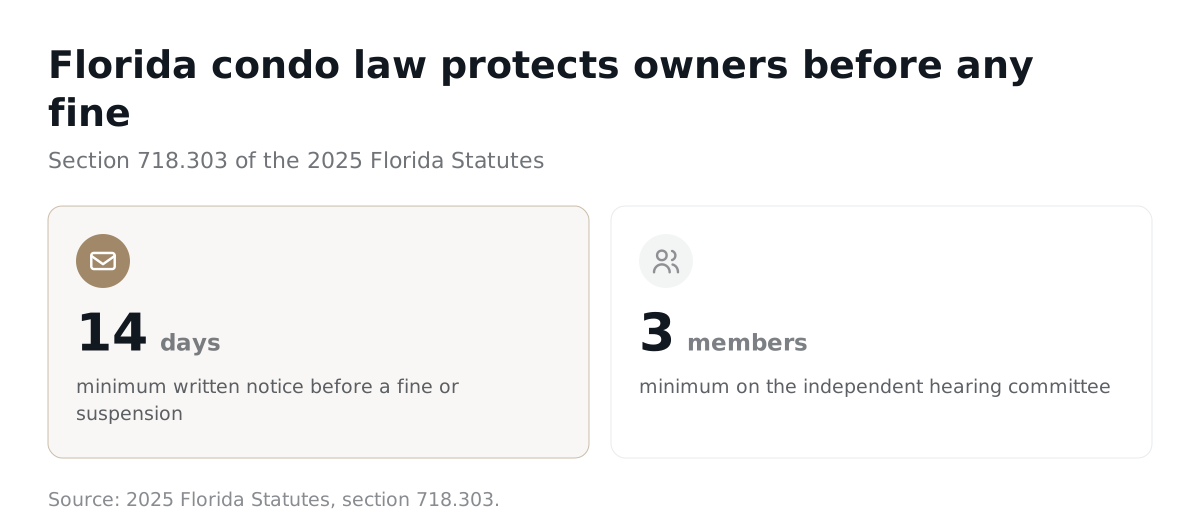
Florida writes much of this into law. Under section 718.303 of the 2025 Florida Statutes, a fine or suspension needs at least 14 days' written notice and a chance for a hearing. The hearing is before a committee of at least three members appointed by the board. Officers, directors, employees and their close relatives cannot sit on it. The committee only confirms or rejects the fine. A fine may not become a lien against a unit. A suspension of common element use cannot reach the elements needed to access the unit, utility services, parking spaces or elevators.
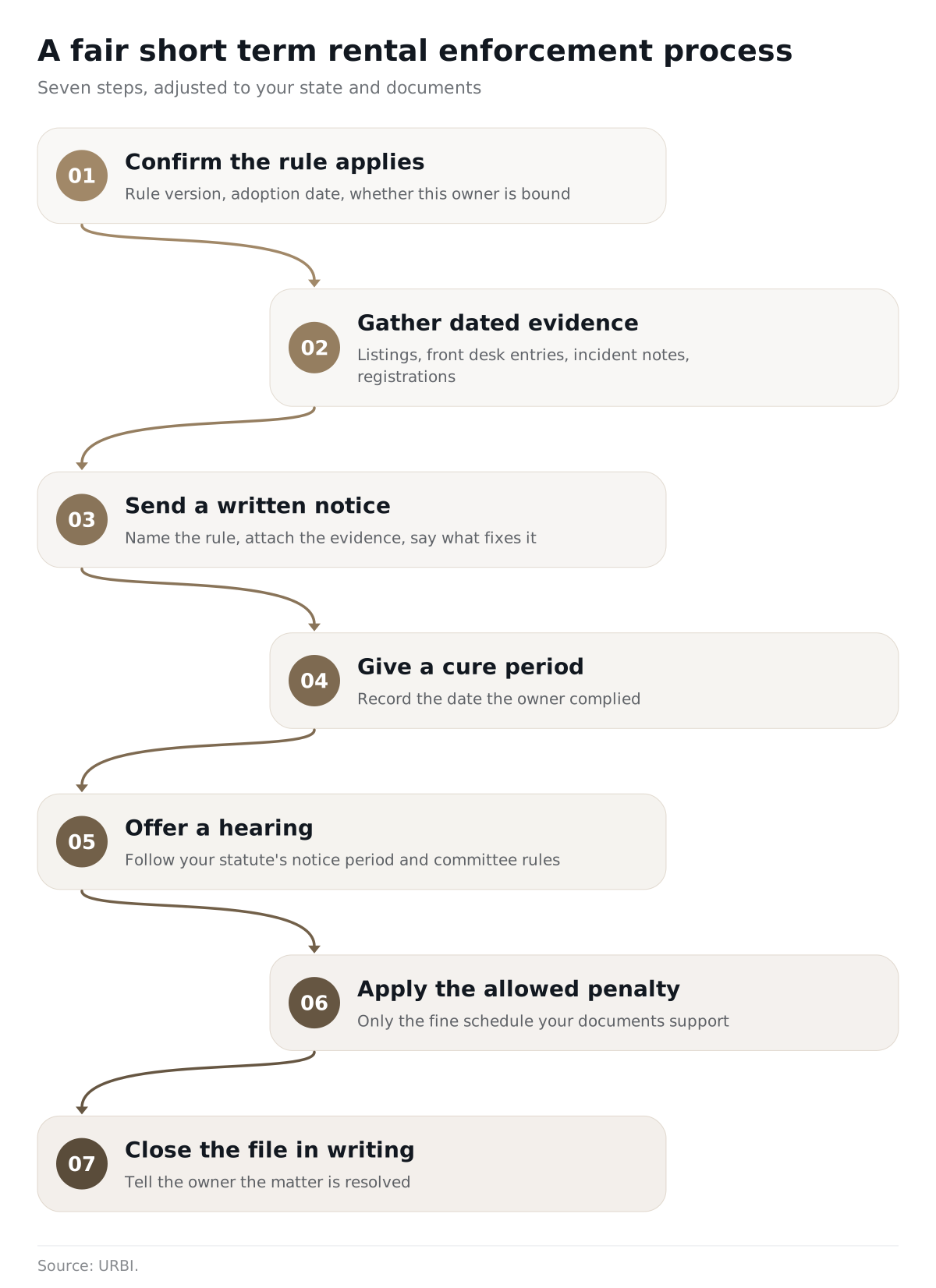
Use this sequence as a starting point, then adjust it to your state and documents:
- Confirm the rule applies to this unit. Check the rule version, its adoption date, and whether this owner is bound.
- Gather dated evidence. Listing screenshots with dates, front desk entries, incident notes and guest registrations. A suspicion is not evidence.
- Send a written notice of violation. Name the rule, describe the conduct, attach the evidence, and say what fixes it.
- Give a cure period. Many violations end here. Record the date the owner complied.
- Offer a hearing. Follow your statute's notice period and committee rules. Keep the hearing materials and the decision.
- Apply the penalty your documents allow. Use the fine schedule set by your declaration and statute. Do not invent amounts or daily penalties the documents do not support.
- Close the file in writing. Tell the owner the matter is resolved. An owner who fixed the problem should never have to guess whether fines are still running.
How should the board tell residents about new rental rules?
Send the rule to every owner in writing, post the governing documents where residents can find them, and keep proof that the notice went out. A rule nobody saw is hard to enforce.
In URBI, HERO, the manager facing AI, can draft the rule notice for a manager to review. Nothing goes out until a person confirms it. On publish, the post reaches residents in the app, by push notification and by email at the same time. URBI keeps the post's publish date and audience on the record. It does not record who opened it, so for a notice to one owner about one violation, use the delivery method your documents require and file that evidence too. Our guide to proof of notice for residents covers what counts.
What records should a condo keep for short term rental enforcement?
Keep a file that would let a stranger understand the case from start to finish. That means the rule, the evidence, every notice and how it was delivered, the owner's response, the hearing record, the decision, and the closing letter.
State law sets how long. Florida, under section 718.111 of the 2025 Florida Statutes, requires permanent retention of core records such as the declaration, bylaws, current rules and meeting minutes. Most other official records must be kept for at least 7 years. Information gathered to approve a lease or sale, and personal details like phone numbers and email addresses, are not open to owner inspection.
- Authority file: the declaration or rule, its adoption record, and the owner consent list where it matters.
- Registration records: guest and occupant registrations, limited to allowed fields.
- Violation file: evidence, notices, delivery proof, responses, hearing materials, decision and closing letter.
- Access controls: who on staff can see guest personal data.
URBI keeps much of this in one place. Front desk staff log typed notes, including incident notes, tagged to the unit and searchable later. Every concierge conversation with a resident is logged and searchable by management. Role based permissions control what each staff member can see, and every action carries a permanent audit trail. For how long to keep each record, use our condo document retention schedule template.
Does the master policy cover an owner's short term rental?
Do not assume it does. The National Association of Insurance Commissioners warns that most homeowners and dwelling policies are not designed to cover accidents from short term rentals. Ask the association's broker how rental activity affects the master policy, and require owners who rent to confirm their own coverage.
FAQ
Can a condo board ban short term rentals with a rule instead of an amendment?
Usually not. A ban changes an owner's right to rent, and that right normally lives in the declaration. Most states and most documents require an owner vote to amend it. Some states also limit who a new ban binds. In Florida, a rental amendment applies only to owners who consented and to later buyers. Board rules are better suited to guest registration, conduct and amenity use. Ask your association's attorney which route your documents require.
Can a condo require guests to register at the front desk?
In most buildings, yes, when the rule is adopted properly and applied to everyone. Registration helps with access, parking and safety. Keep the form short and collect only what your state allows. Arizona, for example, limits what an association may ask about tenants and forbids demanding copies of leases or credit reports. Treat visitors and paying occupants as separate cases with separate forms.
How much can a condo fine an owner for an illegal short term rental?
Whatever your declaration, bylaws and state statute allow, and nothing more. Many states cap fines and require written notice and a hearing first. Florida requires at least 14 days' notice and a hearing before an independent committee, and a fine there cannot become a lien on the unit. Write your fine schedule from your own documents, and have counsel review it before the first fine goes out.
Does NYC Local Law 18 apply to condo buildings?
Yes. It applies to short term rental hosts anywhere in the city, including condo units. Hosts must register, stay in the unit with their guests, and host no more than two paying guests at a time. Condo boards can also apply for the city's Prohibited Buildings List if every unit's occupancy agreements ban short term rentals. Once listed, the city denies new registrations in the building.
Short term rental rules work when the board can show its authority, its evidence and its process. URBI runs the daily side of that: guest registration, the front desk log, rule notices and a searchable record for every unit. Learn what URBI is, see URBI for condos and multifamily, or read a condo board's guide to evaluating building software. To see it in your building, email hello@myurbi.co.


