



A small property management team can carry about 20 buildings when every building runs in one system instead of five. Key Condo proves it: a small management group with an extremely small team, named Property Manager of the Year in 2025, with every property on URBI.
How many buildings can one property manager run?
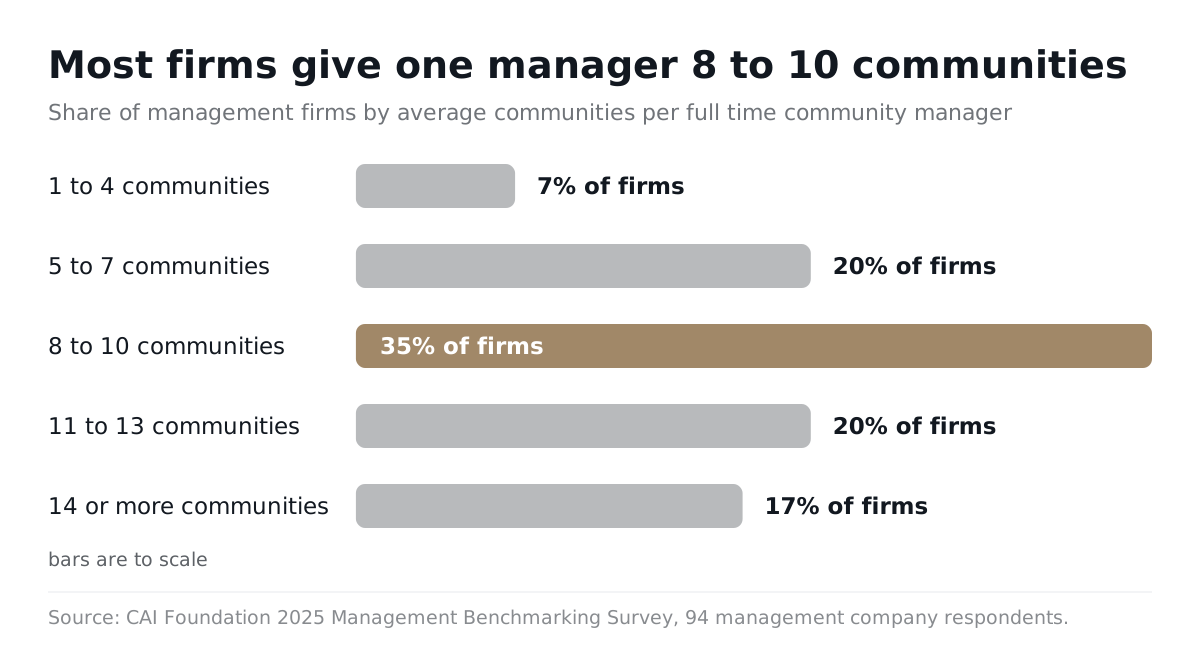
There is no single safe number, but the most common answer in association management is 8 to 10 communities per full time manager. That band comes from the Community Associations Institute Foundation's 2025 management benchmarking survey, which drew 94 management company respondents in October 2025.
The spread around that middle is wide:
- 35% of firms reported an average of 8 to 10 communities per full time community manager.
- 20% reported 5 to 7, and another 20% reported 11 to 13.
- 17% reported 14 or more.
- 7% reported 1 to 4.
Older New York numbers tell the same story. In a 2005 Cooperator article on caseloads, Deborah Gordon, director of operations at Kaled Management, put the average New York City manager at about seven buildings. In the same article, Albert Mayas of Charles H. Greenthal Management said a small boutique firm might have one or two senior people overseeing "up to 20 or 25 properties." He added that they had support staff behind them.
That last detail matters. A building count without the team behind it says very little.
Why does a building count alone mislead?
Because the count hides who else is doing the work. The same CAI survey measures support staff separately from managers, and the range is large.
- 25% of firms run 0.5 to 0.9 support staff per community manager.
- 22% run 1.5 or more.
- 20% run 0.1 to 0.4.
So a manager with 12 communities and two assistants is not the same job as a manager with 12 communities and nobody. Complexity matters too. A 300 unit tower with a pool, a garage, and a busy board is a different load than a quiet 40 unit building.
There are three different ratios floating around, and they get mixed up often:
| Ratio | What it counts | US reference point |
|---|---|---|
| Communities per manager | How many associations one manager is responsible for | 8 to 10 is the most common band (CAI, 2025) |
| Support staff per manager | Assistants and admin behind each manager | Ranges from under 0.5 to over 1.5 (CAI, 2025) |
| Units per employee | All staff spread across rental units | 45.3 units per full time employee (NAA, 2018 data) |
The last row comes from the National Apartment Association's staffing guide, which reported 45.3 units per full time employee in stabilized apartment communities of 50 units or more. That counts every employee, managers and everyone else. Read it as a staffing ratio. It does not tell you how many buildings one manager can carry.
What burns a property manager out?
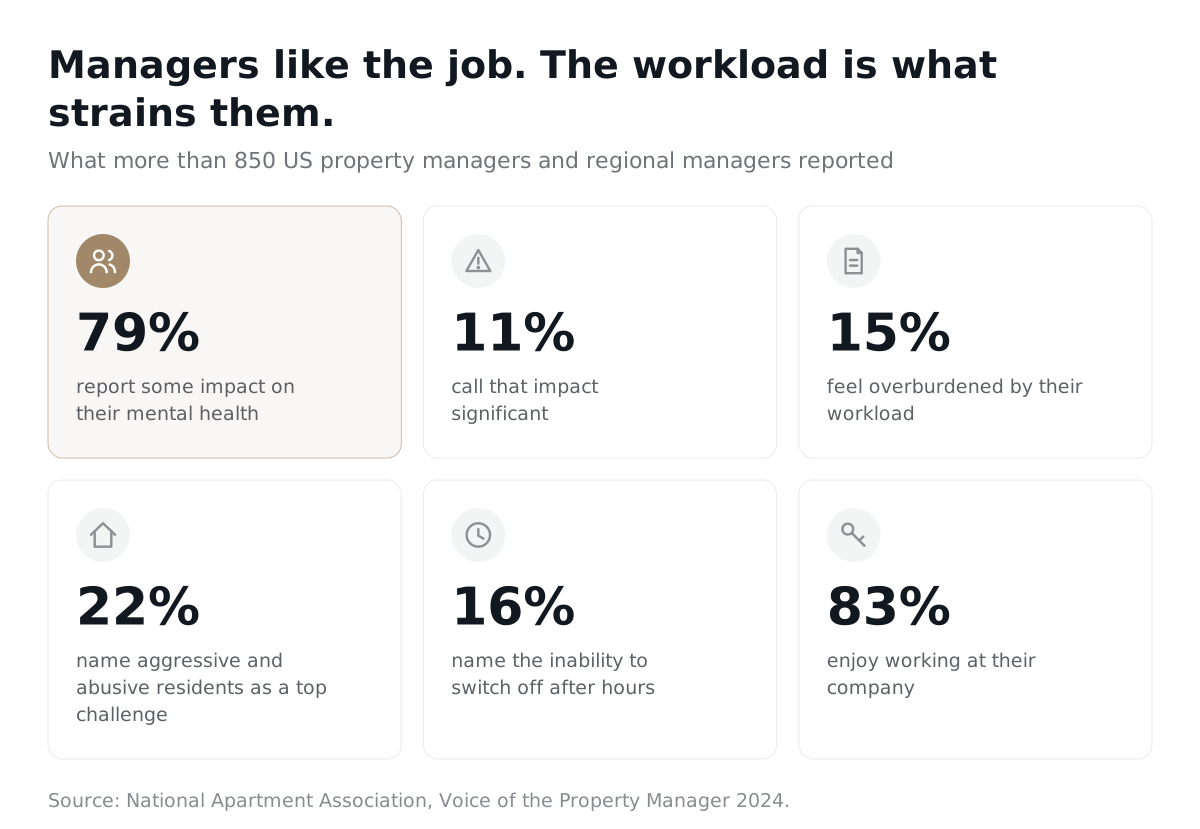
The volume of small, repeated work, plus the parts of the job that never switch off. The NAA Voice of the Property Manager 2024 report surveyed more than 850 US property managers and regional managers. Here is what they said:
- 79% reported some impact on their mental health, and 11% called it significant.
- 15% said they feel overburdened by their workload.
- 22% named aggressive and abusive residents and tenants as a top challenge.
- 16% named the inability to switch off after hours.
The same report has a fair counterpoint: 83% said they enjoy working at their company. People like the job. The strain comes from how the work arrives.
Hiring does not fix it quickly. In the CAI survey, 62% of firms named hiring and keeping managers as a top outside pressure, and 59% named board workload and expectations. When a seat stays empty, the rest of the team absorbs it. An NAA article on time to fill lists what follows: longer hours, more errors, and slower responses.
Turnover itself is lower than many people assume. 66% of firms in the CAI survey reported community manager turnover under 10% over the past year. So the bigger risk is the people who stay, carrying more each month.
Where does a small team's week actually go?
Most of it goes to answering, chasing, and retyping. Very little goes to the judgment calls only a manager can make.
The work that should stay human is clear. The 2025 IREM Jobs Analysis, built on responses from nearly 700 members, found that the top property operations task across all three of its certifications is the same one: investigating and resolving complaints about the property.
That is where a manager's best hours should go. Instead, a typical day for a small team looks like this:
- The same question about the gym hours, asked by phone, text, and email.
- A notice written once, then pasted into email, a lobby sign, and a group text.
- A package that sits for a week because nobody followed up.
- A repair request that lives in someone's inbox while the resident calls back twice.
- A colleague out sick, and nobody knows what she promised the resident in 412.
None of these is hard. Together they eat the week. They also scale with every building you add, which is why a small team hits a wall long before it runs out of skill.
What changes when the whole team works in one system?
The repeated work shrinks, and the knowledge stops living in one person's head. URBI puts every building, every resident conversation, and every request in one place, with AI that drafts and people who approve. Here is what that looks like day to day.
Who writes the building updates?
HERO drafts them, and a person approves them. HERO is URBI's AI for the management team. Ask it to write a water shutoff notice and it drafts the post. Nothing goes out until a person confirms. Once published, the post reaches residents in the app, by push notification, and by email at the same time. One post can go to several properties, each sent at its own local time.
Where does the team's memory live?
In logged notes and conversations, not in one person's head. Staff log typed notes against a unit, a person, or the property, and every concierge conversation is logged and searchable. HERO draws on those records when it answers a question, and it shows what it checked. When a colleague is out, the next person can see the history instead of guessing.
Who answers residents when the office is closed?
Arthur does, and it escalates what it does not know. Arthur is URBI's AI for residents. It answers by phone, text, email, and in app chat, in ten languages. On the Premium plan, it can book an amenity, open a service ticket, or register a guest's parking once the resident confirms. When it does not know an answer, it sends the question to the manager with a summary, relays the reply, and saves it so the next resident gets the answer right away. Arthur resolves up to 80% of inquiries.
What happens to packages, bookings, and service tickets?
They keep moving without someone chasing them.
- Packages: staff photograph the label and the AI scanner reads it. The resident is alerted, URBI sends reminders while the parcel waits, and it records who picked it up and when. More on this in our package room workflow guide.
- Bookings: residents book and pay for amenities in the app, with capacity limits, deposits, and cancellation rules applied the same way every time.
- Service tickets: requests come in with photos and move through clear stages. Vendors respond from an emailed link without needing a login, as covered in our guide to vendor management for property managers.
How does privacy hold across a portfolio?
Onsite staff see only their own property. Inside a property, role based permissions decide who can view or change each part of the system. A manager with many buildings gets one login across all of them, which our post on multi property management software explains in detail.
The Royal, a 250 unit building on URBI, saved more than 40 hours a month after moving its operations into the platform. That is one building. Multiply the same kind of time across a portfolio and the capacity math changes.
How did Key Condo win Property Manager of the Year with an extremely small team?
With every property on one system, which gave a small team room to carry a large portfolio. Key Condo is a small management group with an extremely small team. It runs 17 properties and more than 2,000 residents on URBI, with more than 100 resident touchpoints every day.
In 2025, Key Condo was named Property Manager of the Year. That award belongs to Key Condo and its people. URBI did not win it. What URBI gave them is capacity: room to operate about 20 buildings without burning out the team.
Look at that against the benchmarks above. The most common band in the CAI survey is 8 to 10 communities per full time manager. In the Cooperator example, a boutique firm overseeing 20 or more properties had support staff behind its senior people. Key Condo carries a portfolio close to that size with an extremely small team, and it won the year.
That is what one system is for. Less retyping, less chasing, fewer repeat answers. The hours that frees up belong to residents and boards.
How can a team tell if it has room for more buildings?
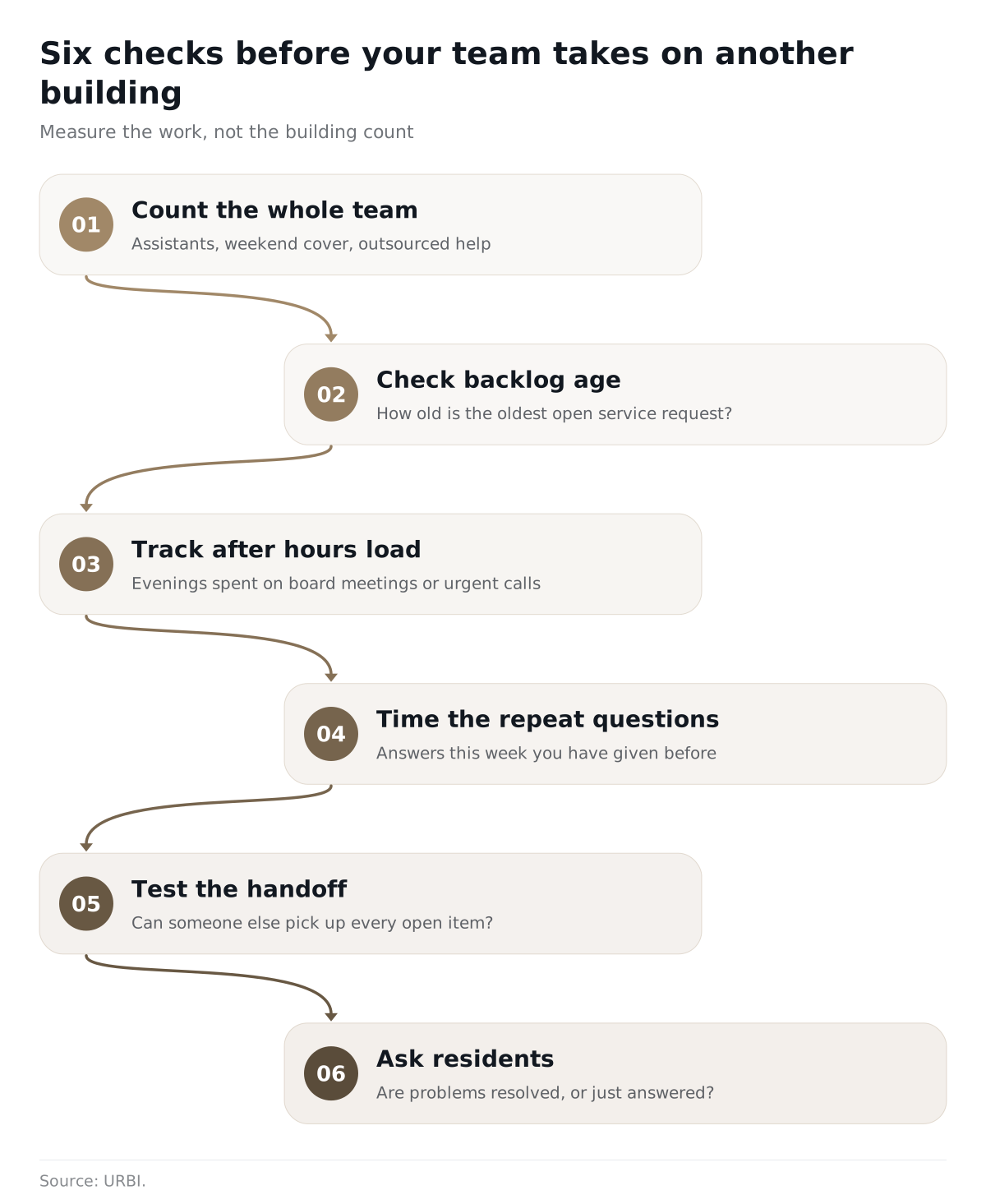
Measure the work, not the building count. Before you take on the next property, answer these questions honestly:
- Count the whole team. Include every assistant, the owner who covers on weekends, and any outsourced help. Compare it with the CAI support staff ranges.
- Check backlog age. How old is the oldest open service request? A growing backlog means the team is already full.
- Track after hours load. How many evenings a week go to board meetings or urgent calls?
- Time the repeat questions. How many resident questions this week were ones you have answered before?
- Test the handoff. If one person is out for a week, can someone else pick up every open item from the record?
- Ask residents. Are problems getting resolved, or just answered?
If the honest answers are bad, adding a building will make them worse. Fix the system first, then grow.
Does a smaller team mean worse service?
It does when the team is simply stretched. It does not when the repeated work is gone and people spend their time on the problems. The NAA time to fill article quotes Chris Simon, executive vice president at RADCO, on AI helping staff "work smarter, not harder." That is the right test for any tool.
So hold the line on two things. First, measure resolved problems, not fast replies. Second, keep people in charge of every action. In URBI, AI proposes and people approve, and you can read where we draw that line in our post on AI approval rules in property management. A small team that grows without those two rules ends up overloaded, whatever it calls itself.
FAQ
How many buildings should one community association manager handle?
The most common band in the 2025 CAI benchmarking survey is 8 to 10 communities per full time manager, but 17% of firms reported 14 or more. The right number depends on building size, amenities, board demands, and how much support staff sits behind each manager. Treat a high count with no support staff behind it as a warning sign.
Can software replace hiring another property manager?
Sometimes it can delay a hire, but that should not be the goal. The goal is to remove repeated work like retyping notices, chasing packages, and answering the same question again. When that work goes away, a small team can carry more buildings at the same service level. If problems stop getting resolved, you still need another person.
What should a board ask its management company about workload?
Ask how many buildings your manager handles, how many support staff sit behind them, and how old the oldest open request is. Ask who covers when your manager is out and whether that person can see the full history. A firm that can answer all four quickly usually runs on a single system. One that cannot is probably running on inboxes.
A small property management team does not need to be a stretched one. If you want to see how one system carries a whole portfolio, start with what URBI is, read URBI for residential buildings, or see how URBI compares in our guide to the best AI property management software. Then write to hello@myurbi.co with your portfolio size, and we will show you what your team's week looks like in URBI.


