



Unclaimed packages after the holidays need a written January cleanup policy: one hold period, a final notice, a return or disposal step, and a log of every decision. URBI logs each parcel on arrival, reminds residents while it waits, and records who picked it up and when.
This guide is about the leftovers. It is not about the December rush. If you are still planning for volume, start with how apartment buildings prepare for holiday delivery volume. If the rush is over and the shelves are still full, keep reading.
Why do packages pile up unclaimed in January?
Packages sit unclaimed in January because December puts a year of volume through the package room in a few weeks, and not every parcel has a resident who is coming to get it.
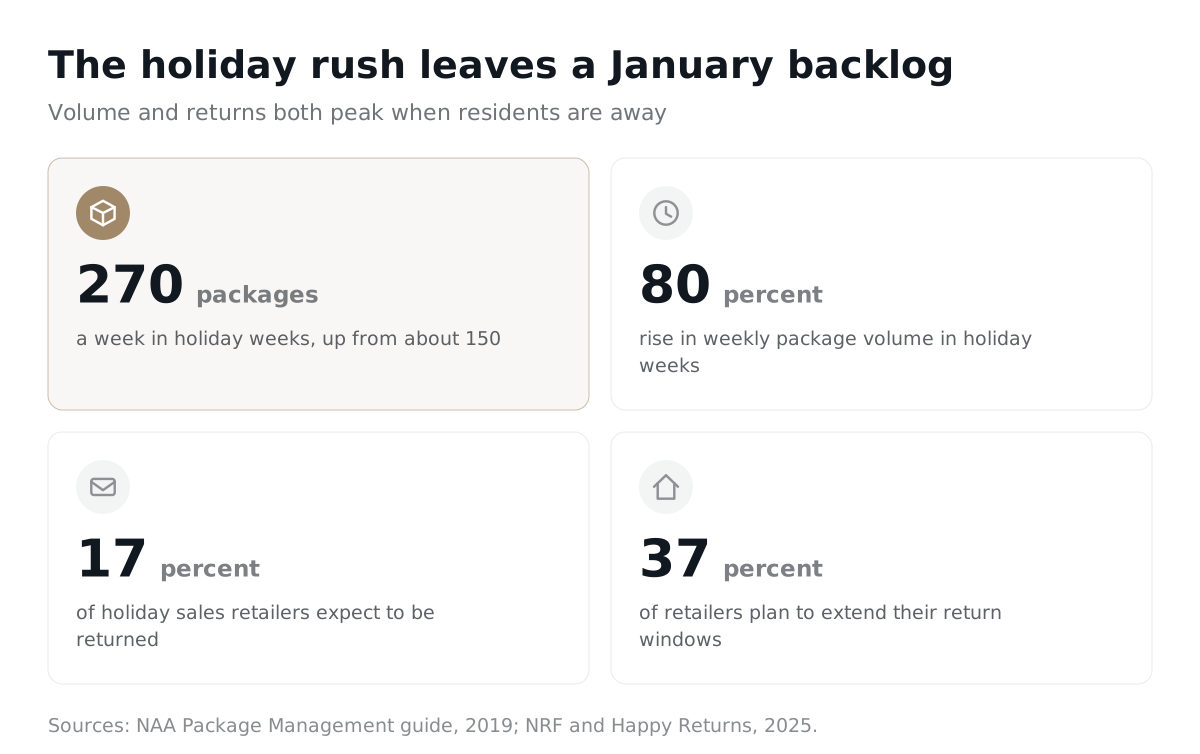
The National Apartment Association reported in 2019 that November and December account for almost 20 percent of a community's annual package volume. It put the average community at about 150 packages a week, rising to 270 in holiday weeks, an 80 percent increase. Those figures rest on package data that ends in 2018, so treat them as dated. Elie Rieder, founder and CEO of Castle Lanterra, told Multifamily Executive in November 2024, "Package delivery volume has doubled since last year."
The leftovers come from a handful of causes:
- Residents travel for the holidays and come back weeks later.
- Gifts arrive for guests and relatives who never had a unit in your building.
- Residents moved out in December and their orders kept arriving.
- Perishable food sat on a shelf while the recipient was away.
- Return parcels get left at the desk waiting for a carrier. The National Retail Federation and Happy Returns reported in 2025 that retailers expect 17 percent of holiday sales to be returned, and 37 percent plan to extend their return windows. That means January return traffic is real and it runs late.
Every one of these needs a different answer. A single "throw out anything old" rule fails on most of them.
How long should a building hold a package?
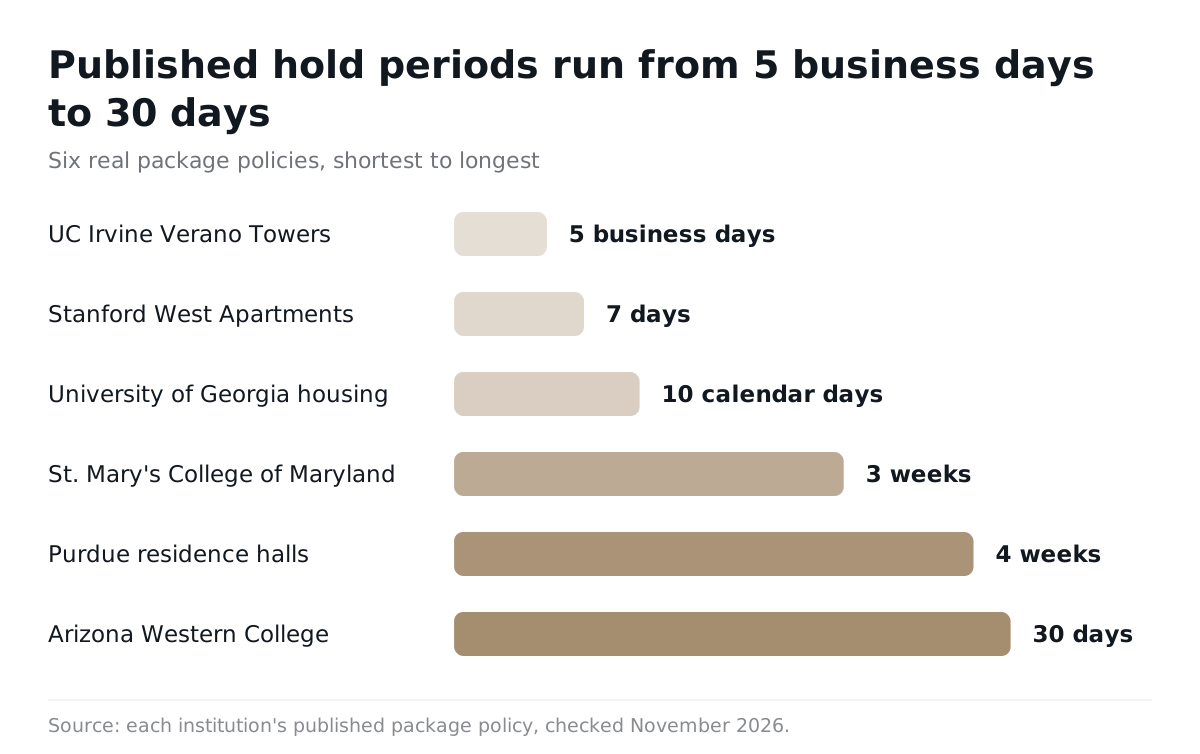
Most published policies hold a package between five business days and four weeks, and the length matters less than writing it down and starting the clock from a recorded notice.
The table below shows real policies. They come from universities and colleges, because those mailrooms publish their rules and apartment buildings mostly do not. They are institutional policies, not laws. Treat them as a range to choose from.
| Where | Hold period | What happens next |
|---|---|---|
| UC Irvine, Verano Towers student housing | 5 business days | Returned to the sender. Donated or destroyed if the sender refuses returns. |
| Stanford West Apartments | 7 days | Returned to the sender after the seventh day. Residents can ask for more time. |
| University of Georgia housing | 10 calendar days from the first notification | Treated as abandoned property on day 11 and logged. Returned if possible, donated if not. |
| St. Mary's College of Maryland | 3 weeks, and the clock does not pause for breaks | Donated or discarded when the carrier will not take the parcel back. |
| Arizona Western College | 30 days with three attempts to contact the recipient | Returned to the sender. |
| NJIT | 7 days in a locker, then 30 days at the mailroom | Abandoned after 30 days. Returned if free, otherwise held to the end of the semester, then disposed of or donated. |
| Purdue | 4 weeks at the university surplus store | Considered abandoned, then disposed of or sold. |
Sources: UC Irvine Verano Towers mail policy, Stanford West parcel pickup, University of Georgia unclaimed packages policy, St. Mary's College of Maryland package room policies, Arizona Western College unclaimed package handling, NJIT abandoned packages, and Purdue residence hall package process.
Two details are worth copying. Georgia counts from the first notification, not from the day the parcel arrived, so the resident always gets the full period after being told. St. Mary's does not pause the clock for breaks, which is the honest choice for a January cleanup. Pick your number, state it in the lease or house rules, and apply it the same way to everyone.
What does a January cleanup policy say, step by step?
A January cleanup policy says who counts the shelves, when, what each kind of leftover gets, who decides, and where the decision is recorded.
Copy the text below into your house rules or your staff procedure and fill in the blanks. For the daily routine around it, see the package room procedure template.
- Hold period. We hold each package for ______ days from the date of the first notice sent to the resident.
- Notices. The resident gets a notice on arrival, a reminder on day ______, and a final notice on day ______ that names the last pickup date.
- Extensions. A resident who will be away can ask for more time, in writing, before the final date. We grant up to ______ extra days.
- Clearing date. On ______ of each January, two team members count every package on the shelves and match it against the package log.
- Sorting. Each package is placed in one group: active resident, former resident, name does not match a unit, perishable, outgoing return, or oversized.
- Decision. After the final date, ______ (title) decides whether each package is returned to the sender, donated, or disposed of. The decision is written in the log with the date and the person's name.
- Not our responsibility. The building does not insure packages and is not responsible for items left past the final date. Residents are responsible for checking for their deliveries.
- Records. We keep the log, the notices and the decision record for ______ months.
Item 7 matters more than it looks. The Habitat Group, a publisher of apartment law guidance, describes a case where a resident's perishable package spoiled before pickup and she sued. According to attorney Robert P. Hein, a handbook statement that residents are responsible for checking for deliveries helped the owner escape liability. Write that sentence into your rules before you need it.
What do you do with each kind of leftover package?
Each kind of leftover gets its own next step, because the right answer for a package addressed to a resident is wrong for a package addressed to someone who left in December.
| Leftover | Next step | Why |
|---|---|---|
| Active resident, notices sent, not picked up | Send the final notice, then follow the decision step in your policy after the last pickup date. | The resident was told in writing and given the full period. |
| Former resident | Check the file for a forwarding address. If there is none, return to the sender using the label. Do not open it. | The package still belongs to someone. A return gives the buyer a chance at a refund. |
| Name does not match any unit | Check the guest and short stay records, ask the likely unit, then return to the sender after a shorter hold. | Nobody is going to ask for it. Holding it only uses space. |
| Perishable food | Handle the same day. Tell the resident, and never leave it on an open shelf. | Penn State Extension notes that shipped perishables arriving above 40 degrees Fahrenheit are at risk for spoilage and harmful bacteria. |
| Outgoing return left at the desk | Check the label and the carrier pickup date. Log it as outgoing. | Retail return windows run into January, so these arrive late. |
| Oversized | Notify first and release first. These take the most room per package. | One large parcel can block a shelf that holds ten small ones. |
Source for the perishable row: Penn State Extension on receiving home delivery meals.
Can a building return, donate or throw away an unclaimed package?
A building can follow the steps in its own written policy, but return to the sender is not always available, and a package is still someone's property until the policy and your local rules say otherwise.
Returning a parcel is the cleanest ending, and it is the first step in most of the policies above. It does not always work. St. Mary's College of Maryland says Amazon told it the carrier will not take packages back as return to sender, and that FedEx will not take them unless the recipient arranges a pickup. UC Irvine's policy says a package is donated or destroyed if the sender refuses returns. NJIT says it will not reimburse a recipient or shipper for abandoned packages that are discarded or donated.
So plan for the worst case. Decide in advance what happens when a carrier refuses a return. Name the charity, name the person who signs off, and write down the date. The University of Georgia treats a package as abandoned only after reasonable efforts to deliver it or to have it returned. Copy that order: tell the resident, try the return, then donate or dispose.
As of November 2026, the hold periods in this guide are examples from institutions, not rules set by a statute. Abandoned property rules differ by state and by lease. This is general information, not legal advice. Confirm the rules for your building with your attorney.
How do you warn residents before the shelf is cleared?
You warn residents with three notices on a fixed schedule, and the last one names a date and says what happens to the package after it.
- Notice one, on arrival. It says the package is here and where to get it.
- Notice two, a reminder. It goes out partway through the hold period.
- Notice three, the final notice. It names the last pickup date and the next step, and says how to ask for more time.
Here is a final notice you can copy:
Hello ______, a package addressed to unit ______ has been in the package room since ______. Under the building's package policy, the last pickup date is ______. After that date the package is returned to the sender, or donated if it cannot be returned. If you will be away, reply before ______ and we will hold it until ______. Questions: ______.
Notices are easy to miss, so use more than one channel and keep the wording short. The post on apartment package notification systems covers what happens when a resident does not pick up after the first alert. A separate notice for the whole building, such as a reminder that January cleanup is coming, helps too. The package room rules notice for residents is built for that.
How does URBI help with the cleanup?
URBI helps by keeping the record the cleanup depends on: what arrived, when, who was told, and who picked it up. The decision to return or dispose of a package stays with your team.
- Logged on arrival. Staff log each package with a photo, and the resident gets a push alert immediately. The AI scanner can read the tracking number, carrier and recipient unit from the shipping label, and a team member confirms before it posts.
- Reminders while it waits. URBI sends reminders while a parcel waits, so notice two does not depend on someone remembering.
- A pickup record. URBI records who picked up each parcel and when. That record settles most "I never got it" disputes.
- Smart lockers for small parcels. URBI integrates with smart locker systems, so small packages can go to residents without passing through the desk.
- A package tab on every unit. In URBI Kore, each unit profile has a package tab, so staff can see a unit's packages next to its residents and notes.
- The final notice. A news post can go to specific units in the app, by push and by email at the same time. Each post keeps its publish date and audience on the record. URBI does not record who saw a post, so your pickup record and your dated notices are the proof. HERO, the AI inside Kore, can draft the notice. A person reviews and confirms it before anything goes out.
For how the package room fits into the rest of a building's operations, see the package room workflow guide and the complete residential guide. If you are new to the platform, what URBI is is the short version.
What should the package log show during a cleanup?
The log should show the date and time each package arrived, the recipient and unit, the sender, the tracking number if there is one, and the date and name of whoever released it. The Habitat Group's guidance asks for exactly those entries, plus a signature from the resident at pickup.
During a cleanup, add three more: the notice dates, the extension if one was granted, and the final decision with the name of the person who made it. When a resident comes back in February asking about a package, you can answer in one minute. A crowded shelf is also a theft risk. Security.org's package theft report, updated in October 2026, found apartment residents were more than three times as likely as single family home residents to have a package stolen in the past three months (10 percent versus 3 percent). See who is liable for stolen packages in an apartment building for the liability side.
FAQ
How long should apartment buildings hold packages?
Published policies range from five business days to four weeks. For a building with an attended package room, seven to fourteen days is a reasonable choice. Start the clock at the first notice, tell residents the number in writing, and allow extensions for people who are away. Whatever you pick, apply it to everyone.
Can a building throw away unclaimed packages?
Only after a written policy has been followed. Notify the resident, try to return the package to the sender, and then donate or dispose of it, recording each step. Rules about abandoned property differ by state and lease. Confirm the rules for your building with your attorney before you discard anything.
What about packages for residents who moved out?
Check the resident file for a forwarding address and tell the resident if you have a way to reach them. If you do not, return the package to the sender using the label. Do not open it. Record the date and the person who handled it.
Next step
A January cleanup is easy when the record is already there. To see how URBI logs, reminds and records pickups for your building, email hello@myurbi.co or book a demo.


