



A package acceptance policy is a written rule for what your front desk signs for, what it turns away, and who carries the risk for each. URBI, the building operations platform, logs every package your team does accept. This guide gives you the lists and the policy text.
The legal points are general and current as of November 2026. This is general information, not legal advice. Confirm the rules for your building with your attorney.
Does a building have to accept packages at all?
A building can choose not to act as a receiving station, and some have stopped. A Florida condo law firm writes that no Florida statute gives an owner a right to door delivery. It adds that what an association owes owners depends on its governing documents and on reasonable rules. Check your own documents and state law.
Camden Property Trust is a well known example of a refusal. In 2015 it stopped taking packages in the leasing offices of its 14 North Texas locations. It told residents 30 days ahead, and carriers could still leave parcels at doorsteps.
Refusing has costs, and the National Apartment Association (NAA) lists them in its 2019 package acceptance guide:
- Residents may push back, so explain the rule during leasing.
- Negative online reviews can follow a no delivery policy.
- Carriers may not honor your refusal.
- Parcels left in hallways or lobbies can be stolen, and that raises its own liability question.
The same law firm adds one more limit. A resident with a disability who depends on deliveries may be able to ask for a reasonable accommodation under the Fair Housing Act, so talk to counsel before you write a flat ban.
Accepting packages is a choice. Once you make it, "accept everything" is not a policy.
Why does a package acceptance policy matter?
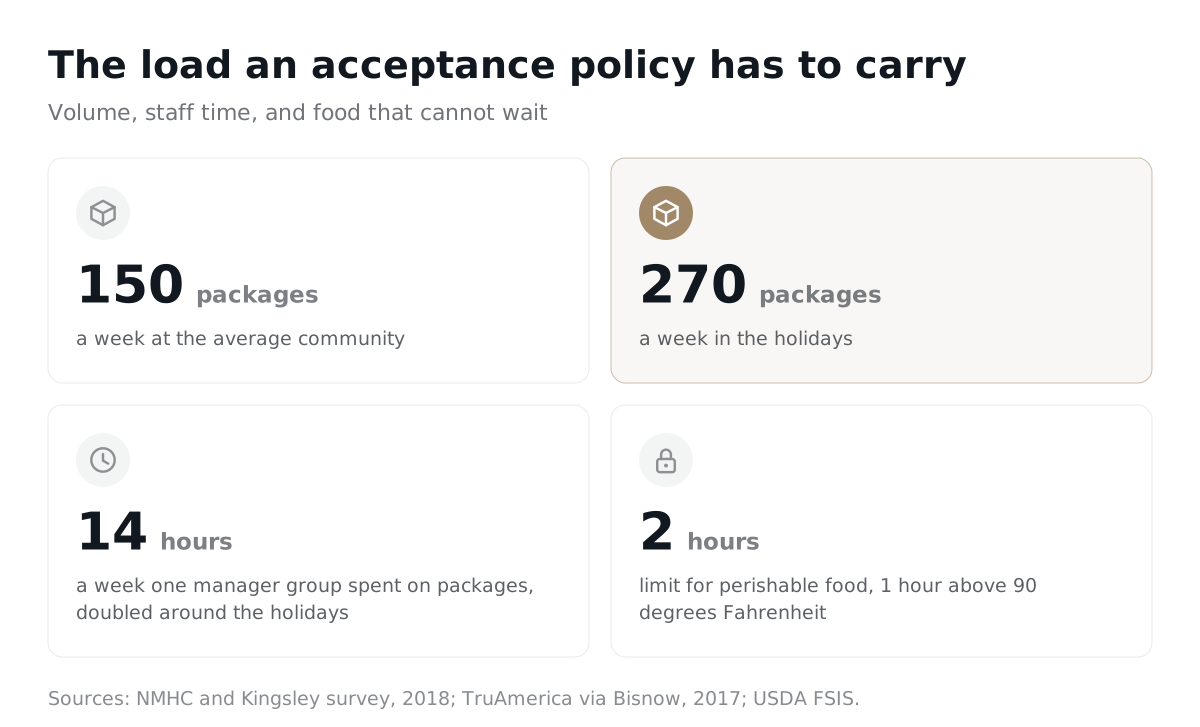
It matters because volume turns every judgment call into a daily argument at the desk. A 2018 survey by the National Multifamily Housing Council and Kingsley Associates covered 2,098 communities and 543,900 units. The average community received nearly 150 packages a week and about 270 a week in the holidays.
The same survey found that more than one third of managers said their package storage was not adequate at high volume. Residents were ordering heavy, oversized and perishable items.
Time is the other cost. TruAmerica Multifamily found its building managers spent 14 hours a week handling packages, and that doubled around the holidays. Its chief operations officer, Lynn Owen, told Bisnow in 2017 that package handling took a large amount of time away from leasing.
These figures are a few years old, so count your own. A written policy ends the case by case debates. This post sets the rule. For the daily steps once a parcel is on the shelf, use the package room procedure template.
Which deliveries should the front desk accept, accept with conditions, or refuse?
Sort every delivery into one of three groups: accept, accept with a condition, or refuse. This table is a starting point you can adjust to your building.
| Delivery | Decision | Why |
|---|---|---|
| Standard parcel or envelope for a current resident, within your size and weight limit | Accept | This is the service you promised. Photograph the label and log it. |
| Package for a resident's named guest or short term occupant | Accept | NAA advises treating it like a resident's package, and calling the leaseholder when you cannot reach the guest. |
| Package that arrives crushed, wet or opened | Accept, with a note | Photograph it and write the condition down before it becomes your problem. |
| Food, medication or anything that needs cold storage | Accept only on a condition | It needs a cold place, a short hold and an immediate notice. If you have none of those, refuse it. |
| Alcohol | Refuse by default | FedEx ties alcohol delivery to an adult recipient with ID. A desk clerk cannot run that check without the recipient in front of them. |
| Item over your size or weight limit | Refuse | It will not fit the shelf, and heavy items are a lifting risk for staff. |
| Package that is leaking, lopsided, unusually heavy for its size, or has no return address | Refuse, do not handle, call the carrier or the postal inspectors | These are the signs the Postal Service tells people to watch for. |
| Package for someone who does not live in the building | Refuse | Nobody can collect it, and it fills the shelf for weeks. |
Pick the size and weight limits yourself and write the numbers into the policy. Put them in your house rules or lease so residents agreed to them before the first delivery.
The size limit matters. At a Virginia Tech area apartment building, a carrier once walked in with a full size kayak. It was still in the front office three weeks later, waiting for a student who had left for winter break.
What does signing for a package make the building responsible for?
Signing can make the building the holder of someone else's property, with a duty to look after it. A court in Washington, D.C. said so in 1985, in Bernstein v. Noble, 487 A.2d 231.
The facts were ordinary. A UPS driver delivered a stereo tuner to an apartment building. The receptionist signed for it and put it on a shelf in a small room next to her desk, where tenant packages were kept. She routinely accepted packages for tenants. The tuner disappeared.
The lease said landlord employees were not to store or handle articles in storage rooms, and that an employee who did so at a tenant's request acted as the tenant's agent. The court still upheld a finding that the landlords were liable. It also said a landlord can sit in two roles at once, as landlord and as bailee. A bailee is someone who holds another person's property for them.
This is one court in one jurisdiction, and the rules differ by state. The pattern is still worth learning. A clause in a lease does not protect you when your staff do the opposite every day.
Here is what that means for your policy:
- Write the policy to match what your staff really do. Then train to it.
- Sign for the number of packages, not the contents. Contents are unknown to you.
- Log every package in and out. NAA recommends this, and it recommends staff be present when a resident signs for a pickup.
- Keep a waiver of liability for new residents to sign at move in, as NAA suggests. Treat it as one layer of protection, not a shield.
- Do not accept what you cannot keep safe.
- Ask your insurer whether holding residents' packages is covered.
For the wider question of who pays when a parcel is stolen, read who is liable for stolen packages in an apartment building.
How should staff handle alcohol, signature items and perishables?
Staff should handle them by a rule that is written down in advance, because each one has a clock or an age check attached.
Alcohol. FedEx requires an adult signature for final delivery of alcohol. Its page says the shipment will not be delivered when the recipient is not 21 or older, has no acceptable ID, or shows signs of intoxication. The Postal Service goes further: beer, wine and liquor may not be sent through the mail except in limited circumstances. So the alcohol that reaches your desk mostly arrives by private carrier, and the carrier's age check is built around the recipient. If you choose to accept it, hand it only to the named resident, in person, with ID checked and logged. Most buildings will find refusing simpler.
Food and medication. The USDA tells people to refrigerate perishable food within 2 hours, or within 1 hour when it is above 90 degrees Fahrenheit. A package room is not a refrigerator. In the Bisnow story, a gift of steaks sat through a resident's multi week vacation and the smell filled the package room. NAA notes that medication and medical supply deliveries need special care too. Accept these only when you have cold storage and can notify the resident at once. The full food rule is in the guide to grocery and perishable deliveries.
Suspicious packages. The Postal Service lists packages sent unexpectedly, with no return address, lopsided, unusually heavy for the size, or leaking an unknown substance as warning signs. Do not sign for these. Do not open them. Call the carrier, and call the Postal Inspection Service if you think there is a threat.
How does the desk refuse a package without a fight?
The desk refuses before it signs, never after. Use the same five steps every time:
- Do not sign. Give the carrier one sentence from the policy, such as "we do not accept packages over the size limit."
- Ask the carrier to try the unit door, hold the package at a pickup location, or return it to the sender.
- Photograph the label if you can. Write down the carrier, the time and the unit.
- Tell the resident the same day, and tell them what to do next.
- If the carrier leaves the package anyway, log it and tell the resident. It is now sitting in your lobby.
Carriers do not always follow a refusal. NAA asks building teams to decide in advance what steps to take if they do not. Our post on delivery drivers ignoring the package room covers the fixes that work.
Residents should hear about the policy before their first refusal. Put it in the leasing packet and the handbook, and post it when it changes.
What does a package acceptance policy look like in writing?
It looks like a one page document with nine short parts. Copy the text below and fill in the blanks. Have your attorney review the liability part.
Package Acceptance Policy for ______ (building name). Effective ______.
- What we accept. The front desk accepts parcels and envelopes addressed to a current resident of ______, up to ______ pounds and ______ inches on the longest side. We also accept packages for a resident's named guest.
- What we accept on conditions. Food and medication are accepted only when the resident has arranged it with the desk ahead of time. They are held in ______ (cold storage location) for no more than ______ hours. Damaged packages are accepted, photographed and noted.
- What we do not accept. Alcohol. Items over the size or weight limit. Packages for people who do not live here. Any package that is leaking, unusually heavy for its size, or missing a return address.
- How we sign. We sign for the number of packages received. We do not check or guarantee the contents.
- How long we hold. Packages are held for ______ days. After that they go back to the sender. Residents get a notice on arrival and another after ______ days.
- Pickup. Residents collect with ______ (ID or pickup code). Staff record who collected the package and when.
- Liability. Residents who use the package service sign the acceptance waiver at move in. The building is not responsible for loss, damage or theft beyond what the law requires. ______ (attorney reviewed wording).
- Refusals. When we refuse a package, we tell the carrier why, note it in the log, and tell the resident the same day.
- Changes. We give residents ______ days notice before this policy changes.
How does URBI help the desk follow the policy?
URBI gives the desk a clean record of every package it accepts, and of every package it hands over. Your policy decides what to accept. URBI does not make that call for you. Packages are part of URBI Kore, the staff dashboard.
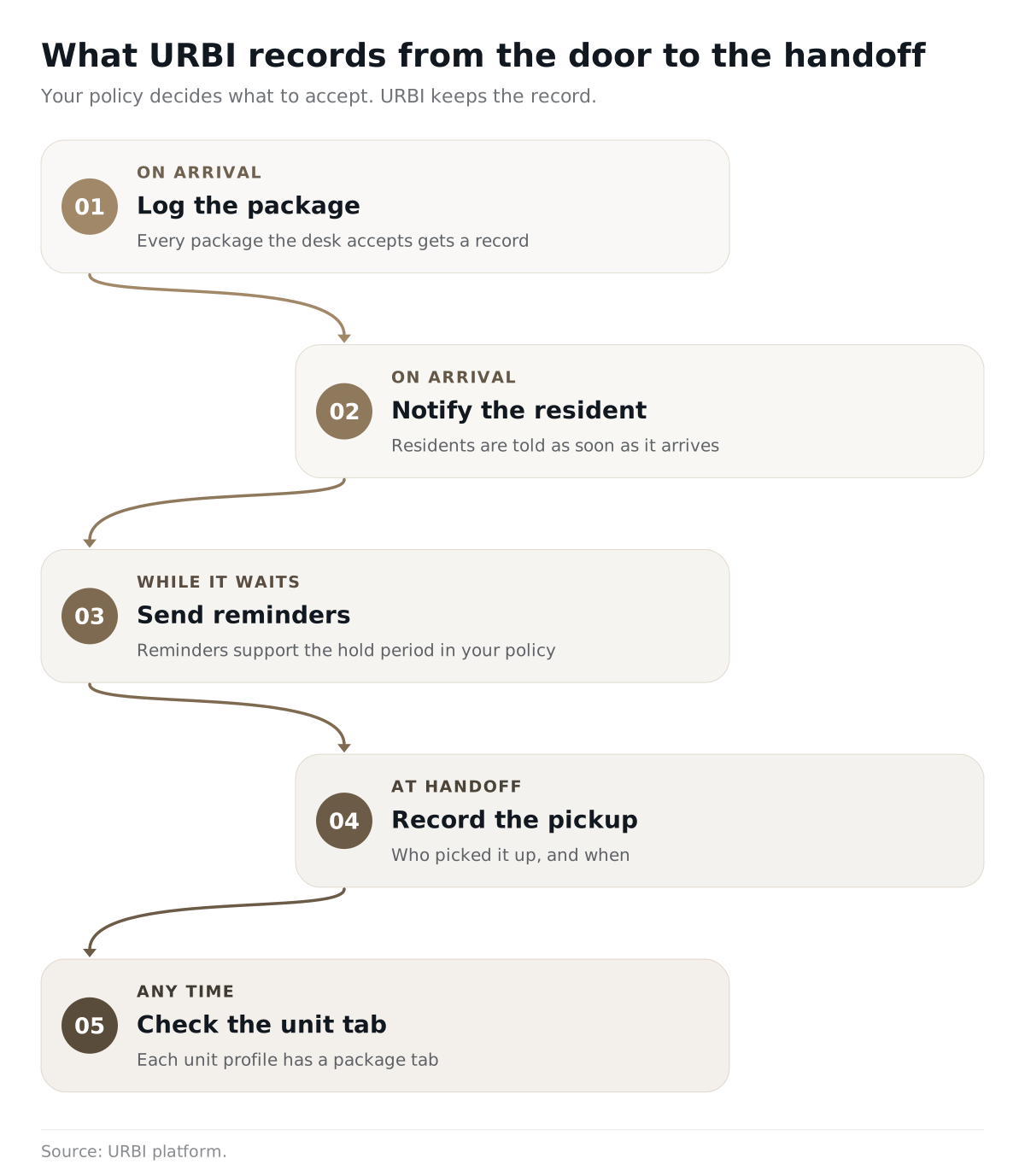
- Staff photograph the shipping label. The AI scanner reads the tracking number, the carrier and the unit, and a team member confirms before the package is posted.
- Smart locker integration handles small parcels. Residents pick those up directly.
- Residents are notified on arrival. URBI sends reminders while a parcel waits, which supports the hold period in your policy. See how residents get told for the details.
- URBI records who picked up each parcel and when. Each unit profile has a package tab.
- Refusals can be written up as typed notes on the unit, so the next person on shift sees what happened.
- When the policy changes, publish it as a news post. It goes out in the app, by push and by email at the same time, to the whole building or to chosen units.
For shelf location and aging reports, see package room inventory software. For a view of the whole platform, read about URBI for residential buildings.
FAQ
Should residents sign a waiver before the desk accepts packages?
NAA suggests keeping a waiver of liability form for new residents to sign at move in. Treat it as one layer. In Bernstein v. Noble, lease language did not save the landlords. Have your attorney write the waiver for your state, and keep logging every package in and out.
What if the carrier insists the desk sign anyway?
Carriers choose where to leave a parcel. You choose whether to sign. Give the policy reason in one sentence, ask for a doorstep attempt or a return, and log the refusal. If one carrier keeps ignoring you, raise it with the carrier's local contact and your property manager, with your log as proof.
How long should the building hold a package?
NAA advises telling residents that packages return to the sender if they are not collected within a period you set, and saying so in the arrival notice. The number is yours. Pick one your storage can carry after the holidays, write it into the policy, and send the reminders on schedule.
Ready to run a package acceptance policy with a clean log behind it? Email hello@myurbi.co or book a demo, and we will show you how the desk works in URBI.


