



Grocery and perishable deliveries in apartment buildings need a written rule, because food has a clock and a parcel does not. Choose one of three paths: accept and chill, accept briefly, or refuse. Then log every handoff. URBI, the building operations platform, supplies the log and the notice.
This guide covers the food safety clock, the three policies, what a storage rule should say, who is liable when groceries spoil, and a rule you can paste into your own package policy. The legal part is general and varies by state, so read it with your attorney.
Why do grocery deliveries break the normal package rules?
Groceries break the normal rules because a box can wait on a shelf for days, but a bag of chicken and yogurt cannot. Your package room was built for the first kind of item.
Three things make groceries different from a parcel:
- They spoil. The clock starts when the driver leaves the bag, not when your team logs it.
- They are bulky and loose. Bags tip, leak and do not fit a standard parcel shelf.
- They are urgent to the resident. Someone who ordered milk wants it in minutes, not tomorrow.
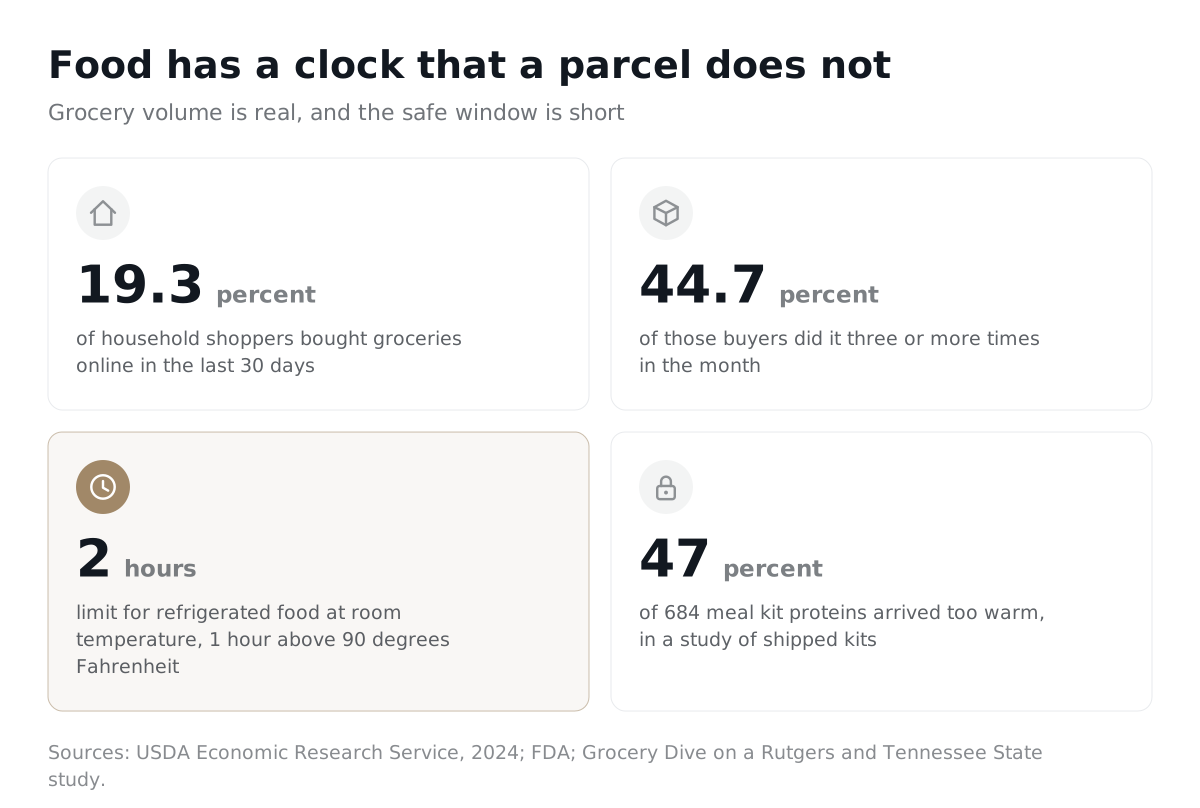
The volume is real. The USDA Economic Research Service reports that 19.3 percent of people who usually shop for their household bought groceries online at least once in the last 30 days, based on its 2022 to 2023 survey data. Of those buyers, 44.7 percent did it three or more times in the month. In a tower of several hundred homes, that is a steady stream of bags at your door.
The National Apartment Association has flagged the same trouble. Its package management guide says storage is getting harder because residents order perishable goods such as food and medications that need temperature controlled storage. The same guide counted nearly 150 packages a week at the average community, rising to 270 a week in the holidays. Groceries ride on top of that volume.
How long can groceries wait before they are unsafe?
Refrigerated groceries should not sit at room temperature for more than 2 hours, or one hour when the air is above 90 °F. That is the FDA's consumer guidance, and it is the number your policy should be built around.
The FDA page on refrigerator thermometers gives three facts worth printing on your staff card:
- Raw meat, poultry, seafood, eggs and produce that needs refrigeration should not sit out more than 2 hours.
- The limit drops to one hour if the air temperature is above 90 °F.
- Bacteria that cause foodborne illness can double every 20 minutes at room temperature, and a refrigerator should hold 40 °F or below.
Your lobby on a July afternoon, or a package room next to a loading dock, can pass 90 °F without anyone noticing. In winter the risk flips, because a bag left outside can freeze.
One more point. The clock may already be running when the bag arrives. A study of meal kit providers by Rutgers and Tennessee State University, as reported by Grocery Dive, found that nearly half (47 percent) of 684 proteins arrived at temperatures too high for consumption. That study looked at shipped meal kits, not store orders, but it shows why a staff member should feel the bag at handoff and not assume it is cold.
This is why the hold time in your rule should be short and written down. It is also why "the front desk will keep it until you get home" is a promise most buildings should not make.
Which grocery policy should a building choose?
A building has three honest choices: accept and refrigerate, accept for a short window, or refuse and redirect. Each one is defensible. What is not defensible is having no rule and letting each shift decide.
| Policy | What staff do | Main risk | Fits best |
|---|---|---|---|
| Accept and refrigerate | Take the bag, label it with the unit, put it in a cooled space, notify the resident right away | Your building now holds food, so storage space, cleaning and spoilage become your job | Staffed buildings with a real cooled space and a 24 hour desk |
| Accept for a short window | Take the bag only while staff are at the desk, hold it for a stated number of minutes, then return it to the doorstep or discard it | Residents forget the window; staff face awkward conversations | Buildings with a desk but no cold storage |
| Refuse and redirect | Do not accept food; residents meet the driver in the lobby or use a pickup option | Drivers leave bags anyway; residents feel the building is unhelpful | Buildings with no desk, tight space or no staff overnight |
Refusing is a real policy and some institutions use it. One university housing office states in its written policy that food or grocery deliveries will not be accepted at the front desk because of space limits and food storage restrictions, and that it is not liable for lost, stolen or damaged food orders. That is a student housing example, so a condo or rental tower may want a softer line. But it shows the logic: if you cannot store food safely, do not take custody of it.
If you accept groceries, say so in the same document that covers every other delivery. The package acceptance policy is the right home for this choice.
What should a perishable storage rule say?
A good perishable rule answers seven questions in plain words, so a new desk hire can follow it on the first night. Write each answer as one short sentence.
- What counts as perishable? Name it: anything cold or frozen, hot food, cut flowers, and medications marked refrigerate on the label.
- Where do these items go? Pick one place, such as a labeled fridge, and say that perishables never go on the general package shelf.
- How long will staff hold them? Set a number. Because of the FDA limit, a short window measured in minutes or a couple of hours is safer than a vague promise.
- How are they labeled? Unit number and the time the bag was logged, on a tag or sticker.
- What happens to a leaking or warm bag? Staff do not open bags. A leaking or clearly warm item is set aside and the resident is told.
- When can staff discard? State the point at which food is thrown out, and who decides.
- What does the resident agree to? The building is helping as a courtesy, and the resident should pick up promptly.
Two small additions save arguments. First, tell residents to put a phone number and unit on the order, and to choose a drop off note such as "hand to front desk" so drivers do not leave bags outside. Second, make the staff check a habit: touch the bag, note if it feels warm, and tell the resident at the moment of notice.
Avoid promises the building cannot keep. Do not write "all items will be kept fresh" or "the building guarantees food quality." You cannot see inside a delivery bag, and your cold storage is not a commercial kitchen. Local health rules may also apply to how food is held, so ask your attorney or local health department if you plan a shared fridge.
Who is liable when groceries spoil?
Liability depends on your state and on whether the building took custody of the food. In general, the more your building acts like it is holding the bag, the more care a court may expect from you. This is general information, not legal advice.
The legal idea behind this is called bailment. Cornell's Legal Information Institute defines a bailment as a transfer of possession without a transfer of ownership. The person who hands over the item is the bailor and the person who receives it is the bailee. When a doorman takes a bag, the building is arguably a bailee.
How much care a bailee owes is where it gets messy. An open law textbook from Saylor Academy explains that, under the rule most courts use, if the bailment is only for the owner's benefit, the bailee owes a slight duty of care. The same text notes that courts split on whether a free service counts that way or whether the holder gets a commercial benefit. Many buildings offer package holding free, but some buildings gain from it, for example in the way it keeps the lobby clear. A court may weigh that.
As of November 2026, the answer to a spoiled grocery claim usually comes from state law and your own governing documents, not from one national rule. Practical steps help in any state:
- Write the policy and give it to every resident. A clear written rule shows what the building did and did not promise.
- Log each handoff. The NAA guide advises staff to protect the company and residents by logging all received and delivered packages for future reference, with staff present when residents sign.
- Consider a waiver. The same NAA guide suggests managers consider a waiver of liability form for new residents to sign at move in, and includes a sample. Whether a waiver holds up depends on your state, so your attorney should review it.
- Check insurance. Ask your broker whether the building's policy covers goods held for residents. Do not assume it does.
- Keep the record of discard decisions. If staff throw out spoiled food, write down who decided, what it was and when.
Our companion piece on who is liable for stolen packages in an apartment building covers theft and missing parcels. This guide is about spoilage, where the clock rather than a thief causes the loss.
This is general information, not legal advice. Confirm the rules for your building with your attorney.
What does a ready to paste perishable rule look like?
Here is a short rule you can copy into your package policy. Fill the blanks, then have your attorney review it. It is written for the accept for a short window option, and you can change the verbs for the other two.
Grocery and perishable deliveries
1. Perishable items include cold or frozen food, hot food, fresh flowers, and medications that must be refrigerated.
2. Our team may accept perishable items as a courtesy during staffed hours, ______ to ______.
3. Perishable items are tagged with your unit number and the time they were logged, and stored in ______.
4. We will notify you as soon as an item is logged. Please collect it within ______ minutes.
5. After ______ minutes, we may return the item to the entrance or discard it if it appears unsafe. Team members do not open delivery bags.
6. The building does not guarantee the condition or temperature of any delivery.
7. For after hours deliveries, please use ______ or arrange to meet your driver in the lobby.
Point 6 is the one to run past counsel. Wording about disclaiming responsibility varies by state, and some places limit what a building can disclaim.
How does URBI help with grocery deliveries?
URBI helps by giving your team a clean package log, instant resident notice and a record of who collected what and when. It does not keep food cold. The rule above and your storage space do that.
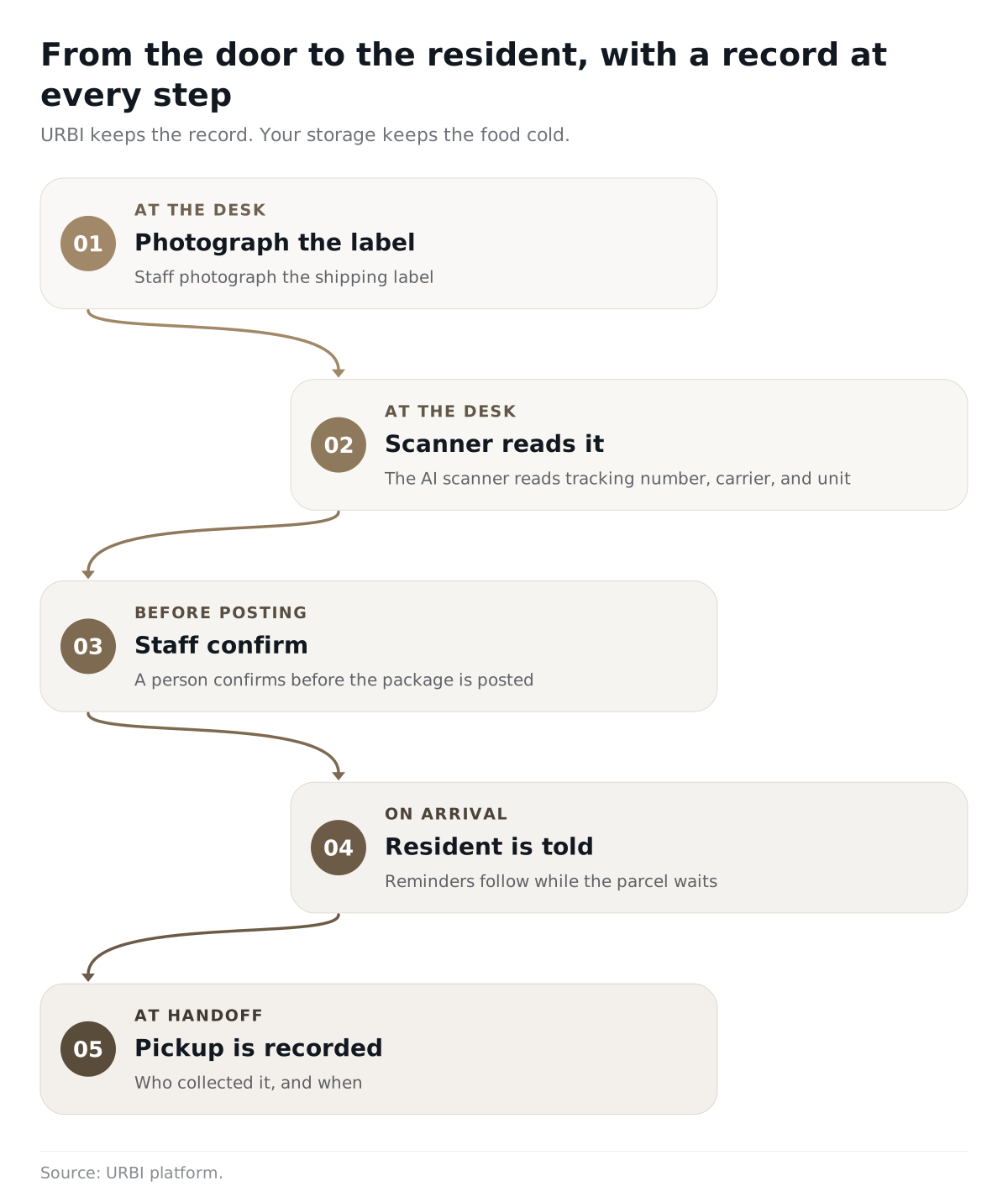
Here is what URBI Kore, the staff and board dashboard, does for packages:
- Staff photograph the shipping label, and the AI scanner reads the tracking number, carrier and recipient unit for staff to confirm before the package is posted.
- Residents are notified when a package arrives, so a bag of groceries does not sit while someone checks their email.
- URBI sends reminders while a parcel waits, which helps when your rule gives a short window.
- URBI records who picked up each parcel and when, which is the handoff record the NAA guide recommends.
- A per unit package tab shows what is waiting for each home.
- Smart locker integration covers small parcels, so the front desk is not holding every box.
If your team has to discard a spoiled item, a note on the unit profile is a simple record. URBI supports typed notes, including an incident type, that can be tagged to a unit. Your package room procedure template can point to that step.
Communication matters as much as logging. A rule nobody reads does not protect anyone. When you adopt or change a grocery rule, tell residents in the app, by push and by email at the same time with a news post. That post goes to the whole building or to chosen units. URBI does not track who has read a post, so keep the policy in your resident handbook as well. Our piece on how residents get told about packages goes deeper on notices.
For the bigger picture, see package room workflow for buildings and what package handling costs a front desk. If you want the overview of the platform, start with what URBI is and the residential buildings guide.
FAQ
Can an apartment building refuse grocery deliveries?
In many places, yes. Many buildings choose not to accept food because they lack cold storage or overnight staff. If you refuse, write it into your package policy, tell residents how to arrange pickup, and post a notice at the entrance for drivers. State rules vary, so confirm with your attorney.
Can the front desk throw out spoiled groceries?
Only if your written rule says staff may. Put the discard point in the policy, such as a set number of minutes after notice, or when an item is leaking or clearly unsafe. Record who decided and what was thrown out. Without a written rule, discarding someone's food can start a dispute.
How long can staff hold refrigerated groceries?
Keep it short. The FDA says refrigerated food should not sit at room temperature more than 2 hours, or one hour above 90 °F. Count from the time the driver left the bag, which staff may not know. A window of well under two hours is the safer rule.
If you want help turning your grocery rule into a logged, notified and trackable workflow, email hello@myurbi.co or book a demo. We will show you how URBI handles packages from the door to the resident.


