



An AI concierge for condos answers the routine questions at the front desk, does the simple tasks, and passes everything else to your team. URBI's Arthur works by voice, SMS, email and in app chat. People stay in charge of security, emergencies, judgment and conflict.
What does an AI concierge actually do at a condo front desk?
It takes the repeat requests so the people at the desk can spend their time on the ones that need a person. In URBI, that job belongs to Arthur, the resident facing AI inside URBI AI.
Think about a normal week at the desk. The same questions come in again and again. Can I book the party room? Can my sister park on Saturday? Who do I call about a leak? Where is the form for moving my furniture? The answers rarely change, which is why a machine can take them.
Arthur takes those requests on four channels: voice calls, SMS, email and in app chat. Everything lands on one dashboard, so the team sees the whole picture and does not have to chase four inboxes. Arthur resolves up to 80% of inquiries. "Up to" matters. That is the top of the range, and your building's mix of questions decides where you land.
Arthur does not replace the concierge. It works the way a very patient new hire would on the first day: it handles the standard questions, and it knows when to go and find a person.
Which front desk jobs can Arthur do, and which stay with a person?
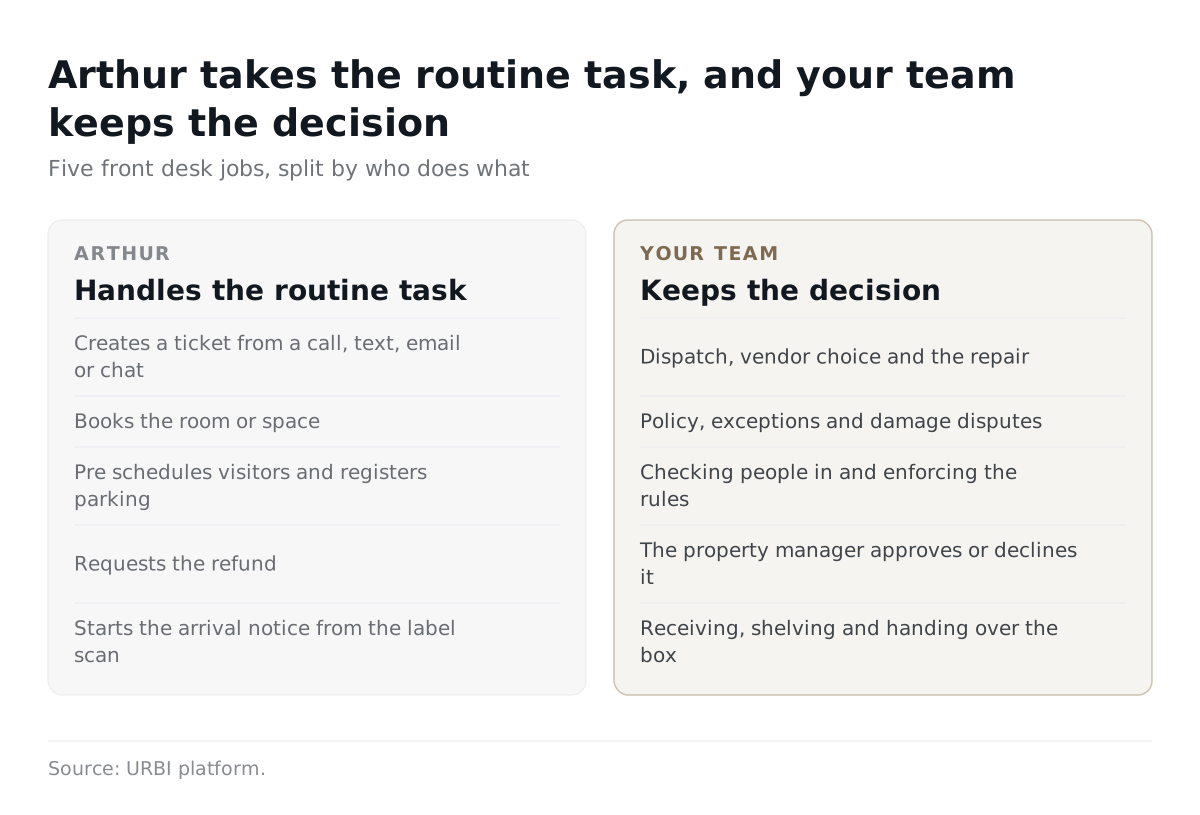
Arthur can do the jobs that follow a clear rule. A person keeps every job that needs a decision, a signature or a physical presence. This table shows the split.
| Front desk job | What Arthur does | What stays with your team |
|---|---|---|
| Questions about rules, hours and procedures | Answers in the voice and style the property chose, and the team can edit what it knows | Writing and updating the rules |
| Maintenance requests | Creates a ticket from the call, text, email or chat | Dispatch, vendor choice and the repair itself |
| Amenity bookings | Books the room or space | Policy, exceptions and damage disputes |
| Visitors and parking | Pre schedules visitors and registers parking | Checking people in at the door and enforcing the rules |
| Events | Takes RSVPs | Running the event |
| Forms and receipts | Sends the right form or pulls a receipt | Reviewing what comes back |
| Payments | Sends a payment link | Deciding what a resident owes and when to bend a rule |
| Refunds | Requests the refund | The property manager approves or declines it |
| Packages | Nothing physical. The desk's label scan starts the arrival notice | Receiving, shelving, handing over, and the damaged box |
| Emergencies | Nothing that replaces people | All of it |
The right hand column is the part that protects residents. Write it into your own building's rules before you switch anything on.
How does Arthur handle bookings, payments and refunds safely?
Arthur checks who is asking before it does anything sensitive, and people approve the parts that involve money going back out. Three guardrails do the work.
- PIN verification. Before a sensitive action, Arthur verifies the resident with a PIN. A caller who sounds right is not enough.
- One household only. Arthur answers about the caller's own household. It does not discuss a neighbor.
- Refunds need approval. Arthur requests a refund. The property manager approves it. Arthur never decides on its own that money goes back.
Phone calls have their own rules. Arthur never dials a number a caller gives it. If a call needs to move to a person, the transfer starts with the caller's consent. The conversation keeps a record too. Even when a caller hangs up in the middle, URBI keeps the transcript and a summary and notifies the manager.
The same list is a good test for any AI concierge you are comparing. Ask what happens before a booking, a payment link or a refund. If the answer is "the bot just does it," keep looking.
What happens when the AI concierge does not know the answer?
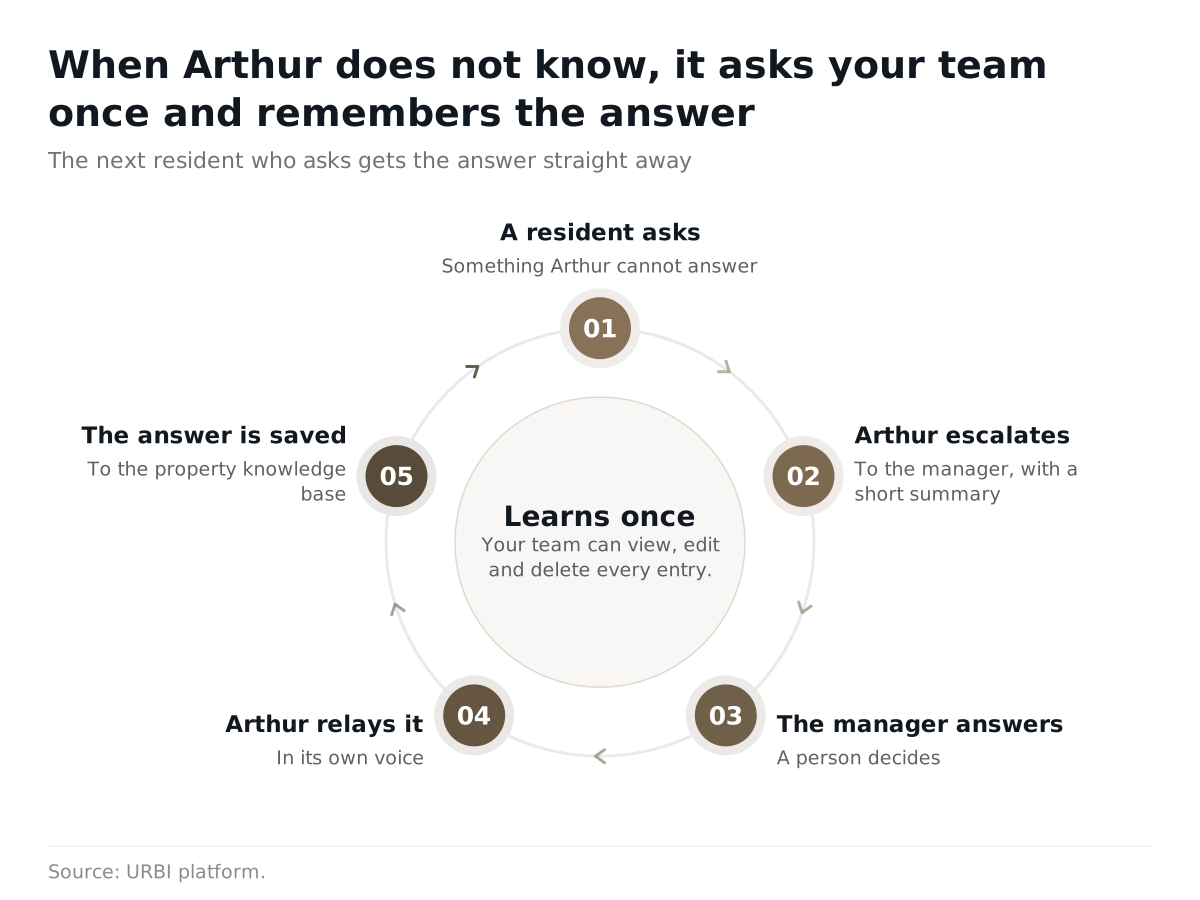
Arthur escalates to your team with a summary, then learns from the answer.
- A resident asks something Arthur cannot answer.
- Arthur sends the question to the property manager with a short summary, so the manager does not have to reread a whole conversation.
- The manager answers.
- Arthur puts the answer in its own voice and passes it to the resident.
- Arthur saves the answer to the property's knowledge base.
The next resident who asks the same thing gets the answer straight away. The team can view, edit and delete every entry in the knowledge base. If a rule changes, you fix the entry and Arthur follows the new version. The knowledge base is scoped to the property, and a building's data never trains outside models. For more on who controls what the AI says, read the AI knowledge base guide for property managers.
What stays human at a condo front desk?
Five things stay human: security, emergencies, physical package handling, judgment and conflict. We say so plainly because it is the honest answer, and because residents notice when a building gets it wrong.
- Security. Deciding who comes through the door, who gets a key and what to do about a stranger in the stairwell belongs to a person. Arthur can pre schedule a visitor a resident invited. It does not wave anyone through the lobby.
- Emergencies. A fire, a flood, a medical problem or a gas smell needs people and the emergency services, not a chat window. Call 911 first, then your building's emergency line. The resident app's ticket form keeps an emergency line notice in view. Our post on what has to be true before AI handles emergency maintenance calls lays out the rules to write down.
- Physical package handling. Staff still lift, shelve, sign for and hand over the parcel. URBI's AI scanner reads the tracking number, carrier and unit from the label and staff confirm it. Smart lockers hold small parcels. Residents are told when a package arrives. The boxes are still moved by people.
- Judgment. Should the building waive a late fee for a resident who just lost a job? Is a noise complaint a one off or a pattern? Arthur can collect the facts. A person decides.
- Conflict. Two neighbors in a dispute, an angry owner, a board member who is unhappy with the answer. These need a calm human voice and, sometimes, a meeting.
Jorge Barro, an economist at the Texas Real Estate Research Center at Texas A&M University, told NPR in September 2026 that companies will always need human workers to step in when the AI cannot. He pointed to entry level concierge questions, such as a rent balance or a low stakes maintenance request, as the work AI can take.
NPR also told the other side of the story. A renter reported a leak by phone, and the building's AI said it would transfer him to maintenance and then hung up. He had to try again and reached a person eventually. That is a handoff done badly. Two details separate a good concierge from that one: the handoff must actually connect, and a person must be there to receive it. If your team will not be reachable, fix that before you add any AI.
How should an AI concierge introduce itself?
It should say it is AI at the start and show people how to reach a person. Arthur identifies itself as URBI's AI assistant, hands off to a team member when someone asks, and never claims to be the property manager.
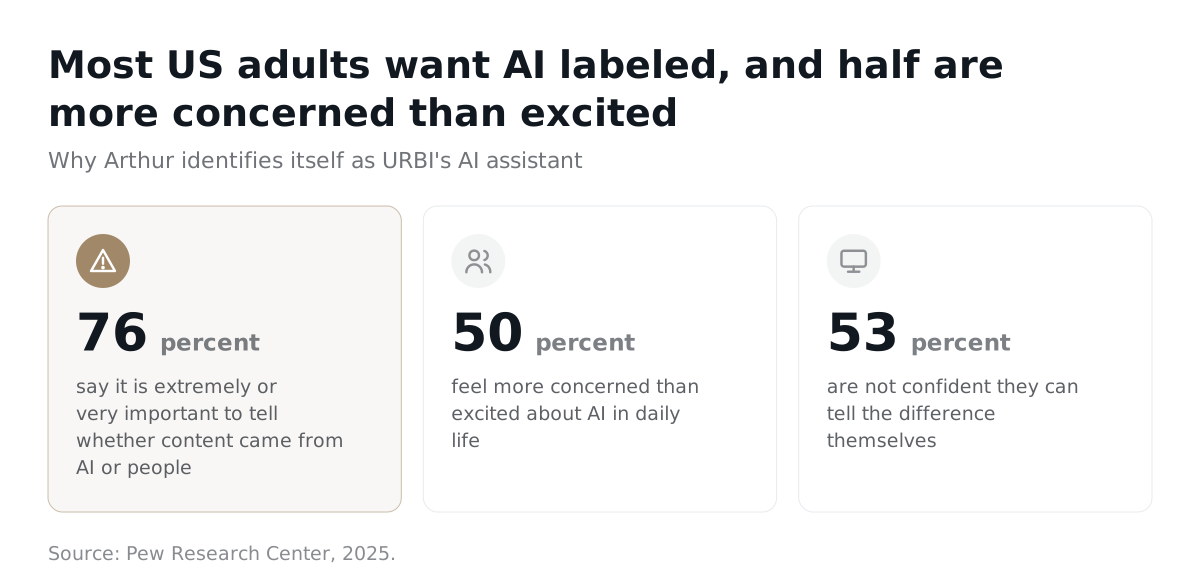
People care about this. Pew Research Center found in 2025 that 76 percent of US adults say it is extremely or very important to be able to tell whether text, pictures and video came from AI or from people. In the same survey, 50 percent said they feel more concerned than excited about the growing use of AI in daily life, and 53 percent were not confident they could tell the difference themselves.
Eric Dunn, Director of Litigation at the National Housing Law Project, told Bisnow in December 2024 that he sees hiding the AI as an "unfair and deceptive practice." A plain label and a clear way to reach your team answer that concern. Our guide to AI disclosure for residents has the wording for each channel and a notice you can copy.
How does an AI concierge serve residents who speak different languages?
Arthur answers in ten languages, so a resident can ask in the language they use at home. That matters in a condo tower, where neighbors speak many languages and the desk rarely has someone for each one.
The US Census Bureau reports that 67.8 million people spoke a language other than English at home in 2019, almost 1 in 5 people in the country. Your building may have the same mix under one roof.
You also choose how Arthur sounds. There are four voices, Arthur, Theo, Adriana and Kora, each in a professional or friendly style. You pick once for the property, and the same personality carries across every channel. Arthur also has phone manners: it waits through a pause instead of cutting the caller off, and it shifts its tone to match the caller's mood. For the wider picture, see multilingual resident communication.
What does HERO do for the team behind the desk?
HERO is the AI for your staff, and it lives inside URBI Kore. Arthur faces residents. HERO faces the team. They are two different assistants with two different jobs.
- HERO answers plain language questions about your property's records and shows what it checked.
- In the staff inbox, it drafts a reply the staff member can edit. Nothing sends until a person confirms it.
- It can propose a ticket, a task, a note or a notice from a conversation. Every action stays a proposal until a person confirms.
HERO does not talk to residents. It helps the staff who do. Residents never see HERO. They meet the same intelligence through Arthur.
How do you roll out an AI concierge without weakening the desk?
Write down the human parts first, then switch on the AI for the routine parts. This order protects residents and your team.
- List your top ten front desk questions. Count a normal week of calls, texts and emails. These are Arthur's first jobs.
- Write the handoff rule. Name who receives an escalation, how fast they reply, and who covers when they are away.
- Write the emergency rule. Residents should know to call 911 first and then the building's emergency line. Put it in the welcome package and on the lobby wall.
- Tell residents it is AI. Announce it before the first call, and say how to reach a person.
- Read the first weeks of conversations. Conversations from every channel feed one dashboard the team can read. Fix wrong or missing answers in the knowledge base.
- Keep a person at the desk. Use the time you save for the work only people can do: walking the building, knowing the residents by name, calming the tense moments.
Arthur is part of URBI's Premium plan. If you are comparing it with an answering service, our honest comparison of AI and answering services shows where each one fits. For the after move in chat view of the same idea, see AI chatbot for apartment residents.
Frequently asked questions
Will an AI concierge replace my front desk?
No. It takes the repeat questions and simple tasks, and the desk keeps security, emergencies, packages, judgment and conflict. The economist quoted above expects companies to keep people ready to step in. The desk changes from answering the same question over and over to handling what is left, which is the more skilled half of the job.
Can residents always reach a person?
Yes, as long as your team is set up to receive the handoff. Arthur passes the conversation to a team member when a resident asks, and it escalates questions it cannot answer. The part you control is who picks up and how fast. Write that down before you launch.
Does the AI learn from our building's conversations?
The property's knowledge base grows when Arthur saves an answer your manager gave, and your team can view, edit and delete every entry. A building's data never trains outside models. Each building's knowledge base stays its own.
Where to start
If you run a condo building and want to see Arthur on your own questions, book a demo or write to hello@myurbi.co. Bring your top ten front desk questions and your emergency rule, and we will show you where the line falls. For the full picture of the platform, read What is URBI and URBI for condos and multifamily buildings.


