



AI disclosure for residents means telling people, early and in plain words, that they are talking to AI, and showing them how to reach a person. URBI's Arthur introduces itself as URBI's AI assistant and hands off to a team member when a resident asks.
What is AI disclosure for residents?
AI disclosure for residents is a short, honest statement that a call, text, email or chat comes from AI and not from a staff member. It has four parts.
- Say it is AI. The label comes at the start of the conversation, not on a policy page nobody opens.
- Never pose as a person. The assistant does not claim to be the property manager or a member of the team.
- Answer honestly when asked. If a resident types "are you a real person?", the answer is no, every time.
- Offer a person. The resident always knows how to reach the team.
In URBI, residents meet Arthur, the resident facing AI in URBI AI. Arthur works by voice, SMS, email and in app chat, in ten languages. It identifies itself as URBI's AI assistant, it never claims to be the property manager, and it hands off to a person when someone asks for one. HERO is the team's AI inside URBI Kore, and residents never see it. If you want the full picture of the platform first, start with what URBI is.
Why does AI disclosure matter to residents?
It matters because people want to know who they are dealing with, and most do not trust their own ability to tell. The research points one way.
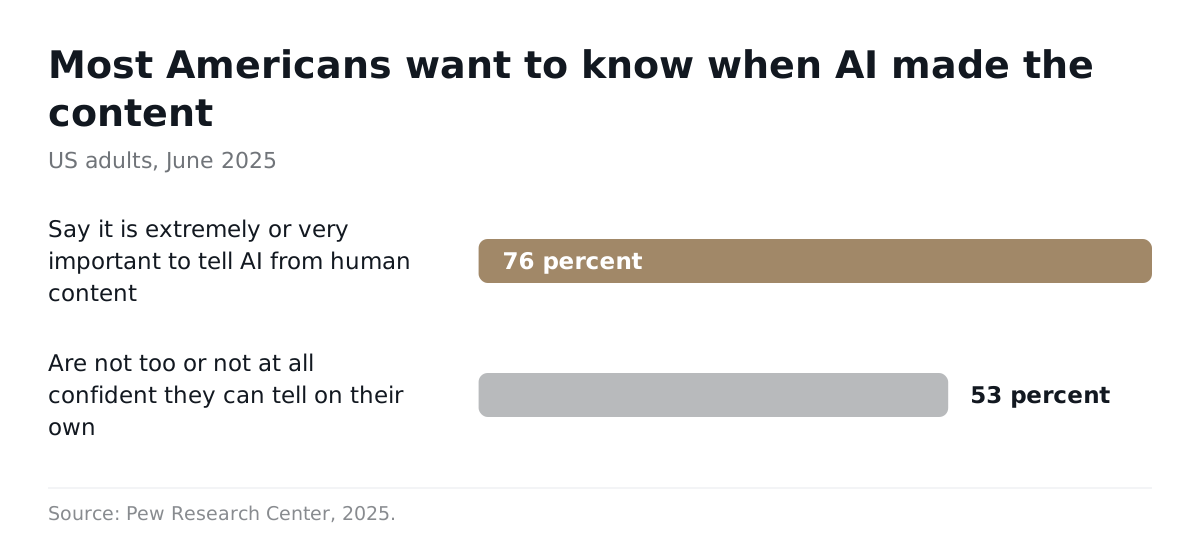
- Pew Research Center surveyed 5,023 US adults in June 2025. 76 percent said it is extremely or very important to be able to tell whether pictures, videos and text were made by AI or by people. Pew also found that 53 percent were not too or not at all confident they could tell on their own.
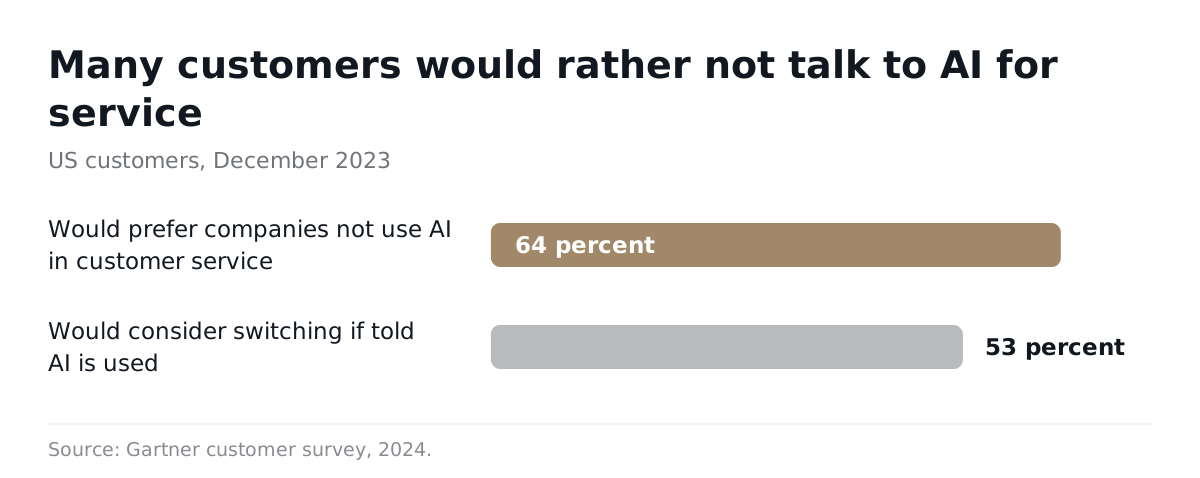
- Gartner surveyed 5,728 customers in December 2023. 64 percent said they would prefer that companies did not use AI in customer service, and 53 percent would consider switching to a competitor. The top concerns included difficulty reaching an agent. That survey covers customers of any company, not residents.
- NPR reported in September 2026 on a Los Angeles renter whose building texted him from an AI assistant. His first reply was "is this a scam?" Routine requests got faster, he said, but reaching an actual human got worse.
People do not mind help. They mind being fooled, and they mind being stuck. Cat Allday, VP of Product at AppFolio, told Propmodo in October 2026: "Don't try to fake it, people will know."
Disclosure has a cost, and it is fair to say so. Some residents will prefer a person the moment they see the word AI. But the top worry in the Gartner survey was reaching a person. A clear label with a clear path to your team answers that worry. A hidden label does not remove it. It adds the feeling of being tricked.
Does the law require AI disclosure for residents?
No single federal law says "tell every resident it is AI," but several rules point the same way, and state rules are still changing. As of November 2026, here is what the primary sources say.
- Maine. 10 M.R.S. §1500-DD says a person may not use an AI chatbot or other computer technology in trade and commerce with a consumer in a way that may mislead a reasonable consumer into believing they are dealing with a human, unless the consumer is told in a clear and conspicuous manner that they are not. A violation is a violation of the Maine Unfair Trade Practices Act.
- Utah. S.B. 226 (2025) requires a supplier that uses generative AI in a consumer transaction to say it is AI and not a human when a person clearly and unambiguously asks (Utah Code 13-75-103). It also gives a safe harbor to an AI that clearly and conspicuously says, at the outset and throughout, that it is generative AI, is not human, or is an AI assistant (13-75-104).
- The FCC. In a February 2024 declaratory ruling, the FCC confirmed that the telephone consumer protection rules on an "artificial or prerecorded voice" cover AI technologies that generate human voices. Calls that use them need the prior express consent of the person called, absent an emergency purpose or an exemption. If you ever have an AI voice place calls to residents, ask your attorney about this ruling.
- The FTC. In September 2024, then FTC Chair Lina M. Khan said in an agency press release that there is "no AI exemption from the laws on the books." Rules against deceiving people apply to AI the same way they apply to any other tool.
These two states are examples, not a full list. Other states have their own chatbot or AI rules, and the list keeps changing, so ask your attorney which ones reach your building.
Notice the gap between the Maine and Utah rules. Utah's floor is "answer truthfully when asked." Maine's is "do not let a reasonable person think you are human." Good practice is stricter than both: label first, answer honestly every time. Whether a state rule reaches your building's messages depends on facts such as whether the contact counts as trade and commerce or a consumer transaction.
This is general information, not legal advice. Confirm the rules for your building with your attorney.
Where should AI disclosure for residents appear?
It should appear at the first moment of contact on every channel, and again whenever a resident asks. Residents reach AI through more than one door, so each door needs its own label.
| Channel | When to disclose | Example wording |
|---|---|---|
| Voice call | In the first sentence of the call | "Hi, this is the AI assistant for ______. I can help, or I can connect you with the team." |
| Text message | In the first message of every thread | "Hi, I'm the AI assistant for ______. Ask for a person any time and I will connect you with the team." |
| In the first line and the signature | "This reply comes from the AI assistant for ______. To reach a person, reply and ask." | |
| In app chat | A banner above the chat, plus the first message | "You are chatting with an AI assistant. A person on the team is one request away." |
| Welcome notice and website | Before launch, then once a year | The full notice later in this post. |
The same label has to work in the languages your building speaks. Arthur answers in ten languages, so write your notice in the languages your residents use.
What should an AI disclosure say?
It should say three things in two short sentences: this is AI, what it can do, and how to reach a person. Anything longer will not be read.
Here is a pattern you can copy and fill in.
I'm the AI assistant for ______ (building name). I can answer questions about the building and your own household. Ask for a person at any time and I will connect you with the team.
A name for the assistant is fine when the label sits right next to it. Arthur is a name, and Arthur introduces itself as URBI's AI assistant. The trouble starts when a name stands alone. Avoid these:
- A human first and last name with a staff style photo.
- A title such as "your property manager" or "front desk team."
- Background sounds or fake typing pauses meant to make an AI seem like a call center or a person.
- A label in small print under a long message.
- Replies such as "our team will get back to you shortly" when no person has seen the message yet.
Some vendors let an assistant pass as a person unless a tenant asks. Eric Dunn, Director of Litigation at the National Housing Law Project, told Bisnow in December 2024 that he sees not revealing the AI upfront as an "unfair and deceptive practice." His comment was about rent messages, but the logic holds anywhere residents deal with AI.
What happens when a resident asks for a person?
The assistant stops, says so, and hands the resident to the team. In URBI, Arthur hands off to a person when someone asks, and it never claims to be the property manager. A handoff only counts if a person picks up. In the NPR story, the renter said the AI told him it would transfer him to maintenance and then hung up on him. No label can fix that.
Build the handoff into policy with these rules:
- Hand off on the first ask. No second pitch, no "are you sure?"
- Pass along what the resident already said, so they do not repeat it.
- Name who answers and how fast, and say so in the resident notice.
- Keep a path that works when the team is busy, such as a message the team sees first thing the next day.
Two more things belong in the policy. First, questions the AI cannot answer should reach the team. In URBI, Arthur escalates an unknown question to the team with a summary, and the answer is saved to a property scoped knowledge base that the team can view, edit and delete. You can read more about who controls what the AI tells your residents. Second, privacy. Arthur answers about the caller's own household only, and it verifies with a PIN before anything sensitive. A building's data never trains outside models. The post on AI data privacy questions to ask a vendor goes deeper.
HERO, the team's AI, works differently. A team member who reads, edits and confirms a HERO draft has sent that message as a person. In URBI, HERO suggestions stay private to the staff member, and nothing sends until they confirm. Some boards still add a line to policy saying staff review every AI assisted draft.
How do you set an AI disclosure policy for your building?
Follow seven steps, in order. A board can finish them in one meeting and one week of drafting.
- List every channel where residents meet AI: voice, text, email, in app chat and your website.
- Write one label for each channel, using the table above.
- Name the assistant and keep the label next to the name.
- Set the handoff rule: one request, then a person. Name who answers and how fast.
- Publish the resident notice below before launch, then again each year, for example at your annual meeting.
- Give one person the job of reviewing the knowledge base saved answers every month.
- Review the wording whenever the tool or the law changes, and confirm it with your attorney.
Here is a resident notice to copy, with blanks to fill in.
Subject: Meet the AI assistant for ______ (building name)
Hello ______ (resident name),
Starting ______ (date), you can reach an AI assistant by phone, text, email and in app chat. It is AI, not a person. It answers questions about the building and your own household. It passes anything it cannot answer to the building team.
You can ask for a person at any time, and the assistant will connect you with the team. For an emergency, call ______ (emergency number).
The team reviews the answers the assistant has saved and can edit or delete them. Your building's data is not used to train outside AI models.
Questions about the assistant? Write to ______ (contact email).
______ (manager name), ______ (building name)
For the wider board level questions, such as which topics AI should never touch, use the condo board AI policy template. Before you sign with any vendor, run through the questions to ask an AI vendor. To see where AI fits at the front desk, read what an AI concierge handles and what stays human.
FAQ
Do residents need to be told it is AI if it seems obvious?
Do not rely on obvious. Maine's rule turns on whether a reasonable consumer could be misled, and voice and text assistants now sound human. A one line label costs nothing and removes the doubt. Treat obvious as a bonus, never as a reason to skip the label.
Can an AI assistant have a name?
Yes, if the label sits next to the name. Arthur is a name, and Arthur introduces itself as URBI's AI assistant and never claims to be the property manager. The problem is a name with no label, a human photo, or a title that suggests a staff member. Name and label go together.
What if a resident wants nothing to do with the AI?
They ask for a person and get one. Say in your notice that this is always allowed. Gartner found that many customers would rather companies did not use AI at all, so a fast route to the team is part of the policy, not a failure of it.
Does disclosure apply when staff use AI to draft replies?
A team member who reads and confirms an AI draft has written the message as a person. Your board can still choose to say in policy that staff review every AI assisted draft. The key point is that no resident message goes out until a person has read it. URBI works that way with HERO drafts.
Next step
URBI built Arthur to say what it is and to hand off to your team. If you want to see how that works on your own channels, book a demo or write to hello@myurbi.co. For building types and fit, see URBI for residential buildings. For how AI answers residents after move in, read what an AI chatbot should handle for apartment residents.


