



Apartment package theft prevention in a building over 100 units comes down to custody. Every parcel needs one known place and a record from the moment it arrives. Build that with one receiving point, a photo scan at intake, and an instant resident alert. URBI runs that record for you.
This is the operator playbook. It covers how exposed apartment residents are, where parcels go missing, which controls have evidence behind them, and what each one costs in staff minutes. It does not cover who pays when a package disappears. That question has its own guide on who is liable for stolen packages in an apartment.
How common is package theft for apartment residents?
Apartment residents lose packages far more often than people in houses. In an October 2025 survey of 3,307 US adults, Security.org found apartment residents were victimized 3.5 times more often than homeowners in the most recent three month period.
The national number is big but fuzzy. The USPS Office of Inspector General reported at least 58 million packages stolen in 2024. The same 2025 report warns that there is no single authoritative source for package theft data. It also says urban and high density neighborhoods report disproportionately higher rates, especially in the holiday peak.
Read those two facts together. A large apartment building is exactly the kind of place the data points at. Many people share one door. Parcels sit in common space. Strangers walk past them all day.
Is every missing package a theft?
No, and your process should not assume it is. The OIG report says inaccurate claims from misdeliveries, misplaced items, and consumer fraud distort the real scale of package theft. It also says it is hard to tell whether a package was stolen or simply lost.
For a manager, this is the most useful line in the report. Without a record, every complaint turns into an argument. With a record, you can see whether the parcel ever entered the building, where it went, and who took it out. That is why the rest of this playbook starts with custody, not cameras.
Where do packages go missing in a large building?
Packages go missing at four handoff points: the lobby drop, the hallway or door drop, the locker bypass, and the parcel that was never really delivered. The first three are carrier behavior your building can shape. The fourth is a records problem.
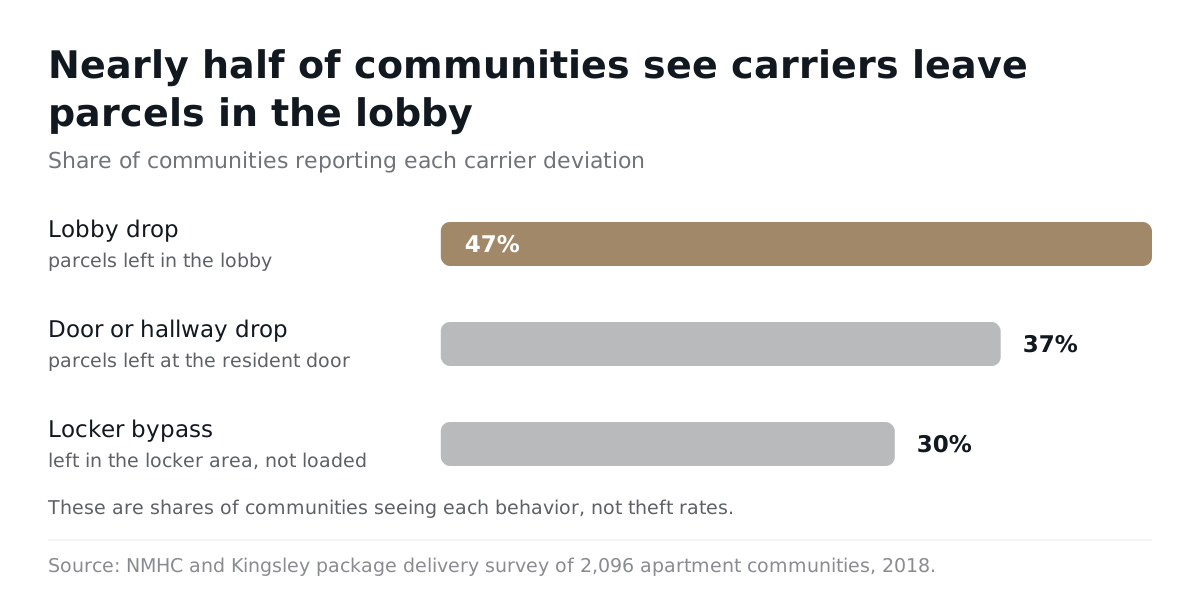
The best benchmark on carrier behavior comes from multifamily operators themselves. A 2018 NMHC and Kingsley survey of 2,096 apartment communities asked how carriers deviate from the building's process. The data is from 2018, but it is still the largest multifamily package benchmark we could find.
| Failure point | What happens | Share of communities reporting it (2018) |
|---|---|---|
| Lobby drop | Carrier leaves parcels in the lobby | 47% |
| Door or hallway drop | Carrier leaves parcels at the resident's door | 37% |
| Locker bypass | Carrier leaves parcels in the locker area without loading them | 30% |
| Never delivered | Misdelivery, misplacement, or a false claim | No reliable rate exists |
These percentages describe how often communities saw each behavior. They are not theft rates. Still, they show where parcels leave the controlled path. Every one of those deviations puts a box in open space with no owner.
Why does time on the floor matter so much?
The longer a parcel sits in open space, the more likely it is to be stolen. A Postal Service official told the OIG that time is a factor in package theft. So aim for short dwell time. A locked room helps only if parcels get there fast.
Dwell time is the one number most buildings never track. You can shorten it in two ways. Move the parcel out of open space fast. Tell the resident fast. Both depend on someone knowing the parcel exists.
Which controls actually cut package theft?
A layered process cuts theft best, because no single control has been shown to cut apartment package theft by a specific percentage. We found no independent study that does. What exists is government guidance, operator benchmarks, and broader crime research.
Here is the evidence, control by control.
- Controlled receiving point. The OIG lists secure pickup points and parcel lockers among its mitigation options. It calls them more secure than front porch drops, with a trade in convenience.
- Scan in with photo. The OIG recommends photo proof of delivery to establish accountability. Some carriers already do this. UPS My Choice lets members receive delivery alerts and photos.
- Instant resident notice. The OIG says advance alerts give people time to arrange secure receipt. A notice at intake does the same job inside your building.
- Lockers. Each parcel sits behind its own locked door until the resident enters a code. The security logic is strong. The capacity limits are real, and we cover them below.
- Cameras. Useful, but weak on their own. See the next section.
- Signature or carrier hold for high value parcels. This avoids an unattended handoff entirely. It is less convenient for residents.
Do security cameras stop package theft on their own?
No. Cameras help most when someone watches them and when they sit inside a wider set of controls. A 40 year systematic review listed by the Office of Justice Programs found CCTV was linked to a significant and modest decrease in crime, including in residential areas. Active monitoring beat passive recording. Cameras combined with other measures beat cameras used as a stand alone measure.
Footage tells you what happened last Tuesday. It rarely stops what happens tonight. Point cameras at the receiving point and the pickup zone, check that they work, and treat them as one layer.
What does each control cost in staff time?
Most controls cost minutes, not hours, if you design them to run on exceptions. The expensive version is a person hand writing a log and messaging every resident. The cheap version is a scan, an automatic alert, and one daily sweep.
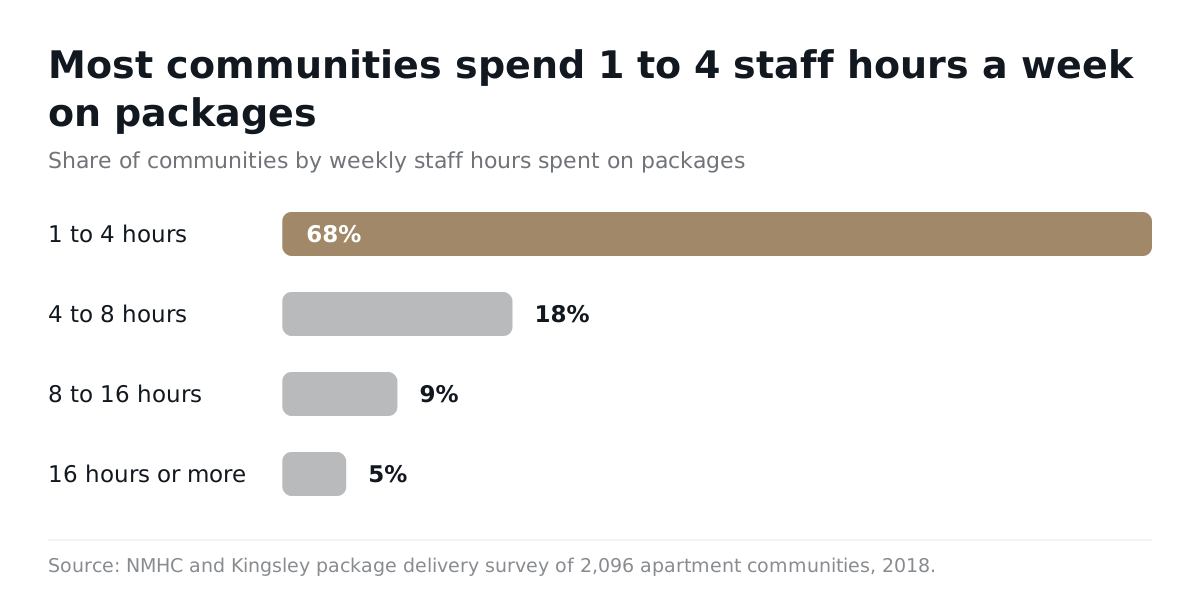
Package work already eats real time. In the NMHC and Kingsley survey, 68% of communities spent 1 to 4 staff hours a week on packages. Another 18% spent 4 to 8 hours, 9% spent 8 to 16 hours, and 5% spent 16 hours or more. The same survey found 20% of communities received 400 or more packages a week at peak, up from 8% in 2014.
The table below uses planning estimates for a building of 100 to 300 units. The minute figures are our reasoning, not survey data. Time your own team for a week and replace them.
| Control | What it stops | Staff minutes (planning estimate) |
|---|---|---|
| One carrier accessible receiving point | Lobby and hallway drops | Setup once, then about 5 minutes a day to redirect stray drops |
| Scan in with photo of the label | Disputes over whether a parcel arrived, lost parcels with no trail | Under 1 minute per parcel with a phone scan |
| Automatic resident notification | Long dwell time and calls asking whether a parcel came | Zero per parcel once scanned; saves call time |
| Signed release at pickup | Wrong person collecting, disputes over who picked up | Under 1 minute per pickup |
| Lockers for standard parcels | Open shelf access, after hours pickup queues | Near zero per parcel; about 10 minutes a day for jams and overflow |
| Daily exception sweep | Unscanned parcels, long dwell parcels, mislabeled units | 10 to 15 minutes a day |
| Actively checked cameras | Unwitnessed removal at the room or pickup zone | About 5 minutes a day to confirm cameras work; more per incident |
| Signature or carrier hold for high value items | Unattended handoff of expensive parcels | Zero for staff; the resident arranges it with the carrier |
Our longer breakdown of package handling costs in apartment buildings shows how to turn those minutes into a yearly budget line.
Why do lockers alone fall short?
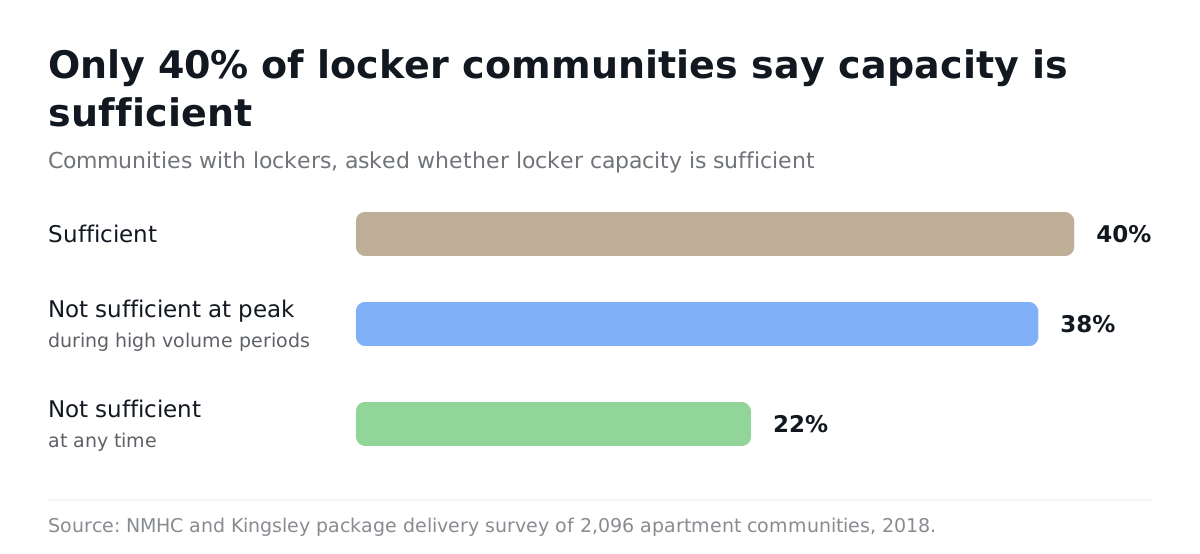
Lockers run out of room when you need them most. In the 2018 NMHC and Kingsley survey, only 40% of locker communities said capacity was sufficient. Another 38% said it was not sufficient during high volume periods, and 22% said it was not sufficient at all.
Volume keeps climbing, and the boxes keep getting bigger. In a November 2024 Multifamily Executive story, Elie Rieder, founder and CEO of Castle Lanterra Properties, said, "Package delivery volume has doubled since last year." Other operators in the same piece described furniture and appliances arriving, and leasing and maintenance staff getting pulled into package problems.
So a locker bank needs a plan for what does not fit. Decide where oversize and overflow parcels go, who logs them, and how residents hear about them. Our comparison of package lockers vs package management software walks through that choice in detail.
What do USPS and the carriers advise?
USPS and the private carriers all push the same idea: get the parcel to a secure, known place, and give the recipient a way to redirect it. For buildings, USPS also sets a hard minimum on parcel lockers.
- USPS. All new or remodeled apartment houses must install USPS approved 4C centralized mailbox equipment, with at least 1 parcel locker for every 5 mailbox compartments. That is a postal floor. It does not cover UPS, FedEx, Amazon, or grocery deliveries.
- UPS. Members can receive alerts and photos and change the delivery date or location. Residents can also redirect eligible packages to a UPS Access Point location.
- FedEx. The carrier says it may deliver a package to a nearby secure location for pickup, such as a FedEx Office or Walgreens store.
Put the carrier options in your move in packet. A resident expecting a laptop should know how to hold it at a carrier location. That keeps your highest value exceptions out of your building entirely.
What does a sustainable playbook look like for 100 plus units?
A sustainable playbook lets carriers drop at one place, records every parcel on arrival, and asks staff to handle only the exceptions. Here is the sequence we recommend.
- Pick one receiving point. Give every carrier the same instruction and the same access. Post it at the door.
- Scan every parcel at intake. Capture the recipient unit, carrier, tracking number, time, and a photo of the label.
- Notify the resident immediately. The alert should say what arrived and where to collect it.
- Route by size. Standard parcels go to lockers. Oversize and overflow go to a locked room, logged the same way.
- Record the release. Log who collected it and when.
- Run one daily sweep. Find unscanned parcels, long dwell parcels, and wrong unit labels.
- Review weekly. Count confirmed thefts separately from misdeliveries, unscanned finds, and complaints.
Step 7 is the one that settles arguments. The OIG could not separate theft from loss at the national level. You can, for your building, once every parcel has a trail.
Who should control carrier and visitor access?
The building should, with a record of every entry to the receiving area. USPS rules already require centralized boxes to be grouped at a single point readily accessible to the carrier. Apply the same thinking to every courier. One door, one set of instructions, one log.
Visitor records help here too. When a guest or courier enters, a timestamp narrows any investigation. Our guide to condo visitor and guest parking management covers how to register visitors without slowing the front desk.
How does URBI handle package custody?
URBI gives staff a scan and photo intake, an instant resident alert, and a full chain of custody for every parcel. It is built for the playbook above.
- Scan in with photo. Staff photograph the shipping label. The AI scanner reads the tracking number, carrier (nine carriers recognized), and recipient unit for staff to confirm.
- Instant resident notification. The resident gets a push alert in the URBI app right away. More on that in our post on the apartment package notification system.
- Chain of custody. Each parcel carries its photo and history. Per unit package tabs show what is waiting for each home.
- Locker integration. Smart locker integration handles small parcels, while the desk scan covers everything else. See the URBI IoT and hardware features.
- Visitor records. Visitor registration with live pass counts and a verification desk shows who was expected in the building.
- A dashboard scan widget. Staff can start a scan from the Kore dashboard without hunting through menus.
Packages sit inside the wider platform. Staff also use URBI for notices, service tickets, amenity booking, and concierge messaging. If you are new to the product, start with what URBI is, then see how it fits in URBI for residential buildings.
What else do managers ask about apartment package theft?
Are apartment residents really more likely to have packages stolen?
Yes, based on the best recent survey. Security.org's October 2025 survey of 3,307 US adults found apartment residents were victimized 3.5 times more often than homeowners over the prior three months. The USPS OIG also reports higher incident rates in urban and high density neighborhoods. Shared entrances and parcels left in common space are the likely reasons. A clear receiving point and fast pickup address both.
Do package lockers solve package theft?
Lockers solve access for standard parcels, but they do not solve capacity or carrier behavior. In a 2018 survey of apartment communities, only 40% of locker users said capacity was sufficient. And 30% of communities saw carriers leave parcels in the locker area without loading them. Pair lockers with a logged overflow room, a scan at intake, and a daily sweep for anything left outside a locker.
How much staff time does a package program take?
It depends on your volume and your process. In the NMHC and Kingsley survey, 68% of communities spent 1 to 4 staff hours a week on packages, and 5% spent 16 hours or more. A process that scans once, alerts automatically, and reviews exceptions daily keeps most buildings near the low end. Hand logs and manual resident messages push you toward the high end.
Should a building refuse to accept packages at all?
It can, but refusing custody mostly moves the problem into hallways. Carriers will still leave parcels at doors and in the lobby. If you refuse, write the policy down, tell residents how to use carrier holds and pickup points, and still control who enters. For most buildings over 100 units, an explicit, measured custody policy beats an accidental one.
Package theft in a large building is a custody problem before it is a crime problem. Give every parcel one entry point, one record, and one fast alert, and most of the losses and arguments go away. If you want to see how URBI would run intake, alerts, and lockers in your building, email us at hello@myurbi.co.
Keep reading


