



A guest suite policy template gives your board one written set of rules for who can book the suite, how long guests can stay, who cleans it, and who pays for damage. URBI, the building operations platform, runs the booking side. This guide has the full text to copy.
The legal points are general and current as of November 2026. This is general information, not legal advice. Confirm the rules for your building with your attorney.
What does a guest suite policy need to cover?
A guest suite policy needs to answer eight questions before the first booking:
- Who may book, and who may stay?
- How far ahead, how long, and how often?
- What happens on holidays?
- What does it cost, and what deposit is held?
- What happens when a booking is cancelled?
- How is the suite cleaned?
- How is it inspected, and who pays for damage?
- What happens when a guest breaks a rule?
A guest suite is an amenity, not a hotel room. The resident hosts the stay and answers for it. Every clause in this guide follows from that one idea.
The reasons come from three kinds of source: a federal housing notice on guest suites, the published rules of two real condominium associations, and pest control guidance. The full policy text is further down the page.
Who is allowed to book a guest suite?
Residents in good standing book the suite, and their friends and family stay in it. The public does not.
The U.S. Department of Housing and Urban Development (HUD) sets this out in Housing Notice 2018-10. For insured projects, only residents may reserve a guest suite, use is limited to residents' friends and family, and the suite is not available to the public. HUD ties this to the National Housing Act, which bars renting a project for transient or hotel purposes. The notice is best practice guidance for FHA insured rental and cooperative projects. Treat it as a benchmark for your building, not as a rule that binds every condo.
Two published rule sets add detail:
- Portico Condominiums in Denver lets only residents in good standing with the association reserve the suite. The resident must be living in the building while the guest stays.
- The Claridge Condominium Association in Collier County, Florida, lets only unit owners reserve its guest suites, and the owner must be in residence during the guest's stay.
The "resident must be present" rule is your choice, because HUD does not require it. Both associations above chose it. It makes the host easy to reach and makes a party less likely.
Marc Luxemburg chairs the real estate department at the law firm Snow Becker Krauss and is president of the Council of New York Cooperatives and Condominiums. He told Habitat Magazine in 2008 that the first question about a stream of guests is whether they are "really social guests" or a bed and breakfast. Your policy answers that question in writing. If owners also rent units by the night, that is a separate problem with its own rules, covered in our guide to short term rental rules for condo buildings.
How many nights, and how often, can a unit book?
Cap the length of each stay and the number of stays per year, and write the numbers down. A suite is one room shared by every household, so limits are what keep it fair.
Here is how three real rule sets handle the limits. The first column is HUD's benchmark. The other two are published by the associations themselves.
| Rule | HUD benchmark (2018) | Portico, Denver | The Claridge, Florida |
|---|---|---|---|
| Who may book | Residents only | Residents in good standing | Unit owners only |
| Booking window | Not stated | Up to three months ahead, at least one day ahead | No sooner than 90 days ahead |
| Length of stay | Not stated | Three days is standard, extended a day at a time if the suite is free | Up to seven consecutive days |
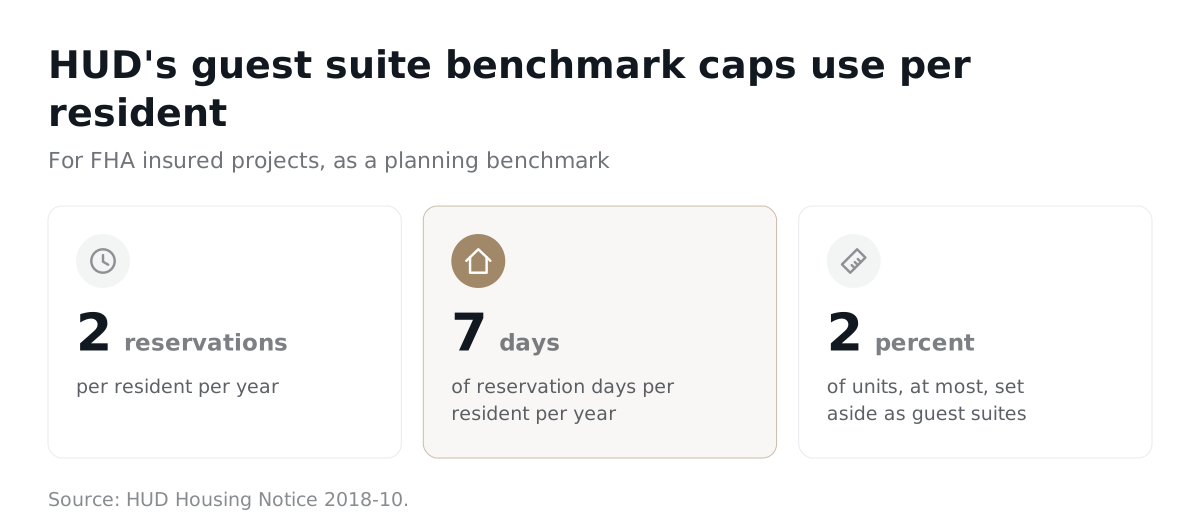
| Yearly limit | Two reservations and seven reservation days per resident per year | Not stated | The same guest may not exceed 14 days in a row or 30 days a year without board approval |
| Occupancy | Not stated | Double occupancy, non smoking | Four occupants, no pets |
HUD adds one more limit that matters for planning: guest suites should be no more than two percent of the units in the project. A building with a few hundred units is looking at a handful of suites at most.
The numbers differ because the buildings differ. A downtown tower with one suite and many owners needs tighter caps than a small building with spare capacity. Start tighter than you think you need. Loosening a rule is easy. Tightening one after residents are used to it is not.
Specific day counts also help enforcement. Gianna Solari works for a California property management firm that managed nearly 5,200 units when she spoke to The Habitat Group in 2010. In an article on house rules for guests, she described how her team handles guest stays: "We keep track of the dates and contact the resident." A written limit gives staff something to point to. Our guide to amenity booking fairness rules covers how to keep the same few households from taking every good date.
How should holidays and cancellations work?
Give holiday dates a rotation or a lottery, and set a cancellation cutoff that frees the dates in time for someone else.
Both published rule sets handle holidays the same way in spirit. Portico books popular dates on a rotating basis so that no resident can monopolize the room. The Claridge gives preference to an owner who did not use the suite for the same holiday the year before, and it holds a lottery when requests collide.
For cancellations, they pick a cutoff and stick to it:
- Portico refunds a reservation only if it is cancelled at least 72 hours ahead.
- The Claridge credits the owner's account if the cancellation comes seven days or more ahead, and gives no credit after that.
Set your cutoff longer than the time you need to offer the dates to a waiting household. Add a no show rule too, so a booking that nobody uses is released on the first morning. Our post on amenity booking deposits explains how flexible deposit handling keeps these rules from feeling harsh.
Who cleans the guest suite, and what about bed bugs?
The building cleans the suite after every stay, and guests handle only daily upkeep. This is what separates a guest suite from a hotel room.
HUD's notice says the project does not provide cleaning, linens or other customary hotel services to the guest during the stay. It allows one charge: a one time cleaning and laundering fee, at cost, billed to the resident who reserved the suite. The guest is not charged. The Claridge's rules say the same thing from the practical side: no housekeeping, and the suite is cleaned only before guests arrive and after they leave.
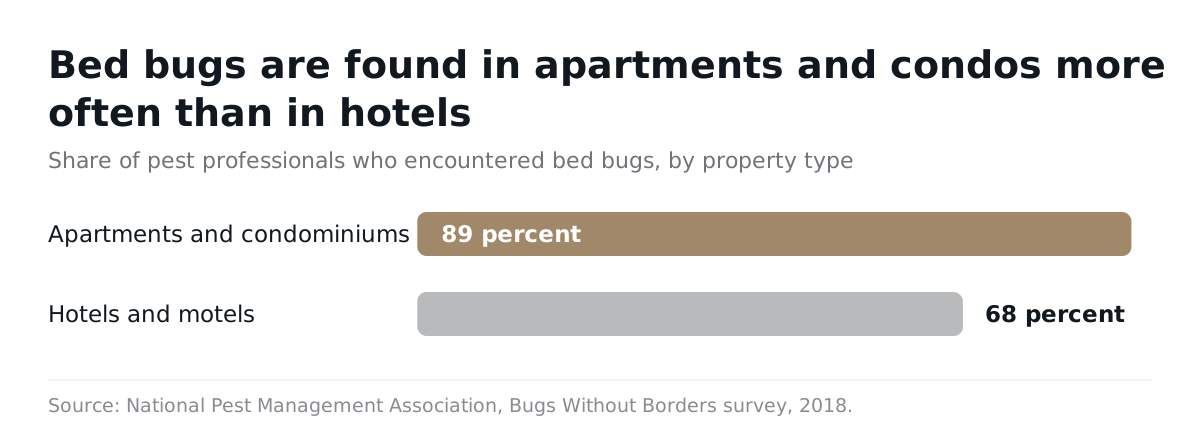
Bed bugs are the reason to take the cleaning turn seriously. The National Pest Management Association surveyed pest professionals in 2018. It found that 89 percent had encountered bed bugs in apartments and condominiums, and 68 percent in hotels and motels. Cornell's pest management program notes that in multifamily housing, bed bugs move easily from one apartment to another. People carry them on luggage, bags and coats. A guest suite often sees a new traveler every few days.
The U.S. Environmental Protection Agency (EPA) gives the guidance your cleaning checklist should follow. Its travel tips say to use luggage racks rather than the bed or floor, to check the mattress and headboard, and that time in a dryer at high temperatures kills bed bugs while washing alone generally does not. Write those points into the policy and the turn checklist:
- Strip every sheet, pillowcase and towel. Wash them, then dry them on high heat.
- Check the mattress and the headboard, with a flashlight if you have one.
- Clean the bathroom, kitchen surfaces and floors.
- Empty the trash and the refrigerator.
- Put out a luggage rack, and tell guests to use it instead of the bed or floor.
- Restock supplies, then photograph the ready room with the date visible.
- Reset the key or access card for the next arrival.
These steps lower the risk. They do not remove it. So the policy also needs a reporting rule: anyone who sees signs of bed bugs tells the office the same day, and the suite closes until a licensed pest professional clears it.
Who pays when a guest damages the suite?
The host resident pays, because the host sponsored the guest. Every clause on damage depends on proof, so inspect the suite at both ends of every stay.
The Claridge requires the owner to inspect the suite with a representative of the office before the guests arrive and again after they depart. The owner is financially responsible for any damage or missing items. Portico has management inspect the suite after the guest leaves, and it charges the resident for repairs and for replacing missing items.
Build the damage process in four steps:
- Staff photograph the suite before arrival and after departure, with dates.
- The host holds a refundable deposit that stays in place until the post stay inspection.
- If staff find damage, they send the host a written notice with photos and the repair cost.
- The deposit covers the damage first. Any balance goes to the host's unit account.
Separate normal wear from damage in the policy. A scuffed floor after a week is wear. A broken lamp or a stained mattress is damage. Ask guests to sign a waiver and the house rules at check in. Our guide to amenity booking waivers covers what a waiver can and cannot do.
What can a board actually enforce?
A board can enforce only what its declaration and bylaws let it enforce. Check them before you adopt any fee, deposit or fine.
The law firm Smith Gambrell and Russell explains why in When Making Rules, Boards Need to Know Their Limits. The governing documents work like a contract. A supermajority of owners can usually amend them, but a board cannot do it by decree. A court in the case the firm describes held that a board may adopt reasonable rules, but not rules that conflict with a right the bylaws give owners.
Fines are the sharpest example. Attorney Marijana Predovan of Armstrong Teasdale, writing in CooperatorNews in 2021, says a board can fine only if its governing document authorizes it to. Without that power, she writes, the document has to be amended, which usually takes a two thirds or three quarters vote. She also says a New York cooperative board can require shareholders to announce guests in advance by house rule. Your state and your documents may differ.
Before you adopt the policy, run this check:
- Do your documents let the board make rules for common elements such as the guest suite?
- Do they let the board set fees and hold deposits?
- Do they let the board fine, and by what process?
- What does the building's insurance cover when a guest is hurt in the suite, and what does the host's own policy cover? Ask your broker.
Then apply the policy the same way to every household. Rules that bend for friends of the board stop working fast.
Guest suite policy template: copy and fill in
Here is the full policy. Replace each blank with your own number and name, delete the options you do not want, and have your attorney review it before the board adopts it.
Guest Suite Policy of ______ (building name)
1. Who may book and who may stay
- The guest suite is for overnight stays by friends and family of residents. It is not open to the public and is never rented to non residents.
- Only a resident of ______ whose account is in good standing may book the suite. This resident is the host.
- [Option] The host must be living in the building during the guest's stay.
- The host answers for the guests and for every rule in this policy.
2. Booking limits
- Bookings open ______ days before arrival and close ______ day(s) before arrival.
- A stay is at least ______ night(s) and at most ______ consecutive nights.
- Each unit may book up to ______ stays and ______ nights in a calendar year.
- The same guest may not stay more than ______ nights in a year without written board approval.
- Holiday dates (______) are assigned by [lottery / rotation]. A unit that held a holiday date last year goes to the back of the line.
- A stay may be extended one day at a time, and only if no other booking follows.
3. Check in, check out and guest rules
- Check in is at ______. Check out is at ______. Late check out needs written approval from ______.
- The host gives the office the name of every guest at least ______ hours before arrival.
- No more than ______ people may stay in the suite. No pets. No smoking.
- Guests follow the same house rules as residents. The host gives every guest a copy of these rules before arrival.
- [Option] Each guest signs a waiver at check in.
4. Fees and deposit
- Charges for the suite are set by the board in the fee schedule dated ______. Guests are never charged directly.
- A refundable deposit is collected at ______ and held until the suite has been inspected after the stay.
- All charges are posted to the host's unit account.
5. Cancellation and no shows
- The host may cancel for a full refund up to ______ hours before arrival. After that, ______.
- If the guest has not arrived by ______ on the first day, the booking is released and ______.
6. Cleaning and pest control
- The building cleans the suite after every stay and before the next arrival. No housekeeping is provided during a stay.
- Guests handle daily upkeep: dishes, trash and tidying.
- Staff wash all linens and towels after every stay and dry them on high heat.
- Guests use the luggage rack and keep bags off the bed and floor.
- Anyone who sees signs of bed bugs tells ______ the same day. The suite closes until a licensed pest professional clears it.
7. Inspection and damage
- Staff inspect and photograph the suite before arrival and after departure.
- The host is financially responsible for damage, missing items and extra cleaning caused by the host or the guests. Normal wear is not damage.
- Staff send the host written notice of any damage, with photos and the cost, within ______ business days of departure.
- The deposit is applied first. Any balance is charged to the host's unit account.
- The host may dispute a charge in writing within ______ days. ______ decides.
8. Rule violations
- A guest who breaks the rules or disturbs other residents may be told to leave within ______ hours. Refund: ______.
- Fines apply only as the declaration and bylaws allow, and follow the schedule dated ______.
- Repeated violations may suspend the host's booking privileges for ______ months.
9. Adoption
- The board adopted this policy on ______ and will review it every ______ months.
How does URBI help run a guest suite policy?
URBI runs the booking, the deposit and the record, and your policy decides the limits. The suite is booked like any other amenity in URBI amenity booking.
These parts of URBI Kore map to the policy above:
- Multi day bookings, with a buffer after each stay that your team can use for the cleaning turn, and a collision guard that stops two stays from overlapping. Multi day bookings are part of the Kore and Premium plans.
- Conflict detection, so the same nights cannot be booked twice.
- Card checkout and deposits, cancellation and refund flows, and a deposit keep or return with an audit trail. Deposit collection can also be deferred closer to the date.
- Manual payment recording, so staff can log a cash or check payment.
- A unit profile with a bookings tab, so staff can see what a unit has already booked before they answer a request.
Annual caps, holiday lotteries and fines are decisions your team applies. URBI keeps the bookings in front of them. URBI also has visitor registration and a front of house verification desk, so your team can record who arrives. Our guide to visitor and guest parking management covers that side. For a closer look at the software side, read our post on apartment guest suite booking software.
Frequently asked questions
Can a guest suite earn money for the building?
In FHA insured projects, HUD's guidance says no. The project charges no rent for the suite and takes only a cleaning and laundering fee at cost, billed to the resident. Other buildings set their own charges. Put every charge in a written fee schedule that the board adopts, and ask your attorney and accountant whether public rental would change anything for your association.
Should the resident have to be in the building during the stay?
HUD's notice does not require it, but Portico and The Claridge both do. A present host is easy to reach and makes a party less likely. If you drop the rule, make the booking resident reachable by phone during the stay and keep the rest of the host's responsibility unchanged. Pick one approach and write it into the policy.
What happens when a guest breaks the rules?
Decide the consequence before it happens. The Claridge gives a guest who breaks the rules or causes a disturbance notice to vacate within twelve hours, with no refund to the owner. Portico charges the resident for the damage. Whatever you choose, check that your governing documents allow it, especially for fines.
Ready to put the policy to work?
A policy only works when someone applies it the same way every time. If you want the booking, deposit and record handled in one place, book a demo or write to hello@myurbi.co. You can also see how URBI runs the amenities, packages, visitors and communication of a whole building in URBI for condos and multifamily buildings.


