



The questions to ask an AI vendor before a property management demo fall into six groups: your data, accuracy, approvals, fair housing, onboarding, and how pricing is structured. Bring them in writing. Each question below shows a good answer and a red flag, and URBI answers every group on the record.
Why should a property manager bring written questions to an AI demo?
A demo is built to show the best case, so written questions are how you see the normal case. The vendor picks the sample building, the sample question, and the sample answer. Your questions pull the conversation back to your own building and its risks.
Regulators treat AI claims like any other sales claim. In September 2024 the Federal Trade Commission announced Operation AI Comply, a sweep against companies using AI hype to mislead people. FTC Chair Lina Khan said "Using AI tools to trick, mislead, or defraud people is illegal." One case in that sweep was about testing. The FTC's complaint alleged that DoNotPay, which sold an AI lawyer service, never tested whether its chatbot performed at the level of a human lawyer. So if a vendor says its AI does a person's job, ask what testing backs that up.
You also have a free yardstick. The NIST AI Risk Management Framework, released on January 26, 2023, is a voluntary guide for judging the trustworthiness of AI products. NIST added a Generative AI Profile on July 26, 2024. You do not need to read either one cover to cover. You only need the habit they teach: ask for evidence, not adjectives.
Use the six groups below as your checklist. Each table gives the question, what a good answer sounds like, and the red flag.
What should you ask about data and privacy?
Ask who sees your residents' data, whether it trains anyone's model, and how long it is kept. These are three separate promises, and a vendor can make one without the others.
In January 2024 the FTC warned that AI model companies that break their privacy promises may be liable under the laws it enforces. That includes a promise not to use customer data to train or update models (FTC). Promises matter, so get each one in the contract, not only in the slide deck. Our AI data privacy guide goes deeper on contract language.
| Question | What a good answer sounds like | Red flag |
|---|---|---|
| Does our data train any AI model outside our account? | "No. Your building's data stays with your building." They put it in writing. | "We anonymize it first," with no detail on what that means. |
| Do you sell or share resident data? | A plain no, with no conditions attached. | A long answer about partners and "improving the service." |
| Who on our team can see what? | Staff only see the properties they work at, and roles control what each person can open. | Everyone with a login sees the whole portfolio. |
| Can the AI tell one resident about another household? | No. It answers about the caller's own household only. | "It is pretty good at not doing that." |
| How long do you keep conversations, and what happens when we leave? | A clear retention period and a clear exit process. | Nobody on the call knows. |
What should you ask about accuracy and grounding?
Ask where each answer comes from and what the AI does when it does not know. A good AI answers from your building's own records and says so when the records are silent.
The key word is grounding. A grounded answer points back to a source you can check: the bylaws, the move in procedure, a logged note from last month. An ungrounded answer sounds confident and points at nothing. That is how a resident gets told the pool opens at 6am when your rules say 7am. Our post on what happens when property management AI gets it wrong walks through real failure patterns.
| Question | What a good answer sounds like | Red flag |
|---|---|---|
| What does the AI read before it answers? | Your documents, your procedures, your records, and your team's logged notes, scoped to the property. | "It knows property management in general." |
| Can I see where an answer came from? | Yes. Each answer shows the sources it checked. | "Trust us, it is accurate." |
| What happens when it does not know? | It says so, or hands the question to a person. | It always has an answer. |
| How did you measure accuracy? | A test set, a date, and how many answers were wrong or escalated. | A single percentage with no test behind it. |
What should you ask about approvals and the audit trail?
Ask which actions the AI can take alone and which wait for a person. The safe answer is that the AI can read and draft freely, but anything that changes a record, spends money, or reaches residents waits for a human to confirm.
Then ask to see the log. Every action should show who proposed it, who approved it, and when. If a board member asks why a notice went out on a Sunday night, you want a record, not a guess. We wrote a full guide on what AI can do alone and what a person must approve.
| Question | What a good answer sounds like | Red flag |
|---|---|---|
| Can the AI send a notice or book something without a person? | No. It proposes, and a person confirms. | "It runs on autopilot, so you never have to touch it." |
| Can we stop a multi step job halfway? | Yes. Each step can be approved or rejected, and a failed step stops the job. | The job either runs end to end or not at all. |
| Is there a permanent record of every action? | Yes, with the person who approved it. | Logs are kept for a short window, then deleted. |
| Will residents know they are talking to AI? | Yes. It says what it is and hands off to a person on request. | It is designed to pass as a staff member. |
What should you ask about fair housing and compliance?
Ask whether the AI touches any housing decision, such as screening, pricing, or who sees an ad, and how the vendor tests it for bias. If it does, the Fair Housing Act applies no matter what technology makes the call.
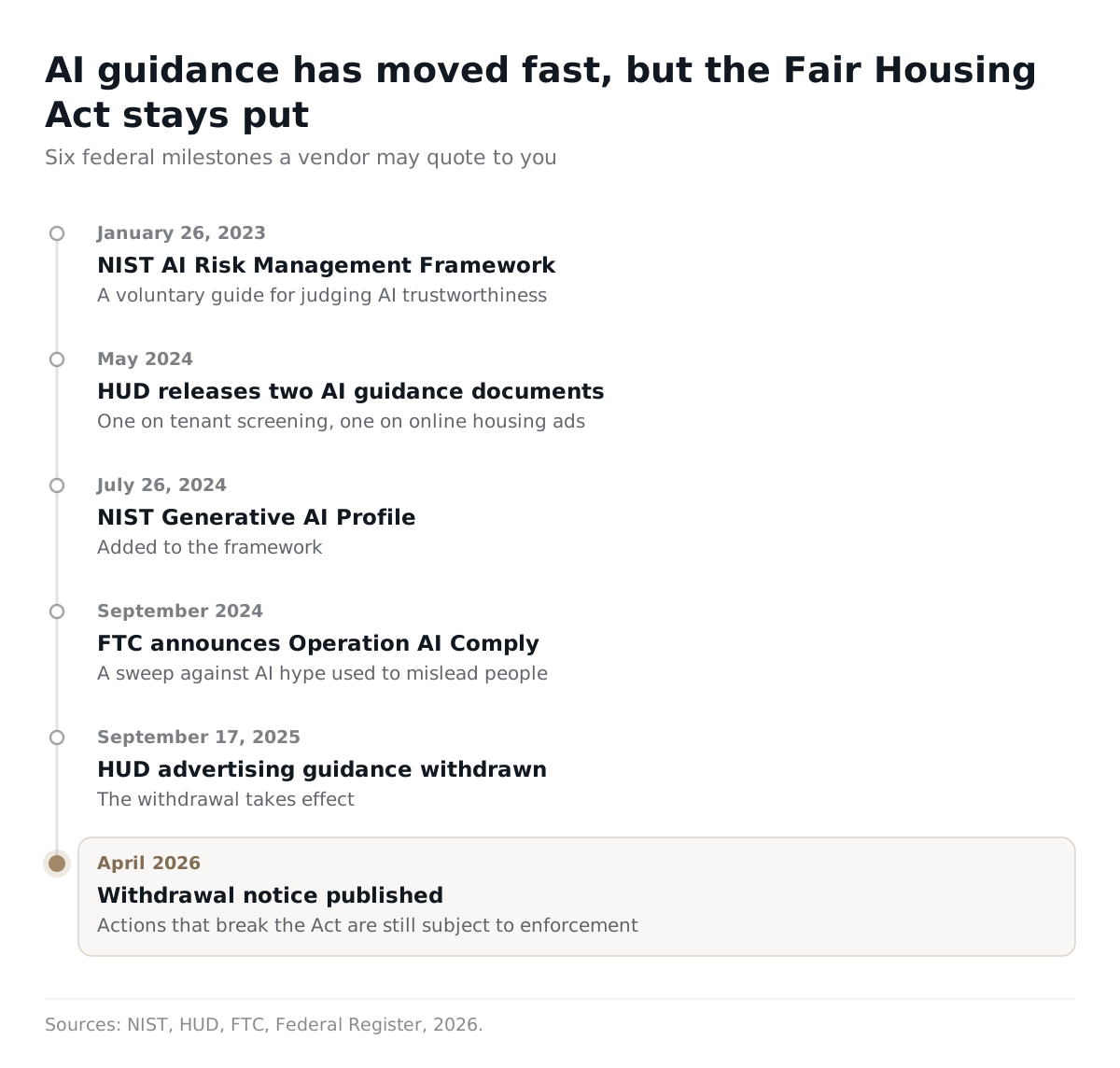
The Fair Housing Act bars housing discrimination because of race or color, religion, sex, national origin, familial status, or disability. In May 2024, HUD released two guidance documents on AI, one on tenant screening and one on housing ads served through online platforms. HUD later withdrew the advertising guidance, effective September 17, 2025, in an April 2026 Federal Register notice. That same notice says actions that do not comply with the text of the Act are still subject to enforcement. So guidance can come and go, but the Act stays. Check the current status of any guidance a vendor quotes to you. Our post on AI leasing tools and fair housing covers the leasing side in detail.
| Question | What a good answer sounds like | Red flag |
|---|---|---|
| Does your AI make or shape any decision about who gets housing? | A clear yes or no, and if yes, which decision. | "It just helps," with no specifics. |
| How do you test for unfair outcomes? | A described test, how often it runs, and who reviews it. | "Our model is neutral, so bias is not possible." |
| Can a person review and reverse a decision? | Yes, and the resident can ask for that review. | Decisions are final once the system makes them. |
| Which laws have you mapped the product against? | Named federal rules plus the states you operate in. | "Compliance is your responsibility." |
This section is general information, not legal advice. Confirm your obligations with your own counsel.
What should you ask about integration and onboarding?
Ask who does the setup work, how your existing data gets in, and how long until residents are using it. A slick AI is worth little if it sits next to your real system instead of inside it.
| Question | What a good answer sounds like | Red flag |
|---|---|---|
| How does our current data get in? | A bulk import, or a direct import from the system you use today. | "Your team can type it in." |
| What does week one look like? | A dated plan: data in, staff trained, then residents invited. | "Every rollout is different," with no plan. |
| Who teaches the AI our building's rules? | It reads your documents and notes, and your team can see and edit what it learns. | The vendor tunes it privately and you cannot see the result. |
| Is the AI part of the platform, or a separate tool? | Part of the same system your staff already use. | Another login, another inbox, another queue. |
What should you ask about pricing structure?
Ask how the price is counted, not just what it is. Per building, per unit, per seat, per conversation, and per minute all behave differently when your portfolio grows or a storm doubles the call volume.
| Question | What a good answer sounds like | Red flag |
|---|---|---|
| What unit is the price counted in? | One clear unit you can forecast. | Three meters stacked on top of each other. |
| Are there setup or implementation fees? | A plain yes or no, in writing. | "We will scope that after you sign." |
| What happens if AI usage spikes? | A visible meter and a hard limit you control. | Surprise overage charges on next month's bill. |
| How long is the contract, and can we change plans? | Clear terms and the freedom to move between plans. | A multi year lock in for a product you have not tested. |
How should you run the demo itself?
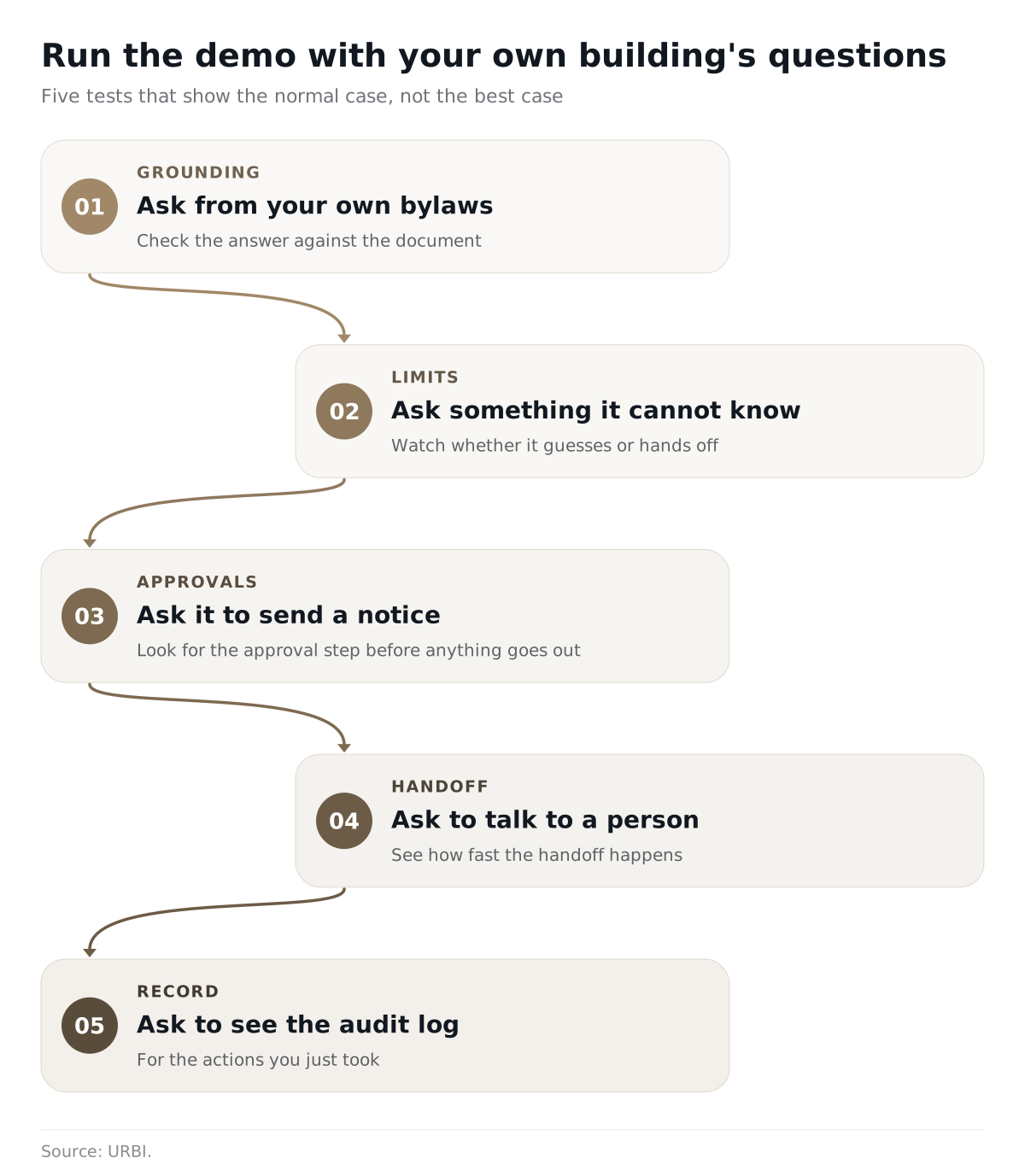
Run the demo with your own building's questions, not theirs. Bring three real resident questions from last month, one question your documents do not answer, and one request that should need a manager's approval.
- Ask a question from your own bylaws or rules and check the answer against the document.
- Ask something the AI cannot know, and watch whether it guesses or hands off.
- Ask it to send a notice, then look for the approval step before anything goes out.
- Ask to talk to a person, and see how fast the handoff happens.
- Ask to see the audit log for the actions you just took.
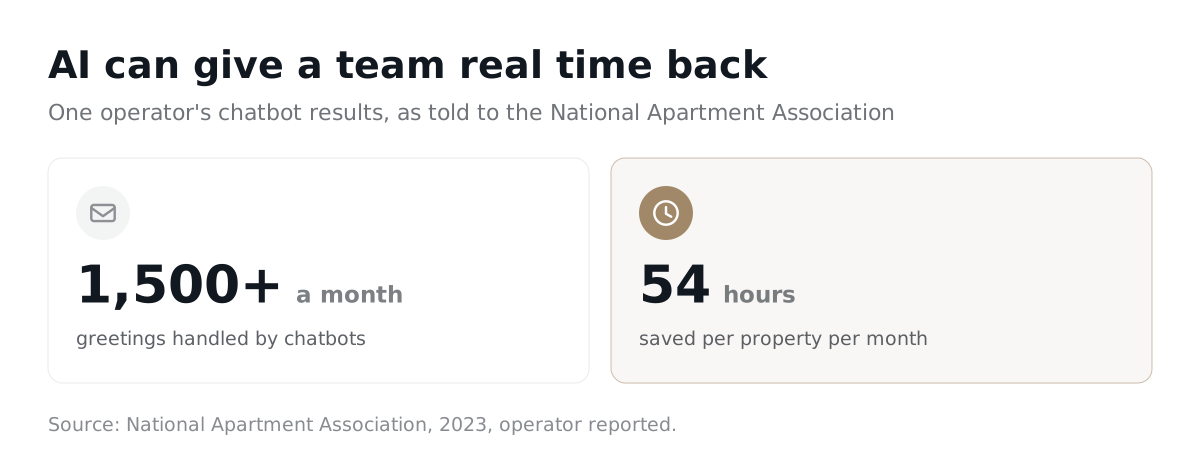
Keep the goal honest. AI can give a team real time back. In a National Apartment Association feature, Wendy Simpson of Edgewood Management and Vantage Management said chatbots handled more than 1,500 greetings a month and saved 54 hours per property per month. She also said, "it's not about replacing people with technology." Your questions are how you find a tool that works that way. For a ranked look at the field, see the best AI property management software in 2026.
How does URBI answer these questions?
URBI answers them with two AIs and one rule: AI proposes, people approve. HERO is the manager facing AI inside URBI's dashboard. Arthur, on the Premium plan, is the resident facing AI that answers calls, texts, emails, and in app chat.
| Question | URBI's answer |
|---|---|
| Does our data train outside models? | No. A building's data never trains outside models. It stays with that building. URBI never sells or shares resident data. |
| Who on our team can see what? | Visibility is property scoped, so onsite staff cannot see other properties. Inside a property, role based permissions control what each person can open and change. |
| Where do answers come from? | HERO works across the building's own records, documents, procedures, and the logged notes, conversations, and concierge messages your team already keeps. Each answer shows a "what I checked" list of sources. |
| What happens when it does not know? | HERO says so instead of guessing. Arthur escalates to the manager with a summary, relays the answer, and saves it to the property's knowledge base. Managers can view, edit, and delete those entries. |
| Can the AI act on its own? | No. Reads run instantly. Every action, from a ticket to a notice to a booking, stays a proposal until a person confirms. Multi step plans are approved step by step, and a failed step stops the plan. |
| Is there a record? | Yes. URBI keeps a permanent audit trail on every action. |
| Will residents know it is AI? | Yes. Arthur identifies itself as URBI's AI assistant and hands off to a person when someone asks. |
| How does our data get in? | Bulk CSV import of units and residents, and an import from Condo Control that brings service requests and tasks across. |
| How is pricing structured? | No setup fee and no implementation fee. A building can move between plans at any time. HERO runs on a weekly AI usage allowance per property, with a visible meter and a hard stop. |
One honest limit: URBI's AI is built for running the building, meaning tickets, bookings, notices, packages, and resident questions. If a vendor's AI shapes leasing or screening decisions, ask the fair housing questions above even harder. You can see how this fits together in URBI for condos and multifamily.
Frequently asked questions
How many questions should I bring to an AI vendor demo?
Bring ten to fifteen, chosen from the six groups above, plus three real resident questions from your own building. That is enough to test data, accuracy, approvals, fair housing, onboarding, and pricing in one hour. Send the list to the vendor a few days ahead. A vendor who answers in writing before the call is showing you how they will behave after you sign.
Should a condo board attend the AI demo?
Yes, if the AI will talk to owners or touch board records. Board members tend to ask the questions staff skip, like who sees owner data and who approves a notice. Invite one or two members, share the question list in advance, and agree before the call on which red flags would end the conversation. That keeps the meeting focused and the decision on the record.
What is the biggest red flag in an AI demo?
An AI that never says "I do not know." Every system meets questions its records cannot answer. A good one admits it and hands the question to a person. A risky one invents a confident answer, and your residents cannot tell the difference. Test this on purpose by asking something your documents do not cover.
Want to put URBI through these questions yourself? Book a demo at myurbi.co or email hello@myurbi.co, and bring your hardest question.


