



An amenity booking policy template for condo and apartment buildings gives every resident the same rules for the party room, the gym and the rooftop. Below is a full policy to copy, with blanks to fill, and a note on how URBI runs the booking side.
What should an amenity booking policy for a condo or apartment building include?
A good policy answers ten plain questions, and the template below turns them into sixteen short sections.
- Who may book?
- How far ahead, and how often?
- How long may a resident keep a room?
- How many guests may come?
- What does it cost, and what happens to the deposit?
- How do you cancel?
- What happens when someone does not show up?
- Who pays when something breaks?
- How does a resident ask for a change because of a disability?
- Who decides when a resident disagrees?
The Cooperator, a magazine for condo and cooperative boards, notes that usage rules often set how far ahead reservations can be taken, the dates a space is open and the fees. Those are the first blanks in any policy.
Our guide to amenity booking fairness rules explains the thinking behind the numbers. This post gives you the finished text.
Where does an amenity booking policy live, and who can adopt it?
The policy belongs in your building's rules, and the board can adopt it only as far as your governing documents allow.
David M. Bendoff, an attorney at Kovitz Shifrin Nesbit, writes in his Daily Herald condo column that the conservative approach is to put party room do's and don'ts in the actual rules, not only in the reservation agreement. He adds that better drafted rules attach the agreement as an exhibit.
The law firm Smith, Gambrell and Russell warns boards against adopting rules and fines that are disproportionate to the offense or not permitted by the bylaws. It adds that governing documents usually change by a supermajority vote, not by board decree.
So do three things before you publish:
- Read your declaration and bylaws for anything about common areas, fees and fines.
- Ask your attorney whether the board can adopt the policy by resolution or whether owners must vote.
- Attach the policy to every booking, so each resident sees the same text.
What does a full amenity booking policy template look like?
Copy the policy below and fill every blank written as ______. Where a line shows two choices in brackets, keep one and delete the other.
Amenity Booking Policy for ______ (building name)
Effective ______ (date). Adopted by ______ (the board or the management office). Questions: ______ (office phone or email).
- Why we have this policy. Shared rooms belong to every resident. These rules keep booking fair, keep rooms in good shape and keep the building safe. The same rules apply to everyone.
- Who may book. [Owners and tenants of record / Residents who are 18 or older and live in the building] may book. You must attend and host your own event. You may not book for a business, a sale or a paid event. Guests may not book.
- What can be booked. The bookable rooms are ______ (for example, the party room, the rooftop terrace, the lounge, the gym studio). Each room has its own page that lists its hours, its guest limit, its fee and deposit, and any safety rule.
- How to book. Book through ______ (the URBI app or the office). A booking is confirmed only when you receive a confirmation. You may book no more than ______ days ahead and no fewer than ______ days ahead.
- Booking limits. Each unit may hold ______ upcoming bookings of the same room at one time and ______ bookings in total each month. On these peak dates, each unit may book ______ time(s) a year: ______ (list holidays and long weekends).
- Hours and length. Events end by ______ pm, and the room must be clear by ______ pm. Setup and cleanup happen inside your booked time [or: we add ______ minutes before and after].
- Guests and capacity. The guest limit is ______ for each room, and it never goes above the maximum set by the fire authority. The host stays for the whole event. The host gives the office a guest list ______ days ahead. Guests follow the same rules as residents.
- Fees and deposits. The fee is ______ and the deposit is ______ (both set by the board). The deposit is due [at booking / ______ days before the event]. We return it within ______ days after the room is checked. We keep all or part of it only for damage, extra cleaning, overtime or a broken rule. For any amount we keep, we send you a written reason and photos.
- Cancelling. Cancel at least ______ [hours / days] before the start for a full refund of the fee and the deposit. After that, [we keep ______ / the fee is not refunded]. If the building must cancel for an emergency or a repair, you get a full refund or a new date of your choice.
- Late starts and no shows. We hold your room for ______ minutes after the start. After that, the room may go to another resident. After ______ unexcused no shows in ______ days, your next booking needs ______ (a deposit paid up front, or approval from the office) for ______ days. This step is temporary and the same for every unit.
- Condition and cleaning. Staff or the host take photos of the room at the start and at the end. Leave the room as you found it by ______ pm. Remove all food, decorations and trash. Do not use tape, nails or confetti on walls or floors.
- Conduct. Follow the building house rules and all state and local laws. Quiet hours start at ______ pm. Alcohol is [allowed only in ______ / not allowed]. Smoking and open flames are not allowed. Music must not be heard outside the room.
- Who is responsible. The resident who books is responsible for every guest and for any damage the event causes. Before the event, the host signs ______ (the waiver and agreement) [and shows proof of event insurance if alcohol is served].
- Accommodations. If you need a change to any rule because of a disability, tell ______ (name or office), in writing or out loud. We will answer within ______ days. We do not charge an extra fee or deposit for an accommodation.
- Decisions and appeals. Staff record every cancellation, kept deposit and exception. If you disagree, ask ______ (the manager or the board) in writing within ______ days. We will answer in writing.
- Changes to this policy. The board may change this policy. We will post any change ______ days before it starts. Confirmed bookings keep the terms they were made under.
Print a one page summary for each room from sections 3 to 10. Residents read the short page. The full policy stays on file for the day someone disputes a deposit.
How do you choose the numbers in the blanks?
Start from what other organizations that run shared rooms publish, then adjust for how busy your rooms are.
| Setting | What a published policy does | Starting point to test in your building |
|---|---|---|
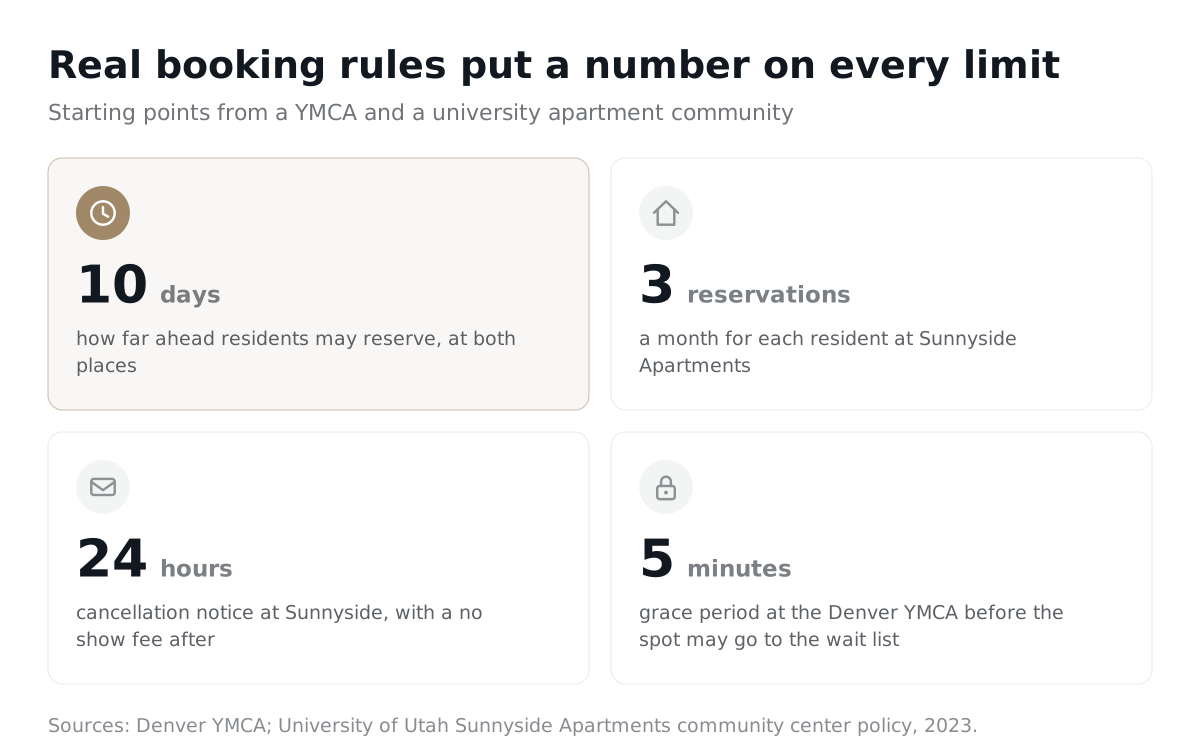
| How far ahead residents may book | The Denver YMCA opens fitness class reservations 10 days ahead and says this helps limit no shows. | A longer window for the party room, a shorter one for a gym or lounge slot. |
| Notice before an event | University of Utah's Sunnyside Apartments asks for new reservations 10 days in advance. | Match the time your staff need to prepare the room. |
| Booking limits | Sunnyside lets each resident make up to three reservations a month. | Two or three a month for each unit, plus a separate cap on holiday dates. |
| Cancellation notice | Sunnyside asks for at least 24 hours, with a no show fee after that. | A short window for small rooms, a longer one for any room that carries a deposit. |
| Grace period | The Denver YMCA gives 5 minutes, then may give the spot to someone on the wait list. | A few minutes for a gym slot, a little longer for an event room. |
| Guest limit | Sunnyside sets a maximum occupancy for each room. | The lower of what the room holds comfortably and the limit your fire authority sets. |
These are examples, not rules. A university apartment community and a YMCA are not condo towers. Their numbers show what organizations that run shared rooms actually ask of people.
On the guest limit, ask your local fire authority for the number. The Illinois State Fire Marshal, for one, says a meeting room with an occupant load of 50 or more is assembly use, which brings the assembly chapters of the life safety code into play. Your state and city may differ.
Then check your numbers against a season of real bookings. If a room is full every Saturday, tighten the cap. If it sits empty, loosen it.
Which amenity booking rules can create a Fair Housing problem?
Two kinds of rules cause the most trouble: rules that limit a family's use of a shared room, and fees charged for an accommodation.
The federal rule, 24 CFR 100.65(b)(4), makes it unlawful to limit the use of privileges, services or facilities associated with a dwelling because of familial status. It names race, color, religion, sex, disability and national origin too.
In a 1992 legal opinion, HUD's General Counsel wrote that the Act does not stop reasonable health and safety rules. The same letter says that restricting children from a pool at certain hours needs a health or safety reason. It describes a rule that a responsible adult supervise young children as more tailored and less problematic. It also says a general policy that excludes anyone who damages recreation room property, whatever their age, is allowed. The letter warns that HUD's views do not bind the courts.
That gives you four drafting habits:
- Write each safety rule for the activity, not for a group of residents.
- Write the safety reason next to the rule.
- Apply every damage and conduct rule to every age.
- Have your attorney read any rule that mentions children before you post it.
Accommodations are the second trap. The HUD and DOJ joint statement on reasonable accommodations says a request can be made orally or in writing. It also says housing providers may not require a person with a disability to pay extra fees or deposits as a condition of an accommodation. Section 14 of the template says so in plain words.
This is the law as of November 2026. This is general information, not legal advice. Confirm the rules for your building with your attorney.
Who is responsible when a guest damages the amenity?
The resident who books the room is responsible, and the policy should say so before the booking is confirmed.
Howard Dakoff, a community association attorney at Levenfeld Pearlstein, told the Cooperator, "People don't like it when they are found liable because of guests' behavior." The same article says whoever signs the agreement for the space is generally legally responsible for the people who attend. It also advises that the property manager and the doorman get the guest list in advance. Sections 7 and 13 of the template do both.
The building has a duty too. Mark Einhorn, an attorney at Marcus, Errico, Emmer and Brooks, says boards should take reasonable steps to protect the association from liability and damage when residents use a room privately. Ask your attorney and your insurer whether hosts should carry event insurance or sign a waiver. Our posts on amenity booking waivers and amenity booking deposits cover both.
How do reminders and grace periods cut no shows?
A reminder shortly before the booking and a short grace period after the start keep rooms from sitting empty.
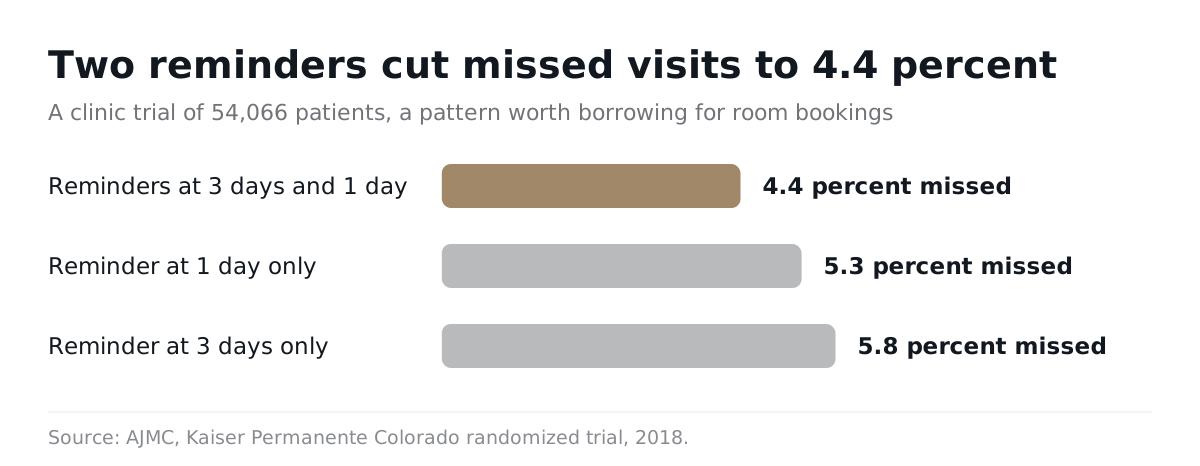
In a randomized trial of 54,066 patients at Kaiser Permanente Colorado, patients who got reminders 3 days and 1 day before a visit missed 4.4 percent of visits. Patients who got only the 3 day reminder missed 5.8 percent. Patients who got only the 1 day reminder missed 5.3 percent.
That is a clinic, not a condo. The lesson still carries: a second reminder costs almost nothing. The grace period is the other half. The Denver YMCA's 5 minute grace period lets staff hand a spot to the next person. Section 10 of the template does the same for a room.
What to do after a repeated no show is a separate question. Our guide to amenity no shows covers it.
How does URBI run an amenity booking policy?
URBI runs the booking itself, and your policy decides the limits. The building team writes the rules first, then sets up each room, its deposit and its cancellation rules to match.
In URBI Kore, the staff dashboard, amenity booking includes:
- Capacity aware scheduling with conflict detection, so two residents cannot hold the same room at the same time.
- Card checkout and deposits, with cancellation and refund flows.
- Deposit keep or return with an audit trail, so you can show why an amount was kept.
- Deposit collection closer to the date, when a building prefers it.
- Multi day bookings with a buffer after service, on the Kore and Premium plans.
- QR links and emailed booking links that open the resident app.
- Analytics on calendar and list views, to check your numbers against real use.
- Room closures scheduled straight from a service ticket.
HERO, the AI inside Kore, can propose an amenity booking, and a team member confirms it before it exists. Arthur, URBI's resident facing AI assistant, can book amenities for residents by voice, text, email or in app chat, with PIN verification before anything sensitive.
When you adopt the policy, announce it as a news post. A post goes out in the app, by push and by email at the same time, to the whole building or to chosen units. Keep it short. Our post on why residents do not read building notices explains why. For the full picture of the platform, see URBI for condos and multifamily.
Gyms need their own hours and guest rules. We cover them in condo gym rules.
Frequently asked questions
How far in advance should residents be able to book an amenity?
No single number is right. Published examples cluster around 10 days: the Denver YMCA opens class reservations 10 days ahead, and Sunnyside Apartments asks for 10 days of notice. Give the party room a longer window than the gym. Review a season of bookings, then move the number up or down.
Can a condo board limit how many times a unit books a room?
Usually yes, if your governing documents allow it and the limit applies to every unit the same way. Sunnyside Apartments caps each resident at three reservations a month. Check your declaration and bylaws first. Keep limits tied to the room, never to a group of residents.
Should every amenity have its own policy?
Use one building policy and a short page for each room. The page lists hours, guest limit, fee, deposit and any safety rule with its reason. One policy keeps the rules consistent. The room pages keep the details easy to find.
If you want to run this policy with bookings, deposits and cancellations in one place, email hello@myurbi.co or book a demo.


