



Why residents do not read building notices comes down to fixable things: the wrong channel, too many messages, notices that do not apply, bad timing, a buried ask, and the wrong language. URBI tackles the first three with targeted notices on channels residents check.
Most advice on this topic is tips with no numbers. This guide uses the data that exists, says where it runs out, and ends with a notice audit your board can run this month.
What share of residents actually read building notices?
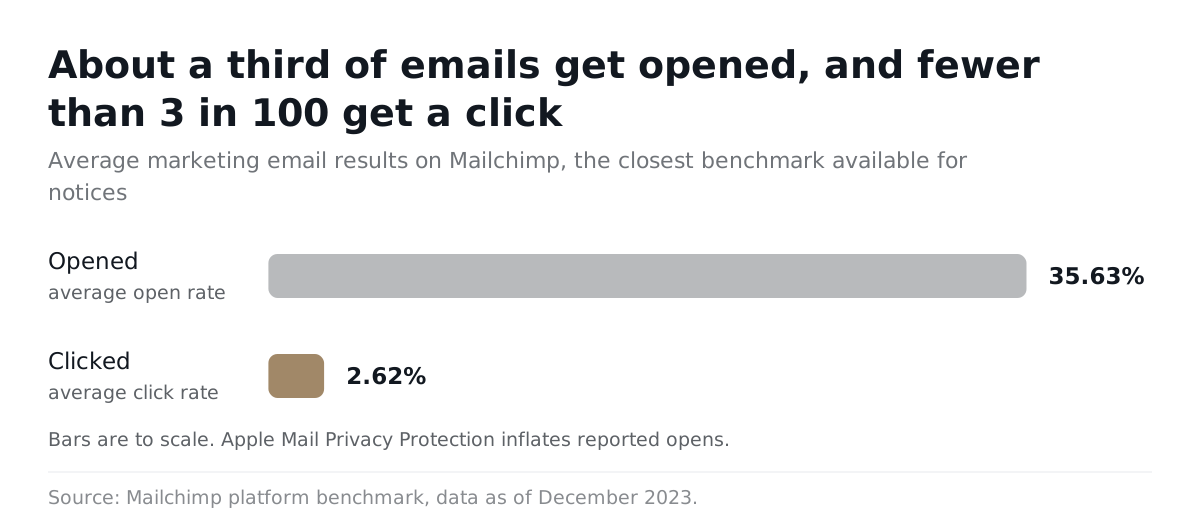
Nobody publishes a verified read rate for building notices, so the best answer comes from email benchmarks: roughly a third of people open a typical email, and only a few percent click anything. Treat that as your ceiling for an ordinary email blast, not your floor.
Here is what the closest reliable data says:
- Opens. Mailchimp's own platform benchmark, covering campaigns sent through its service, put the average open rate at 35.63% and the average click rate at 2.62%, based on data as of December 2023. It is marketing email, not building notices, but no independent benchmark for resident notices exists.
- Opens are overstated. Apple's Mail Privacy Protection stops senders from learning when and how many times a person views a message. It downloads remote content in the background when the email arrives. Many "opens" in your report are a phone fetching an image, not a person reading.
- Skimming is the norm. Microsoft's 2025 research found the average worker receives 117 emails a day, most skimmed in under 60 seconds.
So for a building wide email, at best about one in three residents glances at it, and a small handful act. If a notice needs everyone to do something, email alone will not get you there.
One more caution. You will see claims online that almost every text message gets read within minutes. We could not trace those figures to a published study, so we do not use them here.
Why do residents ignore building notices?
Residents ignore notices because much of what the building sends does not apply to them, arrives on a channel they do not watch, and hides the one thing they need to do. Each cause has its own fix. Work through them in order.
Is the channel wrong?
Often, yes, because the channel people say they prefer is not the one they react to fastest. Renters do say they like email. In the 2024 NMHC and Grace Hill Renter Preferences Survey of 172,703 renters, email was overwhelmingly preferred, even for non emergency maintenance requests.
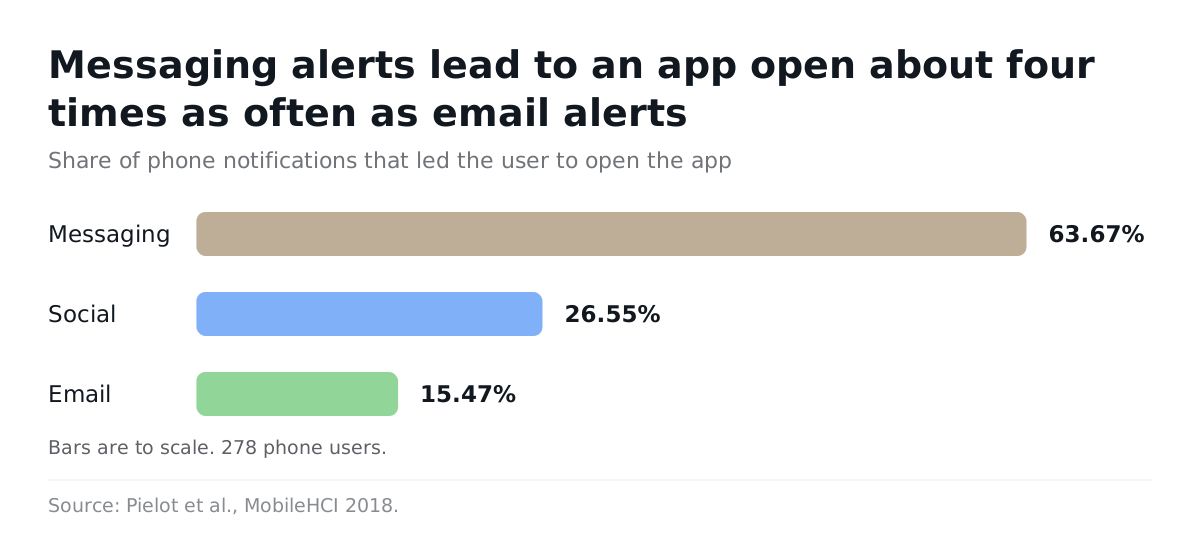
Preference is not the same as attention. In a study of 278 phone users published at MobileHCI 2018, about two thirds of messaging notifications led people to open the app, but only about 15% of email notifications did. The exact rates were 63.67% for messaging, 26.55% for social apps, and 15.47% for email, so messaging alerts led to an app open about four times as often. Email is a fine record. It is a weak alarm. Keeping that written record in one findable place is covered in our guide to the tenant communication log.
Age and income change the answer too. Multifamily Executive reported in 2024 that Gen Z renters favor tech driven communication while baby boomers lean toward email and portals. Pew found in 2025 survey data that only 54% of adults in the lowest income group have home broadband, compared with 94% in the highest income households. About a third of that lower income group rely on a smartphone alone. A notice plan built on one channel will miss someone.
Are you sending too often?
Probably, if every notice goes to every resident. The same 2018 study found participants received a median of 56 notifications a day. Your building is competing with all of them. Each notice that does not matter to a resident teaches them that the next one will not matter either.
FEMA's 2023 IPAWS best practices guide reminds senders that the public may opt out of every wireless alert except a national emergency message. It tells agencies not to use the system as a "super tweet." Residents opt out of buildings the same way. They just do it by ignoring you.
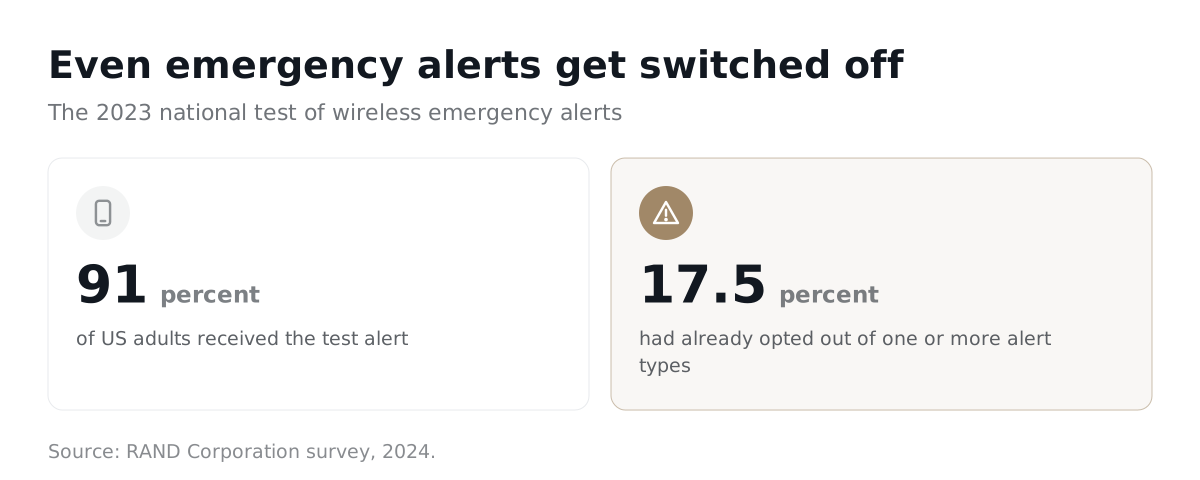
People really do switch alerts off. RAND's survey on the 2023 national test of wireless emergency alerts estimated that 91% of US adults received the test, and 17.5% had already opted out of one or more alert types. If people mute government emergency alerts, a building that sends too much is easy to mute too.
Does the notice apply to them?
Often not, and it is the easiest cause to fix. A stack C water shutoff sent to all 300 units wastes the attention of 270 of them. The FEMA guide asks senders a direct question: are you targeting the affected area, or alerting the whole county out of habit? Swap "county" for "building" and you have the best notice rule a board can adopt.
Is the timing off?
Timing fails in two ways: too early and too late. A notice sent three weeks ahead gets forgotten. A notice sent the night before misses anyone who already planned their morning. Send a first notice with enough lead time to plan, then a short reminder close to the event.
Does the tone bury the ask?
Yes, when the notice opens with a paragraph of context and puts the action at the bottom. FEMA's guide says every public alert must include the source, the hazard, the location, the protective action, and the expiration time. That list works for buildings too. Put what is happening, where, when, and what to do in the first two lines. Save the explanation for later.
Does the notice speak their language?
Not for a real share of your residents if you only send English. The Census Bureau found 21.7% of people age 5 and older speak a language other than English at home, based on 2018 to 2022 survey data. Many of them read English well. Some do not, and they miss the notice entirely. Short sentences and plain words help every reader, including anyone reading in a second language.
Is the unread notice problem overstated?
Partly, yes. Most owners rate their community well. The Foundation for Community Association Research found in its 2026 survey of 3,000 people that 86% rate their community association experience as positive or neutral. Missed notices are a leak. Leaks can be fixed.
Which building notice channels actually get read?
Phone notifications get acted on far more often than email, lobby and elevator screens reach people who never open anything, and email works best as the written record. No single channel reaches everyone. The table shows where each one fits.
| Channel | What the evidence says | Best for | Weak spot |
|---|---|---|---|
| 35.63% average open rate, 2.62% click rate (Mailchimp platform benchmark, December 2023 data); opens inflated by Apple Mail Privacy Protection | Detail, attachments, a record of what was said | Skimmed or buried; poor at urgent action | |
| App push notification | In a 2018 study, messaging app notifications led to opening the app about two thirds of the time, email about 15%; no public benchmark for building apps | Time sensitive notices for specific units | Only reaches residents who installed the app and allowed notifications |
| Text message (SMS) | Widely claimed to be read almost instantly; we found no published study to confirm a rate | Urgent, short notices | Consent and registration rules; character limits |
| App home screen banner | No public benchmark; seen by anyone who opens the app while it is live | Keeping an active notice in view until it ends | Only seen when the app is opened |
| Lobby and elevator screens | No public benchmark; seen by everyone who walks past, including people without the app | Building wide news, reminders, emergencies | Not personal; people who stay home miss it |
| Paper notice on doors or boards | No public benchmark | Legally required postings; unit entry notices | Slow to produce; easy to miss or remove |
Two rules come out of that table. First, match the channel to the urgency. Second, pair a push or text with a longer written version, so people get the alert fast and the details when they want them. Texting has its own legal rules, and our guide to texting residents legally under A2P 10DLC and the TCPA explains them.
Clear writing matters as much as the channel. Sarah Yaussi, vice president of business strategy at NMHC, wrote in Multifamily Dive in 2023 about "creating effective messaging and communicating it clearly." Plain writing helps on every channel.
How many building notices per month is too many?
Too many is any building wide notice that most of its recipients did not need. No published US study sets a safe monthly number for buildings, so be wary of anyone who quotes one. Set your limit by type of notice, then watch whether opt outs and repeat questions rise.
A simple notice budget looks like this:
- Building wide routine notices: bundled into one weekly roundup instead of separate emails.
- Targeted notices: as many as needed, as long as each one reaches only the units, floors, or access levels it affects.
- Urgent notices: whenever safety or service requires it, on push, text, and screens at once.
- Reminders: one per event, sent close to the time it matters.
Targeting changes the math. A resident might get ten notices in a month and feel informed, because all ten applied to them. The same resident getting ten building wide notices about other floors would feel spammed. Treat any count you pick as a starting point, and adjust it after your first 90 day audit.
What does it cost a building when notices are ignored?
Ignored notices cost buildings in damage, staff time, and trust, and the costs show up in places nobody tracks back to the notice. No US study has counted these costs, so the list below is the pattern managers describe, not a measured total.
- Property damage. A resident who never saw the freeze warning leaves a window open or turns the heat off. In a condo, water from one unit can reach the units below it.
- Front desk load. Every resident who missed the notice calls or walks up to ask about it. The same question gets answered again and again.
- Failed access days. Pest control, window cleaning, and fire alarm testing all need units ready. Missed notices mean return visits, rescheduling, and vendor frustration.
- Towing and parking fights. A garage cleaning day with cars still parked starts a week of complaints.
- Governance delays. A missed meeting notice can mean a missed quorum, a second meeting, and a vote that drags on.
- Emergency risk. The worst cost is quiet. Residents trained to ignore routine notices may also ignore the one that says the water main broke or the alarm is real.
The fix is to treat notices as a conversation. Marcella Eppsteiner, chief experience officer at Mission Rock Residential, told Multifamily Executive in 2024 that resident communication should run both ways, asking, "How are you responding?" Our guide to what residents want from their building makes the trust point in more detail. Residents judge a building by whether it tells them what they need, when they need it.
What does a building look like after it fixes its notices?
A fixed building sends fewer notices overall, each one reaches only the people it affects, and residents get answers without calling the desk. This is the part URBI was built for.
The pieces in URBI:
- Targeted announcements. Staff write a notice once, with rich text and a scheduled publish time. Per unit and access level targeting means the stack C shutoff reaches stack C, and nobody else. For multi property operators, one post can fan out across properties at each building's local send time.
- Home screen banners. A banner puts the notice on the resident app's home screen, so a resident who opens the app to book the gym still sees it.
- Push notifications. The alert arrives on the phone right away, for building updates, events, and emergencies.
- URBI Display in the lobby and elevator. Screens show building news, events, and weather. A property wide emergency takeover flips every screen to the alert. Our post on real time building communication with URBI Display shows how it works.
- Email replies that thread into the staff inbox. When a resident replies to an announcement email, the reply lands in the staff inbox as a threaded conversation, not in a forgotten mailbox.
- Arthur for follow up questions. On URBI Premium, Arthur answers residents by voice, text, email, and in app chat, in ten languages. Arthur only answers about the resident's own household. When Arthur does not know an answer, it escalates to the property manager with a summary, and the answer is saved so the next resident gets it right away.
The aim is fewer blasts and fewer calls to the desk. The full feature set is on our communication and community page, and the URBI for residential buildings overview shows how notices fit with packages, tickets, and amenities.
If you are comparing tools, our guide on how to choose building communications software lists the questions to ask any vendor. None of this works if residents never install the app, so read our playbook on resident app adoption before launch day.
How do you run a notice audit this month?
Pull every notice your building sent in the last 90 days and score it against eight questions. One board member or manager can do it in an afternoon. Expect to find notices that went to everyone when they affected only a few floors.
- Count them. List every notice sent in the last 90 days, with date, channel, and audience.
- Check the audience. For each one, mark whether it went to everyone or only to affected units. Circle the ones that should have been targeted.
- Check the first two lines. Do they say what, where, when, and what to do? Rewrite any that start with background.
- Check the channel. Did urgent notices go out on push, text, or screens, or only by email?
- Check the timing. Did each event notice have both a first notice and a reminder close to the day?
- Check the language. Do you know which languages your residents read? Did anyone ask for a translation?
- Count the follow up questions. Ask the front desk which notices caused the most calls. Those notices failed.
- Set a budget. Agree on a limit for building wide notices per month and write it into your communication policy.
Run the same audit again in 90 days. The number to watch is follow up calls per notice. If it falls, your notices are getting read.
What do boards ask most about building notices?
Should we stop using email for building notices?
No. Email is still what many renters say they prefer, and it gives you a written record of what the building said and when. The problem is using email as the only channel. Keep email for detail and records. Add push notifications, text, or lobby screens for anything urgent or time sensitive. That way residents get the alert fast and can read the full details when they are ready.
How do we know if residents actually read a notice?
You cannot know for sure from open rates, because Apple Mail Privacy Protection loads email content automatically when a message arrives. Track the full chain instead: notices delivered, residents who replied or acknowledged, units that completed the action, and follow up calls to the front desk. If a notice produces fewer confused questions than the last one, it was read and understood.
What should go in the first line of a building notice?
The first line should say what is happening and who it affects. For example: "Water off for stack C, floors 4 to 12, Tuesday 9 a.m. to 1 p.m." The second line should say what to do. Everything else, including the reason and the contact, goes below. Residents who read only one line should still know whether the notice applies to them.
If your board wants notices that reach the right people and a front desk that stops answering the same question all day, we can show you how URBI handles it in your building. Email hello@myurbi.co and we will walk you through a real announcement from draft to lobby screen. You can also start with what URBI is for the full picture.
Keep reading


