



Condo gym rules set when residents can train, who they can bring and what they sign. Good rules are short, posted at the door and applied to everyone alike. URBI, the building operations platform, helps with booking and notices. This guide ends with a sheet to copy.
The legal points below are current as of November 2026. This is general information, not legal advice. Confirm the rules for your building with your attorney.
Why does a condo gym need written rules?
A gym is a place where residents can get hurt, and a written rule shows the board took reasonable care. The US Consumer Product Safety Commission estimated about 565,000 emergency department visits in 2024 for injuries tied to exercise and exercise equipment. That count covers all exercise, not only condo gyms. It still shows the scale.
One New York case shows how an injury in a building gym can happen. A resident was running on a treadmill when an exercise ball that another resident had rolled aside got pulled under the belt. The treadmill lurched forward and he fell. He sued the cooperative, its managing agent and the neighbor. Habitat magazine reported that the cooperative pointed to a waiver, and that even with a waiver, the question is still whether the room was run in a safe and reasonable way.
A New York attorney told The Cooperator in 2014 that a building with a gym faces real risk of a lawsuit if someone is hurt. The point still holds. A short sheet of rules, posted and enforced, is cheap protection for a board.
What should condo gym rules cover?
Condo gym rules should cover who may use the gym, when, how many at once, who they may bring, what they sign, how they behave and what happens when they break a rule. Start with your declaration and bylaws. A board rule should fit them, so ask your attorney whether the board can adopt the rule or the owners must vote.
Most good sheets cover these ten things:
- Hours of use.
- Capacity, meaning how many people at once.
- Who may use the gym, and the proof of eligibility.
- Guests and who hosts them.
- Children and supervision.
- The waiver or acknowledgment form.
- Conduct, such as no food, no glass, proper shoes and no dropped weights.
- Equipment care, such as wiping machines down and reporting damage.
- Emergency steps.
- Enforcement.
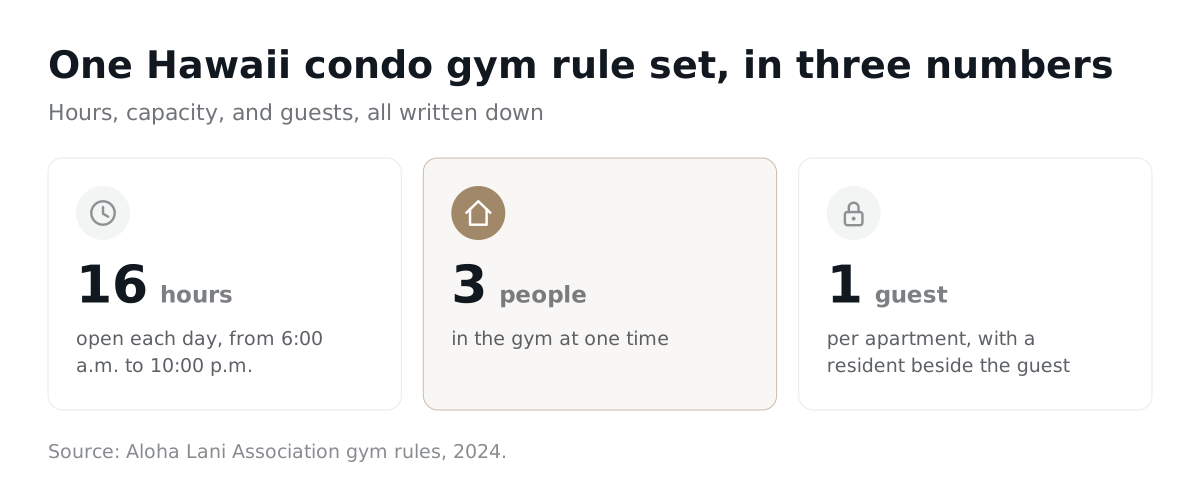
A real condo association in Hawaii posts a good example. Its gym rules set hours of 6:00 a.m. to 10:00 p.m., a limit of three people, one guest per apartment with a resident beside the guest, a signed waiver, and a rule that all policies are age neutral and applied to everyone equally.
The Community Associations Institute adds three habits. Track who uses the facility so you can plan. Let only residents in good standing use it, since common charges pay for it. Require ID at the door, and apply every policy to all members and guests equally, according to its clubhouse policy advice.
What hours should a condo gym keep?
Set hours by how close the gym is to a bedroom and by whether anyone supervises it. Noise is the usual reason for limits. Attorney Bonnie Reid Berkow, a partner at Wagner Berkow, advised in Brick Underground that a building should close the gym during the city noise code hours of 10 p.m. to 7 a.m. when an apartment sits close by. She also suggested signs asking people not to drop weights, and an occupancy limit set by what neighbors can bear. She said, “I don’t think it’s possible to make it dead quiet.”
That advice comes from New York City, so check your own local noise rules. The idea applies anywhere. Use these as starting points, not law:
| Where the gym sits | Hours to consider |
|---|---|
| Next to or under bedrooms | Close overnight, in line with local quiet hours |
| Far from bedrooms, such as a podium level | Longer hours, with key fob access |
| Staffed by the front desk | Match the desk hours, so someone can respond |
| Unstaffed at any hour | Fob or code access, a camera and a posted emergency number |
Joseph Grimes, president of EPG Spa and Pool Management, describes the unstaffed case in The Cooperator. Buildings give residents a key or digital code, and he recommends cameras around the workout stations. A second voice, Darrell Wilson of Playsites and Surfaces, says fobs make residents more careful because only neighbors use the room.
How should a condo gym handle guests?
Allow guests only with a resident host, cap the number and write the cap down. A guest rule works best when it answers five questions in plain words:
- Must the resident stay in the gym with the guest?
- How many guests may one unit bring at a time?
- Do guests sign the same acknowledgment form residents sign?
- Is the resident responsible for the guest’s conduct and for any damage?
- Do guests follow the same hours and age rules?
The Hawaii sheet above answers the first two with a resident escort and one guest per apartment. It also makes each resident responsible for making sure family members and guests can use the equipment safely.
A guest cap is a rule, and a rule can need an exception. The Department of Housing and Urban Development and the Department of Justice explain in their joint statement on reasonable accommodations that an accommodation is an exception, change or adjustment to a rule that a person with a disability may need, including in common use spaces. A resident who needs a helper with them in the gym is one case where the board may need to look at the guest cap again. Talk to your attorney before you say no.
Can a condo set age limits for the gym?
Be careful, because a rule aimed at children can break the Fair Housing Act. The federal rule at 24 CFR 100.65 bars limiting the use of facilities that come with a dwelling because of familial status.
Safety rules are still allowed. A 1992 legal opinion from HUD’s general counsel, numbered GME-0010, says the Act does not stop housing providers from setting reasonable health and safety rules, such as adult supervision for young children at a pool without lifeguards. The same opinion says providers may not require families with children to sign liability waivers that they do not require of others.
The National Apartment Association gives gym specific steps in its familial status chart. It says to check the equipment maker’s age guidance, and its advice is “Don’t tell residents that their children are not allowed.” It says requiring supervision by a competent adult is likely fine, and it gives a rule of thumb of ages 12 to 16 when the maker says nothing. The chart is not legal advice.
Insurers matter too. Andrew Meditz, president of Elite Pool and Fitness Management, told The Cooperator that some insurance companies will not let anyone under 16 use a gym without adult supervision. Call your broker before you pick an age.
| Safer wording | Riskier wording |
|---|---|
| Anyone under the age on the equipment label or in our insurance policy must have an adult in the room. | No children in the gym. |
| Every user and guest signs the same acknowledgment. | Families with children sign a waiver. Others do not. |
| Rules apply to every resident the same way. | Rules enforced harder against some households. |
Does a gym waiver protect a condo?
A waiver protects a condo only in part, so treat it as one layer and not the whole plan. Its best job is simple. The Community Associations Institute suggests asking users to sign waivers that show they understand all the facility rules.
Four limits apply:
- Negligence. Attorney David L. Berkey, a partner at Gallet Dreyer and Berkey, told The Cooperator that where an injury comes from negligent conduct, waivers are “dubious in value.”
- State law. In New York, General Obligations Law section 5-326 voids a clause that frees a paid gym operator from liability for its own negligence. Habitat magazine, writing about a cooperative resident’s gym injury, warned that a general waiver may not be enforceable there. Other states differ.
- Wording. Courts read these clauses strictly. In 2025 the Minnesota Supreme Court held in Lund v. Calhoun Orange that a clause shifting liability for a party’s own negligence is enforceable only when it states that intent clearly and unequivocally. That was a commercial fitness studio, not a condo, but the lesson carries over.
- Fairness. The HUD opinion above bars a waiver demanded only from families with children.
Insurance is the second layer. Berkey says the association must work with its insurance broker to confirm there is coverage for running the facility. Ask the broker three things: does the policy cover the gym, does the management company’s policy name the association as an additional insured, and does the insurer set an age rule.
A sound waiver routine has five steps:
- Your attorney writes the release language for your state.
- Every user signs the same form before first use.
- The form comes with the rules sheet, so people sign having read it.
- The board keeps signed copies on file.
- Guests sign the same form, or the host signs for the guest, as your attorney advises.
For a waiver aimed at residents who host events in shared rooms, see our post on amenity booking waivers.
Does a condo gym need a defibrillator?
A state law may require health clubs to keep one, and the legal definition of a health club decides whether a building gym counts. Illinois is an example. Its Physical Fitness Facility Medical Emergency Preparedness Act requires covered facilities to keep at least one automated external defibrillator. It excludes a facility serving fewer than 100 individuals, and a facility with no staff who instruct, train or assist users. Many building gyms fall outside it.
Ask your attorney and insurer what your state requires. Whatever the answer, post the emergency steps by the door: the building address to give a 911 operator, where the nearest phone is and who to call in the building.
What does a condo gym rules sheet look like?
It looks like one page a resident can read in a minute. Copy the text below, fill each blank and have your attorney review it before you post it.
Gym Rules for ______ (building name)
- Hours. The gym is open from ______ to ______ every day. It is closed from ______ to ______ to protect the quiet of neighbors.
- Capacity. No more than ______ people may use the gym at one time.
- Who may use it. Residents in good standing and their registered household members. Show your fob or ID if staff ask.
- Guests. Each unit may bring up to ______ guest(s) at a time. The resident must stay in the gym with the guest. The resident is responsible for the guest’s conduct and for any damage. Guests sign the same acknowledgment form as residents.
- Children. Anyone under ______ (the age on the equipment label or in our insurance policy) must be with an adult who stays in the room. This rule applies to every household.
- Acknowledgment form. Every user signs the acknowledgment form before first use. Ask the office for a copy.
- Conduct. No food or glass. Water in a closed bottle is fine. Wear closed, clean sports shoes. Keep music and calls to headphones. Lower weights with control and never drop them.
- Equipment. Wipe each machine after use. Return weights to the rack. Do not move equipment out of the gym. If a machine looks broken, do not use it and report it to ______ right away.
- Emergencies. In an emergency call 911 first. The building address is ______. Then call ______ at ______.
- Breaking the rules. The first breach brings a written reminder. A repeat breach may bring ______ (a fine set by our rules, or a pause in gym access) after notice to the unit owner, as our governing documents allow.
- Changes. The board may change these rules with notice to all residents.
What should the acknowledgment form say?
It should say that the person read the rules, understands the risks and agrees to follow them. Your attorney adds the release language your state allows. Here is a plain language shell:
Gym Acknowledgment for ______ (building name)
- I have read the gym rules and I agree to follow them.
- I understand that exercise carries a risk of injury, and I am responsible for knowing my own limits.
- I will not use equipment that looks damaged, and I will report it to ______.
- I will not use a machine in a way the maker warns against.
- [Release language written by the association’s attorney for this state goes here.]
- If I bring a guest, I will stay with the guest and I am responsible for the guest’s conduct.
Name: ______ Unit: ______ Signature: ______ Date: ______
How does URBI help run the gym rules?
URBI helps with the parts of the rules that depend on scheduling and notice. Your board still writes and enforces the rules.
- Peak hour slots. If crowding is the problem, URBI amenity booking schedules the gym by capacity and flags conflicts. It also enforces the cancellation rules the board sets. See URBI amenity management for the full picture.
- Repairs and closures. A team member can schedule a gym closure straight from a service ticket, so a broken treadmill does not stay in use.
- Telling every resident. A news post goes out in the app, by push and by email at the same time, and the team picks the audience by building, units or groups. A post reaches lobby screens only when a team member adds it as a banner. See why residents skip building notices before you write yours.
- Drafting. HERO, the AI for your team inside URBI Kore, can propose a notice about the new rules, and a person reviews and confirms it before it goes out.
- Visitor check in. URBI types each visitor as a guest, contractor, delivery or service, and a check in can require a waiver. That is a waiver for visiting the building, not for using the gym, so collect the gym acknowledgment form separately.
For more on software that handles pools, spas and gyms, read what amenity management software handles. To see whether the gym earns its space, read about amenity utilization. For a whole building policy, see the amenity booking policy template and the booking fairness rules. Building owners and managers can also read URBI for residential buildings.
FAQ
Can a condo gym be open 24 hours?
Yes, if the building can support it. Noise is the main limit, so a gym far from bedrooms suits longer hours better than one next to them. Without staff overnight, buildings commonly use key fobs or codes and cameras, as The Cooperator reports. Check local quiet hours and your insurance before you extend hours.
Can the board limit guests in the gym?
Usually, if the declaration allows the board to make the rule and the rule is reasonable and applied the same way to everyone. Association rule sheets commonly require a resident host and cap guests per unit. Ask your attorney, and plan for accommodation requests from residents with disabilities.
Can a condo ban children from the gym?
A flat ban is risky. Federal fair housing rules bar limiting facility use because of familial status. A rule that requires adult supervision under an age set by the equipment maker or your insurer is easier to defend, and it must apply to every household. Ask your attorney before you post an age rule.
Want a simple way to schedule the gym, post the new rules and reach every resident at once? Email hello@myurbi.co or book a demo and we will walk through it with your building.


