



An elevator outage notice to residents says which elevator is down, for how long, what to use instead, who to call if you cannot use stairs, and when the next update comes. Below are three templates to copy: planned, unplanned and extended. URBI can send them.
What should an elevator outage notice to residents say?
It should answer eight plain questions, in this order, in words a resident can read in ten seconds.
- Which elevator is down, and where is it?
- Since when, and until when?
- Why, in one plain sentence?
- What can residents use instead: another elevator, the freight car, the stairs?
- What changes for move ins, deliveries and trash?
- Who do I call if I cannot use the stairs?
- When is the next update?
- What do I do if I am stuck inside, or if it is an emergency?
A short real example shows the floor. In July 2025, Stanford's Cardinal Apartments posted a notice that named Elevator 3, said it was out for a cable replacement, gave an expected return date, told residents Elevators 1 and 2 stayed in service, and pointed them to the management office. New York City's housing agency publishes a sample interruption notice that asks for the building, the service, the start and end dates and the purpose of the work, in English and Spanish.
What those samples leave out is the sixth question. In September 2026, News4JAX reported that residents of a Jacksonville senior living community said their notice did not mention accommodations for people who use wheelchairs or walkers or cannot safely use stairs. The outage was expected to last four to six weeks. Every template below has that line.
Pick the notice that fits the situation.
| Situation | Send | What it promises |
|---|---|---|
| Work is scheduled and the dates are firm | Template 1, planned | Dates, a reason, the alternative, and a way to ask for help before the work starts |
| The elevator broke today | Template 2, unplanned | A fast first message, what you know, and a time for the next update |
| The outage will run past a few days | Template 3, extended | A status report on a fixed schedule, and a clear way to request help |
What is the template for a planned elevator outage?
Send the planned notice as soon as the dates are firm, then send a shorter reminder two days before the work starts. Residents who cannot use stairs need time to arrange rides, deliveries and help.
Subject: Elevator ______ (name or number) will be out of service from ______ to ______
Dear residents of ______ (building name),
The ______ (name or number) elevator will be out of service from ______ (start date and time) to ______ (expected end date and time).
Why: ______ (one plain sentence, for example: the cables and controls are being replaced).
What you can use instead: ______ (the other elevator / the freight elevator, available ______ (hours) / the stairs on the ______ side).
What changes:
- Move ins and large deliveries: ______ (moved to ______ / not available on these dates).
- Package room, mail and trash: ______ (no change / new arrangement).
If you cannot use the stairs: please tell us by ______ (date). Call ______ (phone), email ______ or message the office in the app. We will talk with you about what can work, such as help carrying groceries and packages, a temporary move to a lower floor, or ______ (other option you can offer).
What we are doing to help everyone: ______ (for example: chairs and water on the landings, extra staff for groceries and packages).
In an emergency, call 911.
Next update: ______ (date) by ______ (email / app message). If the dates change, you will hear from us first.
______ (name), ______ (title), ______ (phone)
Name a reason you can say out loud. Do not promise an end date the contractor has not given you in writing. If a date can slip, say what the date depends on.
What is the template for an unplanned elevator outage?
Send the first message within the hour, even when you know almost nothing. Residents who cannot use stairs may be trapped in or out of their homes, and a repair technician can take a day or more to arrive, according to the Disability Law Center of Virginia.
Subject: Elevator ______ (name or number) is out of service today
Dear residents of ______ (building name),
The ______ (name or number) elevator stopped working at ______ (time) on ______ (date). A technician ______ (has been called and is expected by ______ / is on site now).
We do not yet know how long the repair will take. We will send an update by ______ (time) today, even if there is nothing new.
What you can use instead: ______ (the other elevator / the freight elevator / the stairs).
If you cannot use the stairs, or you have an appointment you cannot miss: call ______ (phone) now. We will work out a plan with you today.
If you are stuck inside a car: press the alarm or emergency call button and wait for help. Do not pry the doors open.
In an emergency, call 911.
______ (name), ______ (title), ______ (phone)
The stuck rider line comes from New York City's Department of Buildings, which gives three rules: ring the alarm, relax because help is on the way, and wait without prying open the doors. The same page says never to use an elevator in a fire.
What is the template for an extended elevator outage?
Switch to the extended notice when the outage will run past a few days, and send it on a fixed schedule that you name in the first line. Residents can wait for news if they know when it is coming.
Subject: Elevator update, day ______: the ______ (name or number) elevator is still out of service
Dear residents of ______ (building name),
The ______ elevator has been out of service since ______ (date). This is our update for ______ (date). We will send the next one on ______ (date), every ______ days until it is fixed.
Where the repair stands: ______ (for example: the part was ordered on ______ and the supplier says ______ / the contractor starts on ______).
Expected return: ______ (a date / "we do not have a firm date yet; we will know more on ______").
What we are doing now: ______ (for example: pushing the contractor for an earlier start, arranging help on the stairs).
Help available today:
- Help carrying groceries, packages and laundry: ______ (hours and who to ask).
- Chairs and water on the landings: ______ (floors).
- Package room and trash: ______ (arrangement).
If you cannot use the stairs safely: tell us. You can ask by phone, email or message, and you do not need a special form. Call ______ (phone) or email ______. We will respond within ______ (time) and talk with you about options, which may include ______ (a temporary move, other lodging, other help).
In an emergency, call 911.
______ (name), ______ (title), ______ (phone)
Do not copy the bracket about a temporary move or other lodging unless you can offer it. Offer only what you can deliver. A short list you keep beats a long one you do not.
What help do residents who cannot use stairs need?
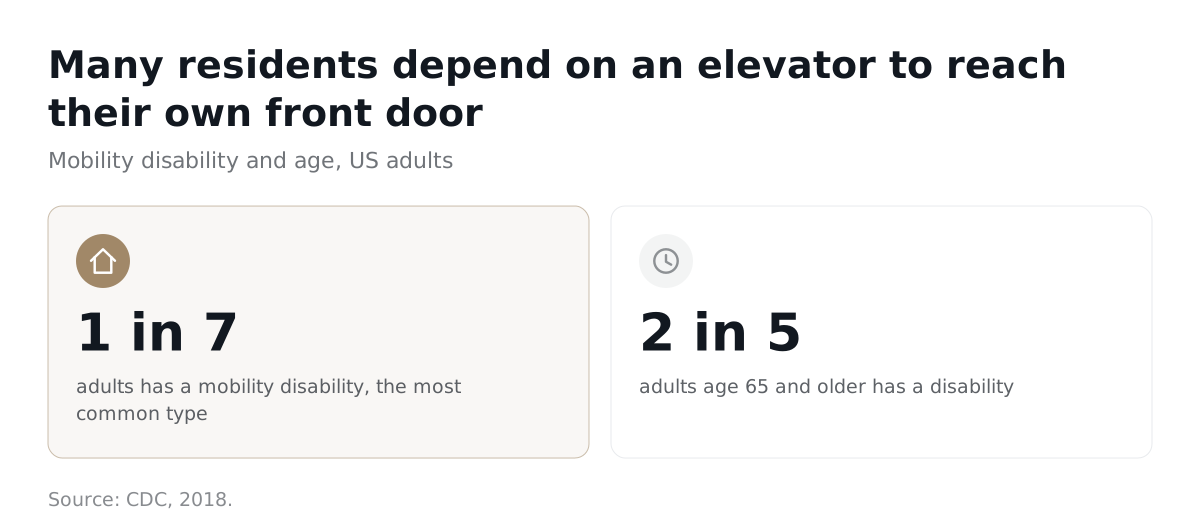
They need a named person to talk to and at least one real option. The CDC reported in 2018 that mobility is the most common disability type, affecting 1 in 7 adults. It also said disability affects about 2 in 5 adults age 65 and older. In a tower, expect several residents who depend on the elevator.
Published guidance lists the same kinds of help.
- Temporary relocation to a vacant unit on a lower floor, or to accessible lodging. The Minnesota Council on Disability and the Disability Law Center of Virginia both list it.
- Errand help for groceries, laundry, medications and trash. Both sources list it too. Minnesota notes that managers added hours on site and that volunteers ran errands in some buildings.
- Supervised elevator use. Minnesota describes one building where management ran the elevator in supervised service for 20 minutes in the morning and 20 in the afternoon for several weeks. That works only when the repair stage allows it, so ask the contractor.
- Comfort on the stairs. Jacqueline Duggin, a building manager at a Manhattan residential management firm, told New England Condominium that her board hired extra staff for groceries and luggage, put chairs on each landing and provided cold bottles of water.
Not every building can do all of this, and the notice should not pretend otherwise. Joe Caracoppa, an elevator consultant at Sierra Consulting Group, put the hard part simply in the same article: "When the elevator is out, it's out." He was describing single elevator buildings, where the question is how people get up and down for weeks. A building with a second car or a freight elevator has an easier answer. Write the one you have.
The Disability Law Center of Virginia says a housing provider must either grant an accommodation request or talk through the options. Plan for that conversation before the notice goes out. Name one person, with a phone number, who takes these calls. Our building emergency preparedness plan post covers the wider list of residents you need to know about before something fails.
How much notice do residents have to get?
It depends on where the building is. New York City sets exact rules, so treat the city rules below as one example and look up your own city and state.
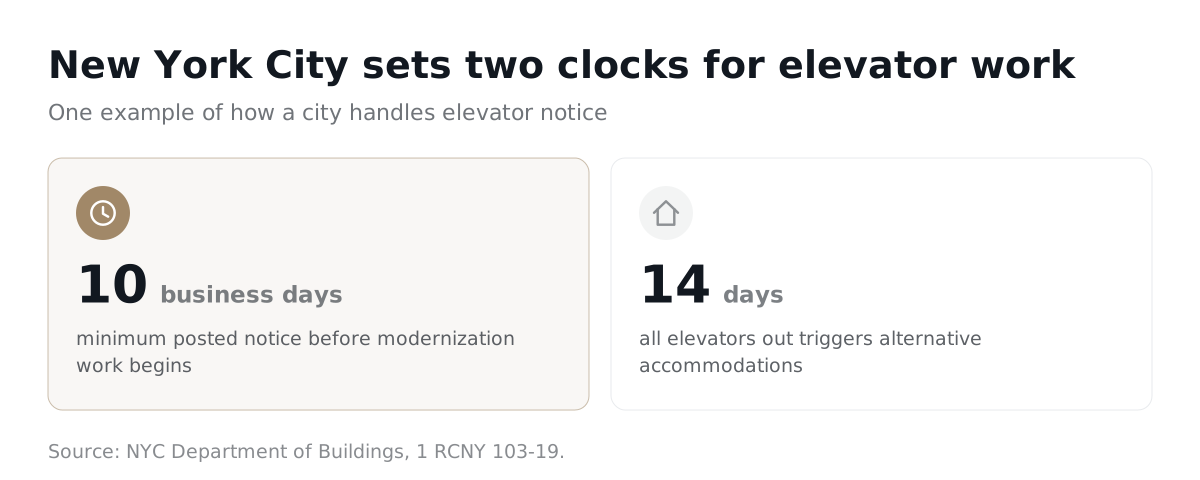
New York City's Department of Buildings says owners of multiple dwellings must notify residents if an elevator will be out during planned construction or is expected to be out for two or more hours. When a modernization application has been filed, it says notices must be posted at least ten business days before work begins, with the type of work and the start and end dates. A separate city rule, 1 RCNY 103-19, says that when all elevators in a building or section are out for more than 14 days, the owner must provide alternative accommodations. That can mean a temporary lift, relocation, or reimbursement of lodging costs, and residents with disabilities must be relocated to an accessible ground floor space. The owner must also post a notice of those rights next to the hall call buttons on each affected floor. The city lists the rule as effective June 11, 2026.
Federal law works differently. The Fair Housing Act makes it unlawful to refuse reasonable accommodations in rules, policies, practices, or services when they may be necessary for a person with a disability to use and enjoy a dwelling (42 U.S.C. 3604(f)(3)(B)). A joint statement from HUD and the Department of Justice says the Act applies to condominium associations as well as owners and managers. It says a request can be made orally or in writing, and that an undue delay in responding may be treated as a failure to provide the accommodation.
The Disability Law Center of Virginia says the Act gives no required repair timeline but that the timeline must be reasonable, and that lengthy or repeated outages may violate the Act. So an outage alone is not a violation. A slow, silent response to the people who cannot manage without the elevator is the risk. The notice, and the record of what you sent and when, is your evidence that you responded.
As of November 2026, this is how these sources read. This is general information, not legal advice. Confirm the rules for your building with your attorney.
How do you send an elevator outage notice so residents see it?
Send it where residents already look, repeat it on the schedule you promised, and keep a dated copy of every version. Paper on the lobby door reaches only the people who walk past it. Our post on why residents do not read building notices explains what to change, and proof of notice for residents explains how to show later that everyone was told. If a water shutoff is on the same calendar, the water shutoff notice templates use the same format.
Also post a sign at the lobby and on each landing. Here is one to print.
ELEVATOR ______ (name or number) OUT OF SERVICE
Since ______ (date). Expected back: ______ (date or "update on ______").
Use: ______ (other elevator / freight elevator / stairs).
Need help getting up or down? Call ______ (phone).
Stuck inside a car? Press the alarm button and wait. Do not pry the doors.
Here is how URBI handles the sending.
- In URBI Kore, a team member publishes a news post. It goes out in the app, by push and by email at the same time. Choose the whole building, specific units or groups, and schedule it ahead if you want. There are three urgency levels, and an AI urgency scan reads each draft. An urgent post reaches residents even if they turned off notifications for news.
- HERO, the AI inside Kore, can draft the post from a few facts. A person reviews and confirms it before anything goes out.
- URBI keeps each post's urgency level, publish date and audience on the record. It does not record who received or read a post, so keep your own copy of what you sent.
- A team member can add the notice to URBI Display as a banner on the lobby screens. A post never lands on the screens by itself. A screen inside the car that is down helps no one, so aim for the lobby. Keep the emergency takeover for emergencies.
- Residents can message the concierge desk in the app, so a request for help arrives as a message you can answer.
- Arthur, the resident facing AI, answers by voice, SMS, email and in app chat in ten languages. It identifies itself as URBI's AI assistant and hands off to a person when someone asks. Questions it cannot answer go to your team with a summary. For buildings with many languages, our post on multilingual resident communication shows the wider picture.
If your building takes elevator bookings for move ins, check them against the outage dates. Our post on elevator booking software for condos covers how to manage those reservations.
To see the whole platform, read what is URBI, or see how it fits condos and multifamily buildings.
FAQ
How long can an elevator be out before it becomes a legal problem?
The Disability Law Center of Virginia says the Fair Housing Act sets no required repair timeline, but the timeline must be reasonable, and lengthy or repeated outages may violate the Act. Some cities add their own limit: New York City requires alternative accommodations after 14 days with all elevators out. Check your city, and document every step you take.
Do we have to notify residents about a short outage?
New York City requires notice when an elevator is expected to be out for two or more hours. Elsewhere, check local rules. Even where nothing requires it, send a short message. A resident who cannot use stairs is affected within minutes, and a two line message costs you almost nothing.
Can a resident ask for help by phone instead of in writing?
Yes. The HUD and Department of Justice statement says a reasonable accommodation request can be made orally or in writing. Writing helps both sides, so write down what the resident asked for and when, and send it back to them to confirm. Then respond promptly, because undue delay can itself count as a failure.
Ready to send the notice, the reminders and the record from one place? Email hello@myurbi.co or book a demo, and we will show you how URBI runs your building notices.


