



A water shutoff notice to residents needs five things: what stops, where, when it starts, when it should return, and who to call. The same shape works for elevator and power outages. With URBI, a building can send all three from ready templates and keep the record in one place.
This guide covers what each notice must say, how much warning to give, who hears first, which channel wins, and how to prove delivery. Three copy ready templates are below. Edit the brackets and send.
What must a water shutoff notice to residents include?
A water shutoff notice must name the service, the affected area, the start time, the expected end time, and a contact. Everything else is a helpful extra. Residents plan showers, laundry, and cooking around the window you give them, so the window is the heart of the notice.
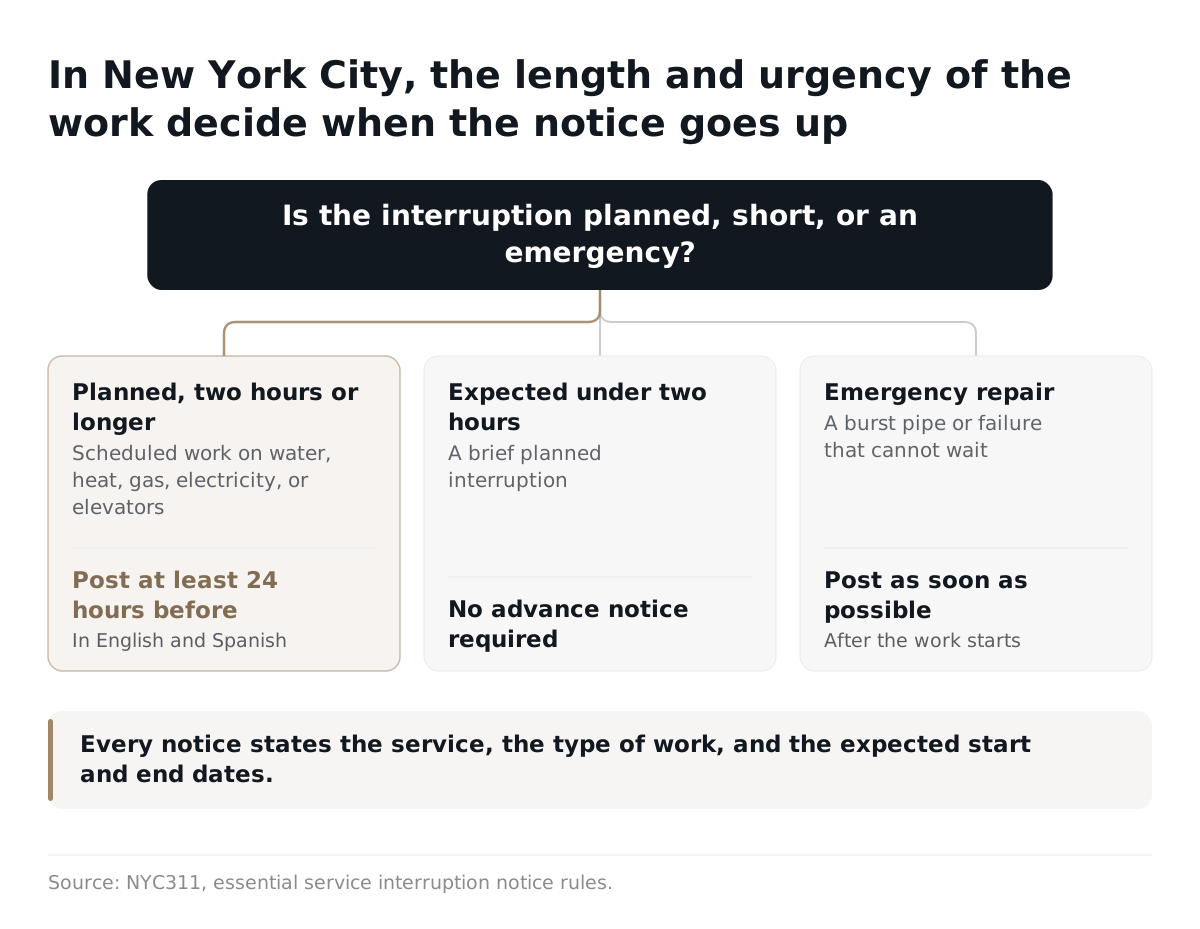
New York City is a good model because it writes the minimum down. Its NYC311 rules require the notice to state the service being interrupted, the type of work, and the expected start and end dates. The city also publishes a sample interruption form that lists cold water, hot water, electricity, and elevators on the same page.
Use this checklist for every water notice:
- Building, stack, floors, or units affected. Say "all units" only if it is true.
- Service affected: cold water, hot water, or both.
- Reason in one plain sentence, and whether the work is planned or an emergency.
- Start date and time.
- Expected restoration time, or the honest word "unknown."
- What residents should do: store drinking water, finish laundry, keep taps closed.
- A phone number for residents who need help, including a voice option.
- The time of your next update.
Then send a short restoration message when water is back. Residents remember the notice you forgot to close far longer than the one you sent.
How much notice should you give for a planned water shutoff?
There is no single US rule, so check your state law, city housing code, lease, and condo declaration first. Where none sets a deadline, a sensible house policy is 24 to 72 hours for planned work. Emergencies are different. You fix the leak and tell residents as soon as you can.
New York City shows how a real rule looks. Its essential service notice rules require posting at least 24 hours before a planned interruption begins. Advance notice is not required if the outage should last less than two hours, or if the work is an emergency repair. In an emergency, the notice goes up as soon as possible after work starts. The notice must be posted in both English and Spanish.
Two lessons travel well beyond New York:
- Write down which rule you follow. "Company policy: 48 hours for planned work" is defensible. A vague "we try to give notice" is not.
- Do not dress planned work as an emergency. If the plumber was booked last week, residents deserve last week's warning.
Language matters too. If your building has residents who read other languages, the notice should reach them in a language they read. Our guide to texting residents legally under A2P 10DLC and TCPA covers the consent side before you add SMS to the mix.
What does a planned water shutoff notice look like?
A good one fits on a phone screen and answers when, where, and who to call. Copy this one.
Water shutoff: [Building name], [date]
[Cold water / Hot water / All water] will be off in [stack, floors, or units] on [day, date] from [start time] to about [end time].
Why: [plain reason, for example "our plumber is replacing a valve on the main riser"].
Before the shutoff, please fill a few bottles of drinking water, finish laundry and dishes, and keep your taps closed.
Need help with water because of a medical or mobility need? Call [front desk number] and we will bring water to your door.
We will post an update at [time]. Questions: [phone] or reply in the URBI app.
What should an elevator outage notice say, and who hears first?
An elevator notice must say which car is down, which floors lose access, when it failed, whether a technician is coming, and when the next update will arrive. The residents who hear first are the ones who cannot use the stairs. They get a direct call or message before the building wide post goes out.
This is not an edge case. The CDC reports that more than 1 in 4 US adults have some type of disability, and 12.2 percent have a mobility disability. In a 200 unit building, that can mean dozens of people for whom "please use the stairs" is not an option.
In one large study, elevators failed more often than any other building service. A Columbia University analysis of New York City public housing outages from 2020 to 2022 found elevator outages were the most common type, averaging 94 per day. They lasted 11.2 hours on average.
HUD's 2026 Multifamily Disaster Preparedness Plan Template tells operators to identify residents most likely to need mobility help, including those with medical equipment. It even suggests asking residents one question in advance: "would you need help using the stairs?" Keep that list current and tagged to units.
The law points the same way. According to HUD Exchange, the Fair Housing Act requires housing owners to provide reasonable accommodations to persons with disabilities. A stranded resident with no plan is a problem you want to avoid.
Contact in this order:
- Residents on your mobility assistance list, one to one, by phone or direct message.
- Front desk, security, maintenance, and after hours staff.
- Every resident served by that elevator.
- Caregivers or authorized contacts, where the resident has agreed.
- Movers, delivery services, and home health visitors booked for that day.
What does an elevator outage notice look like?
It names the car, the floors, and a real person to call for help. Copy this one.
Elevator out of service: [Building name]
[Elevator name or number] is out of service as of [time]. Floors [range] are affected.
A technician is [scheduled for / on the way at] [time]. We do not yet have a firm repair time. We will update you by [time].
[Second elevator / service elevator] is [working / not working]. [Describe any alternate accessible route.]
If you need help getting in or out of your home, carrying groceries, or taking a pet out, call [front desk number]. Staff are available [hours].
Moves and large deliveries booked for today will be rescheduled. We will contact you directly.
What goes in a power outage notice, and how do you reach residents with the power off?
A power outage notice must state the scope, the cause if known, which elevators and doors are affected, what runs on backup power, the restoration estimate or "unknown," and a staffed contact. Then reach residents on phones and in person, because the building's own screens and WiFi may be dark.
Plan for long outages, not short ones. The US Energy Information Administration reports that US customers averaged 11 hours of electricity interruptions in 2024. Major events such as Hurricanes Beryl, Helene, and Milton caused 80 percent of those hours. An 11 hour outage needs three or four updates, not one.
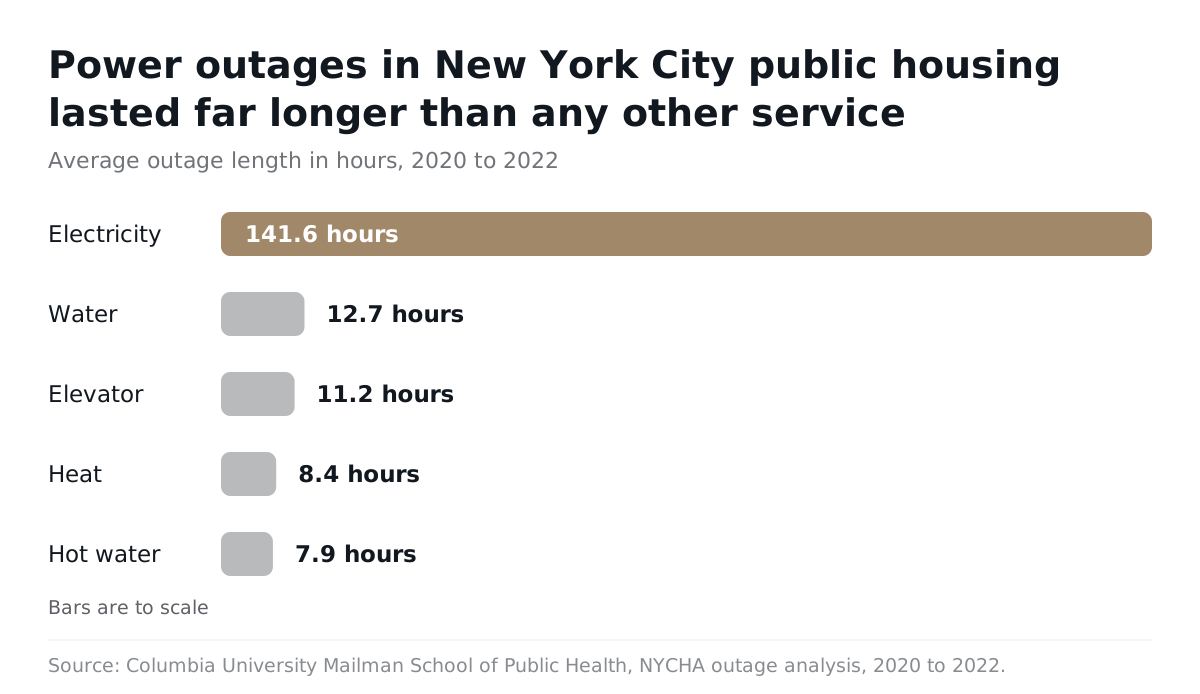
The Columbia study found the same pattern in housing. Electric outages in New York City public housing averaged 141.6 hours from 2020 to 2022, by far the longest of any service in the Columbia analysis. By comparison, water outages averaged 12.7 hours, heat outages 8.4 hours, and hot water outages 7.9 hours.
When the building is dark, use this order:
- Push and email while phones still have cellular data.
- Direct phone calls to residents with medical equipment or refrigerated medicine.
- Staff with radios doing floor checks.
- Paper notices at the lobby, stairwells, and mail room.
- Lobby screens only if they sit on backup power.
HUD's template lists the channels to prepare in advance: phone, email, SMS group messaging, social media, and radios. For the wider plan behind this notice, see our building emergency preparedness plan guide.
What does a power outage notice look like?
It leads with safety status and tells residents where staff are standing. Copy this one.
Power outage: [Building name], [time]
Power is out in [whole building / floors / common areas] as of [time]. Cause: [utility outage / building electrical fault / unknown]. Utility reference: [case number].
Elevators: [status]. Entry doors and fobs: [status]. Emergency lighting: [status]. Backup power is running [list areas, or "no areas"].
Estimated restoration: [time, or "not yet known"]. Next update by [time].
Keep your fridge and freezer closed. Unplug sensitive electronics so they are not damaged when power returns.
If you rely on powered medical equipment or refrigerated medicine, call [front desk number] now. Staff will check on you.
Staff are at the [lobby / front desk] until [time]. Knock or call [phone].
Which channel reaches residents fastest?
Push and SMS reach residents fastest, but no single channel reaches everyone. The winning move is a fast digital first alert plus a physical fallback for residents who will not see a phone. Pick the mix with your residents, not for them.
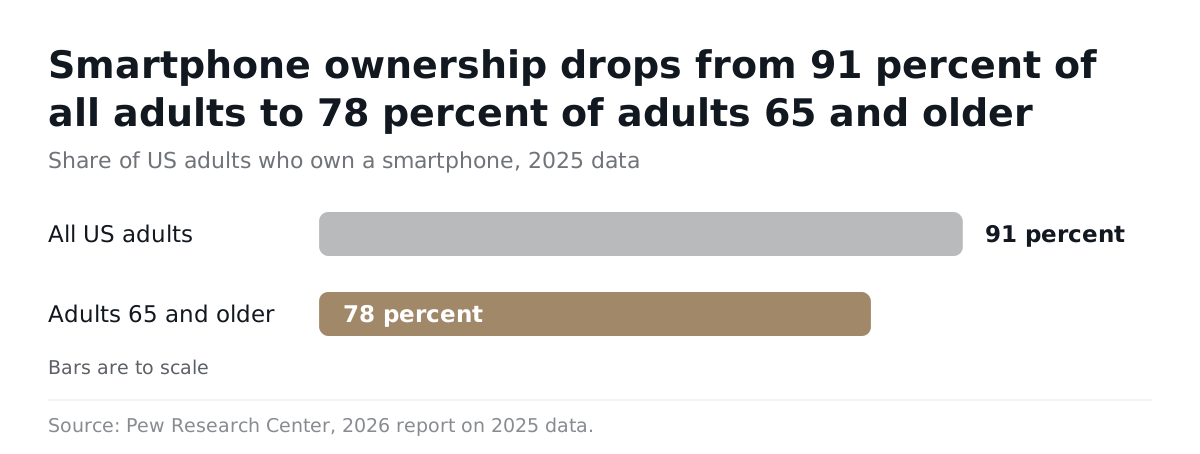
Phones are common but not universal. Pew Research Center found 91 percent of US adults had a smartphone in its 2025 data, compared with 78 percent of adults 65 and older. In an older condo, that gap is a real list of neighbors.
Accessibility rules point the same way. ADA.gov emergency planning guidance warns that many warning systems are not accessible for people with disabilities. It recommends both visual and audible alerts, plus calls, TTY messages, texts, and email.
| Channel | Speed | Who it misses | Proof you keep | Best role |
|---|---|---|---|---|
| App push | Seconds | Residents without the app or with alerts turned off | Published post with time and audience | First alert for enrolled residents |
| SMS | Seconds | Stale numbers and residents who never consented | Carrier send status and replies | Short urgent alert, never the only one |
| Minutes | Anyone not checking inbox right now | Send log and replies | Full details and restoration notes | |
| Lobby and elevator screens | Instant on site | Anyone off site; dark in a power outage without backup | Screen content log | Common area backup |
| Phone call | Minutes per person | Hard to scale building wide | Call notes and outcome | Mobility and medical list |
| Paper and door hangers | Hours | Slow in large buildings | Timestamped photo and staff name | Required postings and offline residents |
HUD's template says to choose communication methods with input from residents and staff. Ask at move in. Record the answer on the unit. For a wider look at tools, read our guide on how to choose building communications software.
How do you prove the notice was delivered?
You prove it with one record per incident that shows what was sent, when, to whom, on which channel, and what happened next. A carrier "delivered" status proves a phone received a text. It does not prove a person read it. So build the record in layers.
Keep these items together for every outage:
- The approved message and every update, each with a timestamp.
- Who wrote it and who approved it.
- The audience: which building, floors, or units were targeted.
- Replies, calls, and questions residents sent back.
- Photos of posted paper notices, with the time and the staff member who posted them.
- Each direct contact attempt for residents on the mobility or medical list, and the outcome.
- The restoration message and the time the incident closed.
Ownership matters as much as the log. As IREM instructor Jeff Lapin, CPM, ARM, told the National Association of Realtors, "As property manager, you're in charge." A record that names who sent, who posted, and who knocked on doors backs that up.
How does URBI send all three notices fast?
With URBI, you paste a template into an announcement, fill the brackets, pick the audience, and publish. The whole flow lives in the URBI Kore web dashboard.
Speed still has limits. James Love of Draper and Kramer, writing in Multifamily Executive in 2025, put it well: "Accuracy always supersedes speed in a sensitive situation." A fast send is for verified facts. Never guess at a repair time to hit a clock.
Here is what each part of URBI does:
- Targeted announcements. URBI's communication tools target a post by unit and access level, so a riser shutoff reaches only the affected stack. A post can carry rich text, show as a home screen banner, and send a push alert.
- Scheduled publish. Write the planned shutoff notice a week early and schedule reminders for the day before and the morning of. One post can fan out across several properties at each building's local send time.
- URBI Display emergency takeover. The property wide emergency takeover flips every lobby and elevator screen to the alert, whether it is fire, water, or a board notice. Our post on real time building communication with URBI Display shows how it works.
- Arthur on the phones. Residents call after every outage notice. Arthur, URBI's resident facing AI on the Premium plan, answers by voice, SMS, email, and in app chat in ten languages. It answers only about the caller's own household. When it cannot answer, it escalates to the manager with a summary, and the answer is saved so the next caller hears it directly. Every call ends with a transcript, a summary, and a manager notification, even if the caller hangs up.
- HERO drafts, people approve. HERO, the manager facing AI in Kore, can draft a notice or an emergency display banner from a thread. Nothing goes out until a person confirms it.
- The record. Email replies land in the staff inbox as threaded conversations. Concierge chats are logged and searchable. Staff can file an incident note on the unit or property with photos of posted notices attached.
Outages rarely wait for office hours. Our guide to condo emergency maintenance after hours covers that side. For the full residential picture, start with URBI for residential buildings, or read what URBI is in one page.
What do managers ask most about outage notices?
Can a building shut off water without notice?
Yes, in a genuine emergency such as a burst pipe, most rules let you stop the water first and notify residents right after. New York City, for example, waives advance notice for emergency repairs but asks that the notice go up as soon as possible after work starts. For planned work, check your state law, city code, lease, and condo declaration. Then give the longest warning you reasonably can, and write your policy down.
How long before a planned shutoff should residents get a reminder?
A good pattern is three touches: the first notice when the work is booked, a reminder the day before, and a final alert the morning of. Scheduled publish makes this easy because you write all three at once. Keep each reminder short and repeat the start time, end time, and contact number. Close the loop with a restoration message so residents know they can run the taps again.
Who should be contacted first during an elevator or power outage?
Residents who cannot use the stairs, and residents who rely on powered medical equipment or refrigerated medicine, should hear first. Call or message them directly before the building wide notice goes out. HUD's 2026 preparedness template recommends identifying these residents in advance. Tag them to their units so staff can find the list in seconds, and log each contact attempt and outcome.
Is a delivered text message proof that a resident was notified?
It is proof a phone received the message, not proof a person read it. Treat it as one layer of evidence. Pair it with the published announcement and its timestamp, resident replies, call logs, photos of posted paper notices, and notes on direct contact with residents on your assistance list. Together, those show a reasonable effort to reach every household.
A water shutoff, a stuck elevator, and a dark building all ask the same thing of you: say what is happening, reach the people who need help first, and keep proof. URBI puts the notice, the screens, the phones, and the record in one place. To see the three templates running in your building, email hello@myurbi.co.
Keep reading


