



A pest control entry notice tells residents when a pest company will come into their home, what it will do, and how to prepare. URBI lets a team send that notice to chosen units in the app, by push and by email at once.
The rules below are as of November 2026. This is general information, not legal advice. Confirm the rules for your building with your attorney.
How much notice does a pest control entry need?
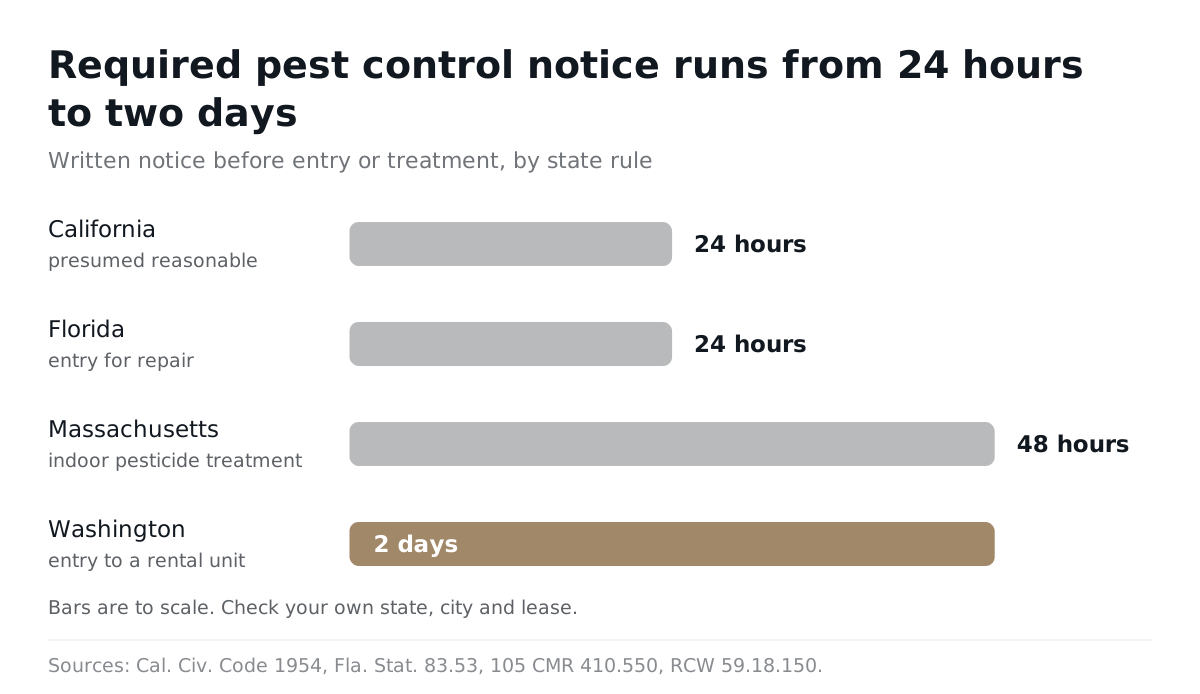
It depends on the state, and the four rules below run from 24 hours to two days.
Each row comes from the statute or regulation itself. None of them is a national rule.
| Place | What the rule says | Source |
|---|---|---|
| California | Written notice with the date, approximate time and purpose of the entry. Twenty four hours is presumed reasonable. If the building applies a pesticide itself, without a licensed pest control operator, the notice must also name the product, carry a warning the statute spells out, and reach neighbors when the application is a broadcast, fogger or aerosol spray. | Civil Code 1954 and Civil Code 1940.8.5 |
| Florida | A tenant may not unreasonably withhold consent to entry to supply agreed services. The statute defines reasonable notice as at least 24 hours only for repair, between 7:30 a.m. and 8:00 p.m. For other entry it says reasonable notice and leaves the number open. | Florida Statutes 83.53 |
| Washington | At least two days of written notice, except in an emergency. The notice states the exact date and time, or a window with the earliest and latest possible times, and gives a phone number for objections or a new time. | RCW 59.18.150 |
| Massachusetts | The pesticide applicator or its employer gives written notice at least 48 hours before an indoor treatment. It names the company and its phone number, the date, the locations, and each product with its EPA registration number and active ingredient. | 105 CMR 410.550 |
Your state, your city and your lease may say something else. Treat the longest period that applies as your floor, and send earlier when you can.
In Massachusetts the duty sits with the pesticide applicator. Ask your vendor who sends the notice, and send your own copy anyway.
What must a pest control entry notice say?
A good notice answers eight questions before a resident has to ask.
- When. The date and a time window with a start and an end. Add a line saying the time may change if the technician runs late.
- Who. The name and phone number of the pest company.
- Why. The pests and the kind of visit: inspection, treatment or follow up.
- Where. The rooms, the whole unit, or only the common areas.
- What. The product names. Ask your pest company for them, and for the EPA registration numbers if you can get them.
- How to prepare. Short steps a resident can finish in an evening.
- Pets, children and health. Where to keep them, and who to tell about asthma, allergies or pregnancy.
- How to reschedule. A phone number, an email and a deadline.
What are three pest control notices to copy?
Send a different notice for each situation: a unit entry, a building wide service and a follow up visit.
Fill the blanks, check the dates against your state rule, and send. The same short format works for other planned entries. See the water shutoff notices for another set.
Notice 1: entry into a home for treatment
Subject: Pest control visit to your home on ______
Hello ______,
______ (building name) has scheduled pest control service for your home.
Date: ______
Time window: between ______ and ______. The visit takes about ______ minutes. The time may change if the technician runs late.
Company: ______, phone ______
Pests we are treating: ______
Products that may be used: ______ (EPA registration numbers: ______)
Please do these things before the visit:
- Clear the floor along the baseboards and the cabinets under the kitchen and bathroom sinks.
- Put food away in sealed containers or the refrigerator, and put dishes away.
- Move pets to a carrier or another place. Keep children and pets away from treated areas until the company says they are safe.
- Tell us by ______ if anyone in your home has asthma, allergies, is pregnant or has another health need.
If you cannot be home, reply by ______ and tell us whether we may enter while you are away.
To change the visit, call ______ or email ______ by ______. If we cannot get in, we will leave a note with a new date.
Thank you,
______ property team
Notice 2: building wide service in common areas
Subject: Pest control service in the building on ______
Hello neighbors,
A pest control company will treat the shared areas of ______ (building name) on ______ between ______ and ______.
Areas: ______ (for example the trash rooms, corridors, garage and lobby).
Pests we are targeting: ______
Products that may be used: ______
- Please do not touch bait stations or traps in the shared areas. Tell us where you see one that is open or moved.
- Keep pets on a leash or in your arms in the corridors that day.
- Treatment inside homes is by appointment only. If your home is on the list, you will get a separate notice at least ______ before the visit.
This notice stays posted until ______. Questions: ______, phone ______.
______ property team
Notice 3: follow up visit, or a visit we missed
Subject: Follow up pest control visit to your home on ______
Hello ______,
The pest control company visited your home on ______. It needs to come back to ______ (check results, finish the treatment).
New date: ______
Time window: between ______ and ______.
If we could not get in last time: we came on ______ and no one answered. Please call ______ by ______ so we can set a time that works for you.
- Please keep following the preparation steps from the first notice.
- Please do not move or throw away furniture or bedding unless the pest company told you to. Moving items can spread some pests.
- Tell us right away if you see pests before the visit.
To change the visit, call ______ or email ______ by ______.
______ property team
How do residents prepare for a pest control visit?
Residents prepare by clearing access, putting food away, moving pets and following the pest company's own instruction sheet.
The U.S. Environmental Protection Agency lists preparing the unit for the pest control visit as part of the resident's role in multifamily housing. Its do's and don'ts of pest control add two steps that belong in every notice: keep pets and children away from treated areas, and store food in sealed containers. It also warns that clutter gives pests places to hide and makes them hard to remove.
Do not assume residents know how. In a 2014 review in Pest Control Technology, Rutgers University entomologist Changlu Wang and two co authors wrote that pest companies commonly ask clients to prepare without realizing that most residents lack the know how to prepare properly. A short numbered list, sent with the notice, beats a long paragraph. For bed bugs, attach the pest company's own sheet and tell residents to follow it instead of improvising.
Why does access matter so much in an apartment building?
Pests move between homes, so one unit that cannot be treated can undo the work in the others.
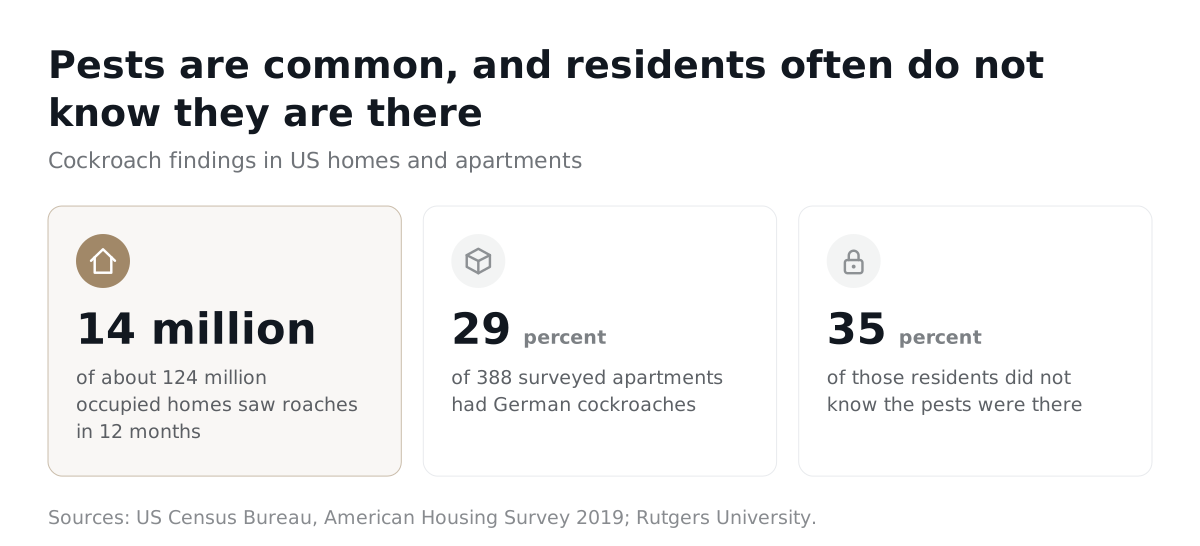
- The Census Bureau's 2019 American Housing Survey found that about 14 million of roughly 124 million occupied homes reported seeing roaches in the last 12 months, and roaches were more common in renter occupied homes.
- A Rutgers study of 388 apartments in seven buildings in New Jersey found German cockroaches in 29 percent of them. In 35 percent of those apartments the resident did not know the pests were there. The residents were seniors and people with disabilities.
- In the 2014 Pest Control Technology review, Wang cites a bed bug case where 101 of 223 units in one building became infested within 41 months of the first confirmed introduction. The review's conclusion: "gaining access to all apartments is critical for success of the treatment program."
The notice is how you ask for that access. Make it early, clear and polite.
What if a resident is away or refuses entry?
Start with your state statute and your lease, not with the door.
The statutes treat consent and absence differently. California says no notice is needed when the tenant is present and consents to the entry. Florida lists several cases when a landlord may enter, among them consent, an emergency, and a tenant who unreasonably withholds consent. Washington says a landlord has no other right of access except a court order, an arbitrator or the tenant's consent. In Massachusetts, owners and occupants must give access after the notice and follow the applicator's preparation instructions.
Wang's review notes that some residents change their locks, do not open the door or ask the company to come back another time. Here is a calm way to handle it.
- Do not enter against a refusal unless your attorney confirms your state allows it.
- Ask why. Privacy, pets, health and a bad past visit are the usual reasons.
- Offer a new window, and offer to have a team member present.
- Send a second notice. Notice 3 above is written for this.
- Keep a copy of every notice and every reply.
- If a resident raises a medical reason, send the question to your attorney before you answer.
How do you deliver the notice and keep a record?
Send it by more than one route, and write down what you sent.
With URBI's news and announcements, one post goes out in the app, by push and by email at the same time. You pick the audience: the whole building, specific units, or groups. That means a unit entry notice can reach only the homes on the schedule. You can set a publish time ahead of the visit. Every post carries one of three urgency levels, and an AI urgency scan reads each draft. For a building wide service, a team member can also add the notice to the lobby screens as a banner.
Be honest about proof. URBI does not record who received or opened a post. Each post keeps its urgency level, publish date and audience on the record. For entry into a home, add a door notice or a hand delivery, and log it as a note on that unit. URBI notes can be tagged to a unit, so the next person on the team sees what was sent and when. Statutes list the delivery methods they accept. California's pesticide notice law, for example, allows mail, personal delivery, email if the tenant gave an address, or posting at the unit entry. Our guide to proof of notice goes deeper on the record, and why residents do not read building notices covers the delivery side.
Replies need a home too. Email replies to a post come into the staff inbox as a threaded conversation, so reschedule requests do not scatter. HERO, URBI's AI for the team, can draft the notice for a person to review, and nothing goes out until a person confirms it. Recurring pest control visits can live as a recurring service ticket, and a vendor can manage work order scheduling from an emailed link without a login.
How do you reach residents who read another language?
Send the notice in the languages your residents read, at the same time as the English one.
The Census Bureau reports that more than 1 in 5 people age 5 and older in the United States spoke a language other than English at home from 2017 to 2021. A notice a resident cannot read is a notice you did not send. Keep sentences short, keep the dates in a clear format, and have a fluent person check the translation. Our post on multilingual resident communication covers the wider approach.
Residents who ask about the visit by phone, text, email or in app chat can also ask Arthur, URBI's resident facing AI on the Premium plan. Arthur answers in ten languages, and a question it cannot answer goes to your team with a summary.
Does a condo need a different notice?
Often yes, because entry rights in a condo come from the declaration, the bylaws and state condominium law, not only from a lease.
California shows the difference. Its pesticide notice law says an association does not have to give notice of pesticide use inside a separate interest in a common interest development, unless the association has taken title to that unit. Whether the association or the owner pays for treatment inside a unit also turns on those documents. Our post on routing a maintenance request by who pays walks through that question. Read your governing documents first, then adapt the three notices above.
Does your city add a yearly pest notice?
Some do. New York City is one example, with a yearly filing window in December.
New York City's housing agency requires owners of rental buildings to file a Bed Bug Annual Report between December 1 and December 31. The owner then gives each tenant the filing receipt at a new lease and at renewal, or posts it in a prominent place, and distributes or posts the health department's bed bug guide. The agency's bed bug page has the details. Check whether your city has a similar rule.
Frequently asked questions
Can a building enter without notice for pest control?
Usually only in an emergency, or when the resident agrees at the time. California says no notice is needed when the tenant is present and consents. Florida lets a landlord enter at any time to protect the premises. A routine treatment is rarely an emergency. Plan on sending notice, and ask your attorney what counts as an emergency where you are.
How early should a routine notice go out?
Send it as soon as the date is set, and never later than the longest period your rules require. The rules above run from 24 hours to two days. A week ahead gives residents room to prepare, arrange for pets and tell you about health needs. Send a short reminder the day before.
Do we have to name the pesticide in the notice?
In Massachusetts, the written notice must list each product with its EPA registration number and active ingredient. In California, a building that applies a pesticide itself must name the product and brand. Even where no rule asks, residents with asthma or allergies will ask. Get the list from your pest company and include it.
Send the notice, keep the record
A good pest control entry notice is early, specific and easy to act on. If you want to send notices like these to the right units and keep the replies in one inbox, book a demo or write to hello@myurbi.co. You can also read what URBI is and how it runs condos and multifamily buildings.


