



A tenant communication log is a dated record of every message, notice, call, and reply with residents, tied to unit, issue, and outcome. It saves you when a dispute turns on who said what, and when. URBI keeps that record inside its messages, notices, notes, and tickets.
This guide covers what each entry needs, which disputes a log decides, and how long to keep records. It is general information, not legal advice.
What is a tenant communication log, and what should every entry contain?
A tenant communication log is a running record that links each communication to the people, the unit, the issue, the action required, the proof of delivery, and the result. Treat it as an evidence chain. A line that says "tenant called about mold" helps nobody a year later. A line that names the caller, the unit, the time, the promised inspection, and the closed ticket does.
Use these fields as your minimum. Paper, spreadsheet, or software, the fields are the same.
| Field | What to capture | Why it matters later |
|---|---|---|
| Timestamp | Date, time, and time zone | Proves sequence and how long a response took |
| Property context | Building, unit, account, and issue or ticket number | Keeps the entry attached to the right resident |
| Parties | Sender, recipient, anyone else present, and the staff author | Shows who had firsthand knowledge |
| Direction and channel | Inbound or outbound; app, email, text, call, letter, or in person | Tells you where the original message lives |
| Category | Maintenance, notice, payment, conduct, accommodation, incident, insurance | Lets you route, restrict access, and treat like cases alike |
| Factual summary | Neutral wording, in the resident's own words where possible | Keeps opinions and guesses out of the record |
| Original evidence | The message itself, attachments, photos, the letter, or call notes | A summary is weaker than the thing it summarizes |
| Related records | Lease clause, work order, inspection, invoice, incident report, claim number | Connects talk to action |
| Notice proof | Method of service, address used, receipt, returned mail, posting photo, witness | Separates "we sent it" from "it was served" |
| Workflow | Next action, owner, due date, status | Turns an archive into a to do list |
| Outcome | Resident reply, completion, refusal, close date | Shows the issue was actually resolved |
| Audit trail | Who created the entry, when, and every later correction | Shows nobody quietly rewrote history |
Two rules make the table work. Log at the time, not after a complaint arrives. And correct entries by adding a new note, never by overwriting the old one.
Why does logging at the time of the event matter so much?
Records made promptly, as a routine habit, are the ones federal evidence rules favor. Under the federal hearsay exception for business records, Federal Rule of Evidence 803(6) looks for a record "made at or near the time" by someone with knowledge, kept in the regular course of business, as a regular practice. The same rule lets the other side attack a record whose preparation shows "a lack of trustworthiness."
That has a plain practical meaning for a building:
- A log kept the same way for every resident, every week, is strong.
- A log that only appears once a resident files a complaint looks like a story written after the fact.
- Notes typed from memory three weeks later invite the question of what else was forgotten.
Habit beats reconstruction.
When does a tenant communication log actually decide a dispute?
A log decides a dispute when the fight is about timing, notice, or consistent treatment, which covers many landlord and tenant conflicts. Here is how it plays out across five common disputes.
| Dispute | US example | What the log must show |
|---|---|---|
| Repairs and habitability | Texas repair remedies turn on how notice was delivered and a seven day presumption | First report, delivery proof, inspection, vendor visits, access attempts, completion |
| Notice and eviction | State statutes set specific service methods; a portal post may not qualify | The exact notice, method, date, address, and proof of service |
| Fair housing | HUD complaints must be filed within one year; HUD may request documents | The request, the policy applied, the decision, the reason, the timing |
| Insurance claims | Model rules require insurer claim files that let events and dates be reconstructed | Incident time, first report, mitigation steps, photos, adjuster contacts |
| Lawsuits and discovery | Federal courts can sanction the loss of electronic records that should have been kept | Complete exports, edit history, and the date deletion was paused |
How does a log change a repair dispute?
A log changes a repair dispute by proving when you received the request and what you did next. The Texas Attorney General's renter guidance tells tenants to send a dated repair letter by certified mail, return receipt requested, or by registered mail, and to keep a copy. It says the law presumes seven days to be a reasonable time for the landlord to act, though the landlord can rebut that. If the first letter was not sent by one of those tracked methods, the tenant may need to send a second notice.
So delivery method changes the clock. Your log should capture the date the letter arrived, how it arrived, and each step after: the inspection, the parts order, the vendor visit, the resident who could not give access on Tuesday. That timeline is what diligent effort looks like in writing.
How does a log change a notice or eviction dispute?
A log supports a notice dispute but cannot fix a notice that was served the wrong way. State eviction statutes often spell out exactly how a notice must be delivered. If the law requires a specific method, an app timestamp does not replace it.
What the log does is corroborate proper service. Record the exact document, the method, the person who served it, the address, and any receipt or returned envelope. Keep the notice itself, not a description of it. Never let software or staff label a portal announcement as "legally served" unless the method actually meets your state's rule.
How does a log change a fair housing complaint?
A log helps in a fair housing complaint by showing that you applied the same policy, in the same time frame, to every resident. HUD's intake guidance says a Fair Housing Act allegation must be filed within one year of the last alleged act, and that investigators may interview witnesses, obtain documents from both sides, and inspect properties.
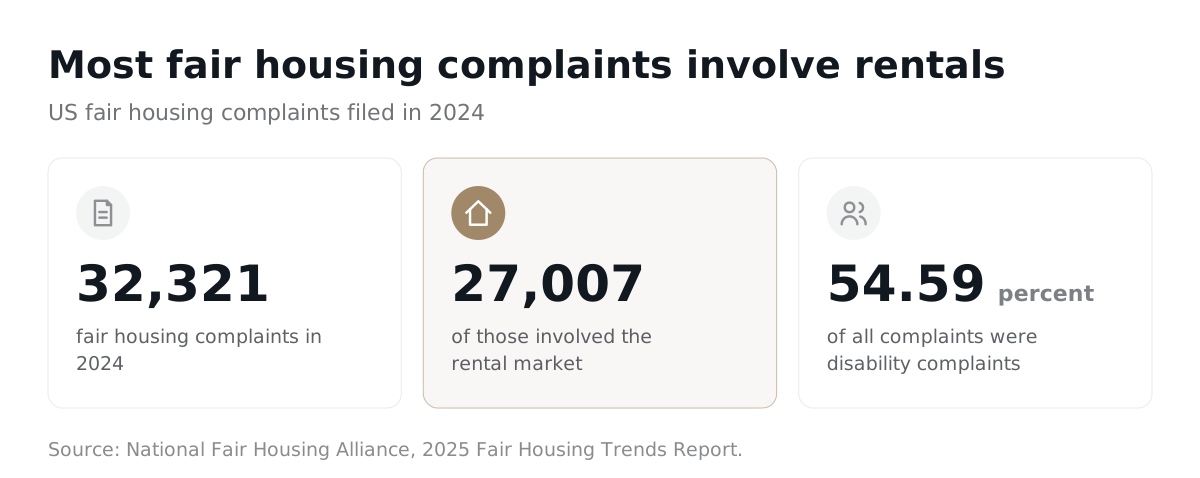
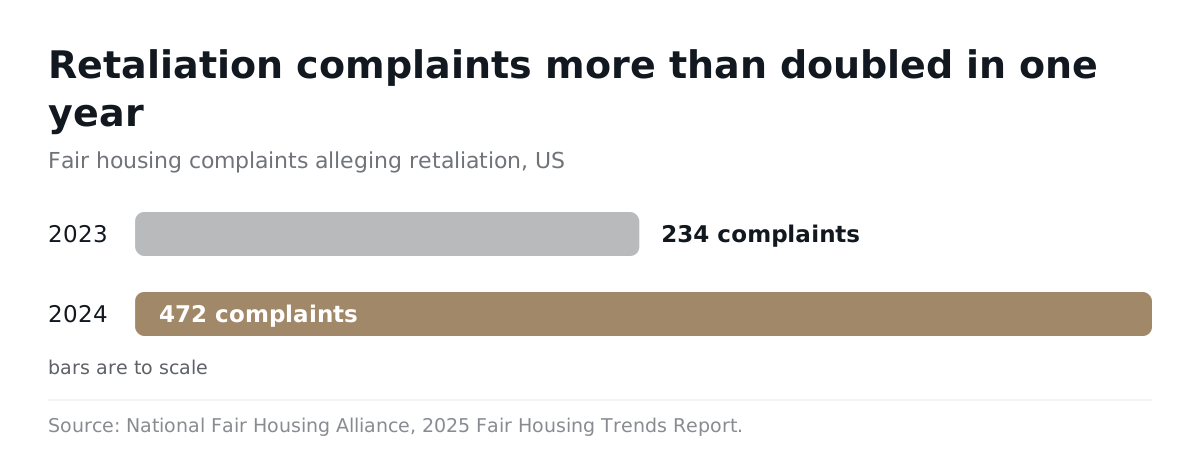
These complaints are common, and most involve rentals. The National Fair Housing Alliance's 2025 Fair Housing Trends Report counted 32,321 fair housing complaints in 2024. Of those, 27,007 involved the rental market. Disability complaints made up 54.59 percent of the total, and retaliation complaints more than doubled, from 234 in 2023 to 472 in 2024.
Lisa Rice, President and CEO of the National Fair Housing Alliance, put the stakes bluntly in the November 2025 release of that report: "America is in the midst of a fair and affordable housing crisis."
The National Center for Housing Management's 2026 compliance guide recommends keeping written records of maintenance requests and accommodation requests "to show how decisions were made." For a log, that means three things:
- Record accommodation requests in the resident's own words, with the date received.
- Record the policy you applied and the reason for the decision.
- Restrict who can read sensitive entries, such as anything touching health or disability.
The retaliation numbers deserve extra attention. If a resident complains about a repair and then gets a lease violation notice, the dates in your log will be the first thing anyone checks.
How does a log change an insurance claim?
A log helps an insurance claim by letting everyone rebuild the sequence of events after water, fire, or storm damage. The NAIC's model regulation on claim file records says an insurer's claim file must be clear enough that "pertinent events and dates of these events can be reconstructed." It lists correspondence and any documented or recorded telephone communication about the claim as part of that file, and sets retention at the calendar year the claim closes plus three years. The rule governs insurers, but it shows the standard your records will meet.
For an owner or board, the matching log entries are the first report, the time the water was shut off, the mitigation vendor's arrival, the photos, and every call with the adjuster.
How long should you keep tenant communication records?
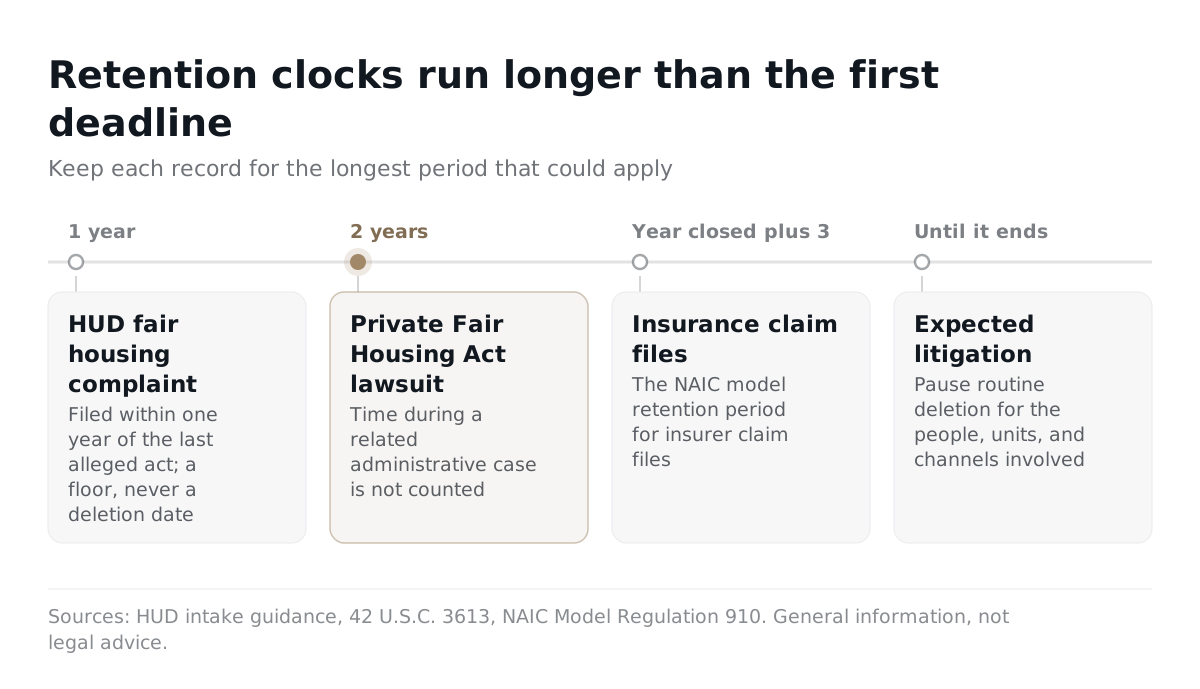
There is no single US retention period for tenant communications, so keep each record for the longest period that could apply to it, then delete it unless a legal hold is in place. Anyone quoting a universal "six year rule" is guessing. Build a written schedule by state and record type, and have your lawyer and your insurance carrier review it.
| Trigger | Period | How to treat it |
|---|---|---|
| HUD fair housing complaint | 1 year from the last alleged act (HUD, cited above) | A floor, never a deletion date |
| Private Fair Housing Act lawsuit | 2 years, with time during a related administrative case not counted (42 U.S.C. 3613) | Keep decision and message history well past the HUD window |
| Insurance claim files | Year of closing plus 3 years in the NAIC model (cited above) | A useful benchmark for your own claim records |
| Expected litigation | Until the matter ends | Stop routine deletion for the people, units, and channels involved |
Start each clock from a defined event, such as move out, ticket closure, or claim closure. The federal Fair Housing Act enforcement section lets a private plaintiff sue up to two years after the alleged practice, and the clock pauses while an administrative complaint is pending. That pause alone can stretch your exposure well beyond two years.
Do not keep everything forever. Every extra record is more to protect and more to hand over in discovery. Log operational facts and skip unrelated personal detail.
What breaks when communication lives in email threads and personal phones?
Email threads and personal phones break the log because the records scatter, get deleted, and leave with the employee who holds them. Under Federal Rule of Civil Procedure 37(e), if electronically stored information that should have been preserved for litigation is lost because a party failed to take reasonable steps, a court can order measures to cure the harm. If the loss was intended to deprive the other side, the court can presume the lost information was unfavorable or even dismiss the case.
Texts on a superintendent's phone are electronically stored information like anything else. Here is what fails with each common setup:
| Setup | What breaks | Better habit |
|---|---|---|
| Staff email threads | Split across mailboxes, forwarded copies, changing subject lines, lost attachments, no status | One shared inbox where each thread attaches to the resident and the issue |
| Personal phone texts | Deleted, lost when the phone is replaced, gone when staff leave, hard to export | An approved business channel with central retention and export |
| Sticky notes and memory | No reliable time, no author, no delivery proof, no owner | Type the call into the system before the next task |
| Screenshots alone | Miss earlier messages, account details, and later edits | Keep the native message; use screenshots only as a readable extra |
Texting residents from a business number raises its own rules on consent and registration. Our guide to texting residents legally covers that side.
What should a building record for notices, not just messages?
For notices, record the notice itself, who it went to, when, how, and what came back. Building wide notices are communications too. A water shutoff notice that went out two days late, or to the wrong floor, is exactly the kind of fact that shows up in a damage claim.
- Save the final text and any attachment, not a draft.
- Record the publish time and which units or floors it targeted.
- Record every channel used: app, email, lobby screen, paper under the door.
- Log every resident reply and question against the notice.
Our water shutoff notice templates show what a good notice says. Sending it is only half the job, because many residents never read building notices on the first channel you try. A log showing several channels beats one showing a single email.
Board records follow the same logic. Minutes, rules, and bylaws belong in a controlled document hub, as our guide to condo document management explains, so the notice log can point to the exact rule version a resident was sent.
How does a system that logs every message, notice, and reply change the outcome?
A system that logs everything changes the outcome by making the record complete before anyone needs it, instead of assembled after. The timeline rebuilds on demand. Overdue replies and missing owners show up while there is still time to fix them. Like requests sit on the same fields, which is what consistent treatment looks like on paper. And when staff move on, the record stays.
Here is how URBI captures most of those fields during daily work, without a separate spreadsheet:
- Concierge and direct messaging. Staff to resident chat happens inside URBI. Every conversation is logged, searchable, and reviewable by management. The conversation does not sit on a personal phone.
- News and announcements. Notices are written, scheduled, and targeted per unit and access level from the URBI Kore dashboard, so the post, its publish time, and its audience stay on file. When a resident replies to an announcement email, the reply lands in the staff inbox as a threaded conversation.
- Typed notes. Staff log calls and hallway conversations as a note, report, incident, or action, tagged to people, units, and the property, with attachments, pinning, and full text search.
- Service tickets. Repair requests carry photos, status, and vendor assignment by category. Vendors work from an emailed link with no login, and residents see progress.
- Arthur, the resident facing AI. On Premium, Arthur answers residents by voice, SMS, email, and in app chat. Every call produces a transcript, a summary, and a manager notification, even if the caller hangs up mid call.
- HERO, the manager facing AI. Inside Kore, HERO can propose a note, ticket, or notice from a thread. A person reviews and confirms each one.
URBI does not make a notice legally served. It keeps the proof of what you did in one place, so your lawyer is not rebuilding it from five phones. See the communication and community features for the full module list, or how it fits a whole property in URBI for residential buildings. If you are comparing tools, our guide on how to choose building communications software lists the questions to ask any vendor about exports and retention.
FAQ: What do managers ask most about a tenant communication log?
Is a tenant communication log legally required?
No general US law requires a landlord to keep a communication log in a set format. The law does require proper notice, fair treatment, and preserving records once litigation is expected. A log is how you prove you met those duties. Some programs, leases, and insurance policies add their own record rules, so check yours with counsel.
Can text messages be used as evidence in a landlord and tenant dispute?
Yes, texts can be offered as evidence, but they must be authenticated, meaning someone must show they are what they claim to be. Native messages from a business account, with dates and sender details intact, are easier to support than screenshots. Texts on a personal phone can be lost when the phone is replaced. Moving resident conversations to a logged business channel keeps them complete and exportable.
Does a portal message count as legal notice?
Only if your state law and your lease allow that method for that type of notice. Formal notices, such as eviction notices, often have delivery methods set by statute. A portal message can still be a helpful extra copy and a useful record of what you sent. Treat it as corroboration, and serve formal notices the way your state requires.
Should I record phone calls with tenants?
Recording rules vary by state, so check with counsel before you record anything. At minimum, write a note right after the call with the time, the people on the line, what was asked, and what you promised. A prompt typed note made as a habit is far stronger than a detailed memory written weeks later.
A tenant communication log is cheap insurance you build one entry at a time. If you want every message, notice, call, and reply to land in one searchable record, write to us at hello@myurbi.co and we will show you how URBI handles it in a real building.
Keep reading


