



How many package lockers does a building need? Usually about 35 to 65 doors per 100 units, depending on daily volume, pickup speed, and how you plan for December. URBI lets you size for the median day, because desk staff log the overflow with the AI scanner.
No neutral body publishes a doors per unit rule for all carriers. The vendors on page one each quote their own ratio. This guide gives you the formula behind any ratio, a worked example you can copy, and the numbers that move the answer most.
What is the formula for sizing a package locker bank?
Required doors equal the parcels that need a door at the same moment, divided by how full you are willing to run the bank. Everything else is detail. Written out, the formula looks like this:
Doors = (Units × Parcels per unit per day × Peak multiplier × Dwell days × Eligible share) ÷ (Parcels per door × Target occupancy)
Round the answer up. Each input is something you can measure or choose:
| Input | What it means | Where to get it |
|---|---|---|
| Units | Occupied units the lockers serve | Rent roll or owner list |
| Parcels per unit per day | Average daily arrivals divided by units | 8 to 12 weeks of desk, room, and carrier logs |
| Peak multiplier | December volume divided by normal volume | Last December's logs, or a published fallback |
| Dwell days | Average time from deposit to pickup, weekends included | Locker or desk timestamps |
| Eligible share | Share of parcels that fit and are allowed in a door | Count oversize, cold, and flat items routed elsewhere |
| Parcels per door | Parcels that share one door for the same resident | Use 1.0 unless your system proves otherwise |
| Target occupancy | How full you let the bank run before it rejects deposits | Your choice; 90 percent is used here |
This is an editorial capacity model, not a vendor or regulatory standard. Its value is that every assumption sits in plain view. When a vendor quotes you a door count, ask which of these seven inputs they assumed.
Is the USPS parcel locker rule enough?
No. The USPS rule sets a postal minimum, not an all carrier capacity. For new or remodeled apartment houses with centralized mail, USPS says "There must be at least 1 parcel locker for every 5 mailbox compartments." That works out to 20 per 100 mailboxes. It covers only the Postal Service. UPS, FedEx, Amazon, grocery, and returns all need space too.
How many packages does each unit receive per day?
Plan on roughly 0.2 to 0.5 parcels per unit per day, and then measure your own building. Published examples vary by more than double. There is no current, representative national figure for apartment buildings.
- In a December 2025 trade article, the general manager of a 740 unit Chicago community reported more than 5,000 packages each month. That is about 0.22 parcels per unit per day.
- The same article cites a package room vendor's figure that an average 400 unit New York City building receives about 187 packages a day. That is about 0.47 per unit per day.
- For scale, US parcel volume reached 22.4 billion shipments in 2024, up 3.4 percent, according to Pitney Bowes.
Your number will depend on who lives there. A tower of young professionals is not a building of retirees. Count before you buy. If you are building from scratch, our guide to package management for new apartment buildings covers what to log in the first months after lease up.
How big is the December peak?
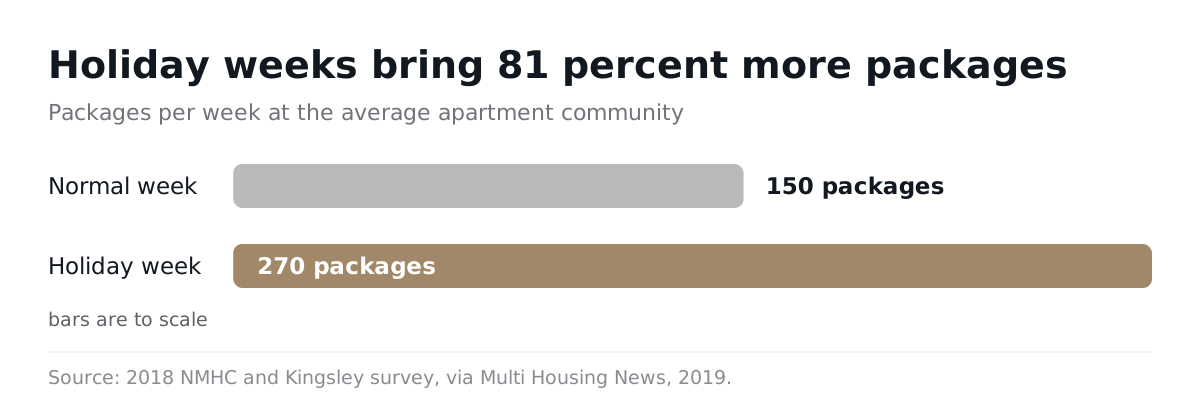
The most cited benchmark puts the holiday peak at about 1.8 times normal volume. It comes from the 2018 NMHC and Kingsley survey of more than 2,000 community managers. NMHC's Rick Haughey summarized it in 2019: the average community saw roughly 150 packages per week, jumping to 270 during the holidays. That is an 81 percent increase.
Peaks are not the same everywhere. The New York example above rises only from 187 to 208 a day during the holidays, a multiplier of about 1.1. Use your own December logs if you have them. Use 1.8 only as a cautious fallback.
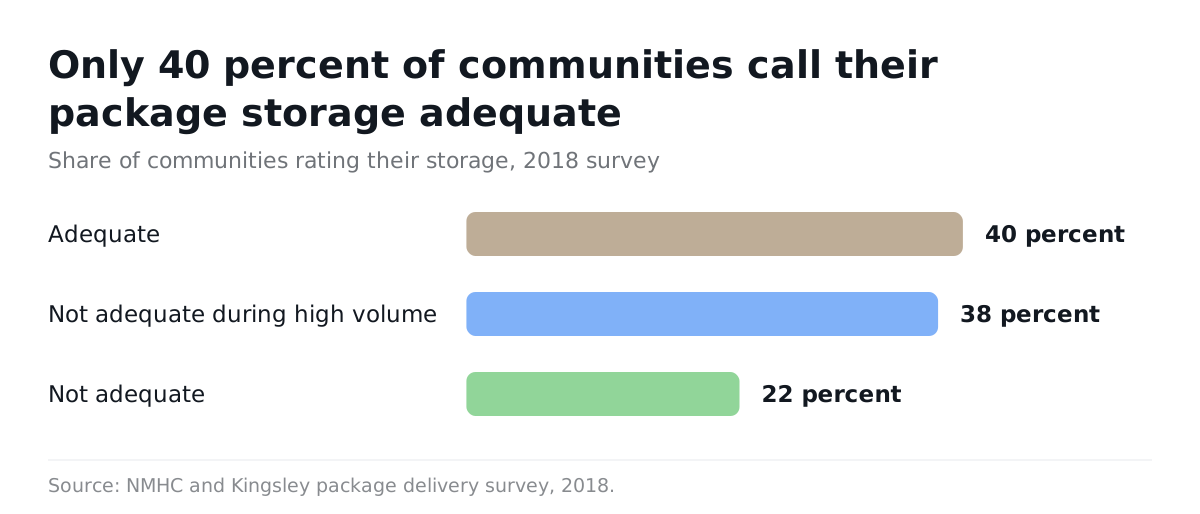
The peak is also the moment when storage fails. In the same 2018 survey, only 40 percent of communities said their storage was adequate. Another 38 percent said it was not adequate during high volume periods, and 22 percent said it was not adequate at all.
Why does dwell time change the answer so much?
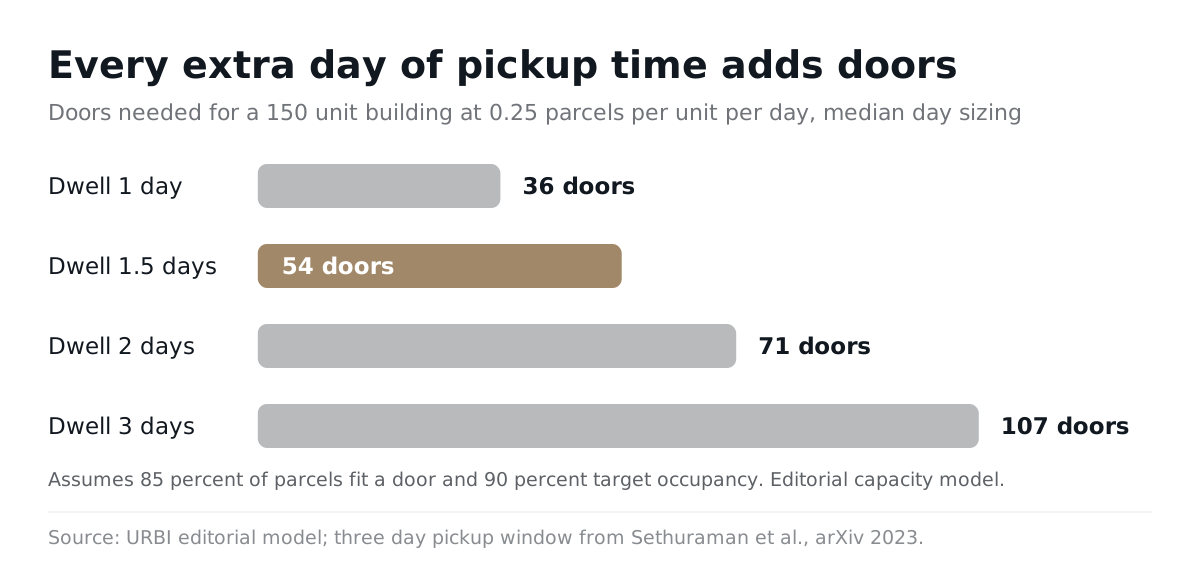
Every extra day of pickup time adds another full day of parcels to the bank. A door holds one parcel until the resident shows up. If pickup takes two days instead of one, you need twice the doors for the same volume.
No public study measures dwell time across US apartment buildings. The best published model comes from Amazon's own locker network, which is mostly public pickup points, not apartments. In that study, "Customers are advised to pick up their packages within three days of delivery." The researchers model dwell as anywhere from zero to six days. They also report that in 2017, 20 percent of locker requests were rejected. That is what a full bank looks like at network scale.
Dwell is the one input a building can change without new hardware. Faster notifications shorten it. So do clear pickup rules and reminders on day two. Cutting average dwell from 1.5 days to 1 day removes about a third of the doors you need.
How many lockers does a 150 unit building need? A worked example
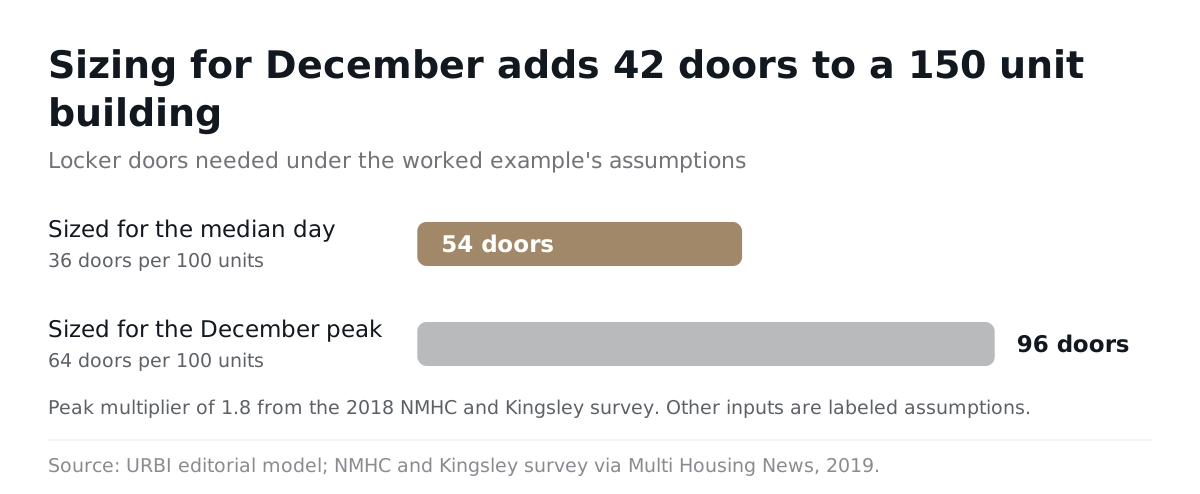
With the assumptions below, a 150 unit building needs about 54 doors sized for the median day, or about 96 doors sized for the December peak. That is 36 or 64 doors per 100 units. Every input is either sourced or labeled as an assumption.
| Line | Input | Value | Basis |
|---|---|---|---|
| 1 | Occupied units | 150 | Example building |
| 2 | Parcels per unit per day | 0.25 | Assumption, inside the 0.22 to 0.47 range from the published examples |
| 3 | Median day arrivals (1 × 2) | 37.5 | Calculated |
| 4 | Eligible share for lockers | 0.85 | Assumption: 15 percent oversize, cold, or restricted |
| 5 | Average dwell days | 1.5 | Assumption, under the three day pickup window in the Amazon study |
| 6 | Parcels per door | 1.0 | Assumption: no consolidation |
| 7 | Target occupancy | 0.90 | Assumption: editorial service target |
| 8 | Parcels needing a door at once, median day (3 × 4 × 5 ÷ 6) | 47.8 | Calculated |
| 9 | Doors, sized for the median day (8 ÷ 7, rounded up) | 54 | Calculated |
| 10 | December peak multiplier | 1.8 | 2018 NMHC and Kingsley survey |
| 11 | Doors, sized for the peak (8 × 10 ÷ 7, rounded up) | 96 | Calculated |
| 12 | Doors per 100 units, median sizing | 36 | Calculated |
| 13 | Doors per 100 units, peak sizing | 64 | Calculated |
The gap between line 9 and line 11 is 42 doors. Those 42 doors sit empty for most of the year. They exist to cover a few weeks in November and December.
What happens at the desk if you size for the median day?
At the December peak, about 86 eligible parcels need a door at once, and 54 doors are available. Roughly 32 parcels spill to the desk or package room. Add the oversize stream, about 10 parcels a day at peak or 15 on hand, and the desk holds around 47 parcels on a busy December day.
For the rest of the year, the desk holds only the oversize and cold items. That is about 8 parcels on hand on a median day. Those numbers are the real trade. You are choosing between 42 extra doors and a few weeks of heavier desk work.
How sensitive is the locker count to each input?
The locker count is very sensitive to dwell and volume. Dwell time and daily volume together can move the answer by a factor of nine. The table below holds the 150 unit building, 0.85 eligible share, and 90 percent target occupancy constant. Each cell shows doors sized for the median day, then doors sized for a 1.8 peak.
| Parcels per unit per day | Dwell 1 day | Dwell 1.5 days | Dwell 2 days | Dwell 3 days |
|---|---|---|---|---|
| 0.15 | 22 / 39 | 32 / 58 | 43 / 77 | 64 / 115 |
| 0.25 | 36 / 64 | 54 / 96 | 71 / 128 | 107 / 192 |
| 0.35 | 50 / 90 | 75 / 134 | 100 / 179 | 149 / 268 |
| 0.47 | 67 / 120 | 100 / 180 | 134 / 240 | 200 / 360 |
Read the table two ways. First, a quiet building with fast pickup can live with about 22 doors. Second, a busy building with slow pickup, sized for December, would need 360 doors. That is more than two doors per unit. No one builds that. Those buildings rely on a package room.
Boards and developers should measure volume and dwell before they order hardware. A quote built on someone else's building is a guess.
What share of packages will not fit in a locker?
Plan for a real share of parcels that no standard door will take. No neutral source measures this share for US apartments, so this guide uses 15 percent as a labeled assumption. Count your own oversize, cold, and flat items during your logging weeks.
The mix is getting bulkier. In a November 2024 Multifamily Executive article, a community manager described residents receiving furniture, artwork, and appliances. Castle Lanterra's founder told the same publication that package volume had doubled in a year. Groceries and meal kits need cold storage, which most standard doors lack.
- Oversize: route to a secure room or a staffed desk.
- Cold: route to a refrigerator with a logged handoff.
- Restricted items: follow your building policy and log the exception.
What happens when the lockers are full?
The next courier has nowhere secure to leave the parcel. It lands at the desk, in the lobby, or back on the truck. Each of those outcomes means work for staff or a missed delivery for a resident.
A full bank is a service failure. It is also why some buildings pull their lockers back into a broader package workflow. Read our comparison of package lockers vs package management software for how the two fit together.
Full lockers also push work back onto staff time. In the 2018 NMHC survey, 68 percent of communities that held packages at the office spent 1 to 4 staff hours a week on them. Another 5 percent spent 16 hours or more. Our breakdown of package handling costs in apartment buildings shows where those hours go.
What do operators report after installing lockers?
Operators who handle heavy volume describe hybrids, not lockers alone. Lockers take the steady flow of small parcels. A room or a staffed desk takes everything else.
Lindsey Bright, vice president of operations at Subtext, told Multifamily Executive in 2024 that the company moved to "a moderate number of lockers coupled with a large package room". Subtext also added refrigerators for perishables. The same article reports that Castle Lanterra hired seasonal temporary staff to handle holiday volume. Another operations director recalled that holiday package work used to take up nearly a whole job.
Lockers cut desk work for the median day. They do not remove the peak. Someone still has to receive, log, and hand off what does not fit.
How does URBI let you size lockers for the median day?
URBI handles the parcels your lockers do not. Lockers take the small parcels through URBI's smart locker integration. Staff log everything else at the desk with the AI scanner, so the bank can be sized for a normal day instead of December.
The desk workflow is short:
- Staff photograph the shipping label.
- The AI scanner reads the tracking number, the carrier (nine carriers recognized), and the recipient unit, and staff confirm it.
- The resident gets a push alert right away.
- The parcel sits on a per unit package tab with full chain of custody and a photo.
Fast alerts also shorten dwell, which lowers the door count in the formula above. A dashboard scan widget keeps logging one tap away during a December rush. For shelf level tracking in an overflow room, see our guide to package room inventory software. For locker hardware and related tools, see URBI IoT and hardware integrations. For a side by side of the tools on the market, read the best package management software for buildings.
Packages are one part of a bigger platform. What is URBI explains the whole system, and URBI for residential buildings covers how condos and apartments use it day to day.
FAQ
How many package lockers per 100 units should I plan for?
With middle of the road assumptions, about 36 doors per 100 units covers the median day and about 64 covers a December peak. Those figures assume 0.25 parcels per unit per day, a 1.5 day dwell, and 15 percent of parcels routed elsewhere. Change any of those and the answer moves. Measure your own volume and pickup time before you commit to a number.
Should a building size its lockers for December?
Usually not, if a desk or room can absorb the overflow. Sizing for a 1.8 peak adds about 42 doors in the 150 unit example, and they sit mostly empty for ten months. A better plan is median sizing plus a logged overflow process. Buildings with no staff and no secure room are the exception. They may need to size closer to the peak.
How long should residents have to pick up a locker package?
Pick a window short enough to keep doors turning and long enough for residents to accept it. Amazon's own locker network advises pickup within three days of delivery. Shorter windows lower the door count, but residents who travel will push back. Pair any window with instant alerts and a reminder, so most parcels leave well before the deadline.
Do I still need a package room if I install lockers?
Most buildings do. Lockers cannot take furniture, large boxes, or cold items, and a full bank sends the next courier to the desk anyway. A secure room or staffed desk covers those cases. The key is logging them the same way as locker parcels, so residents get alerts and staff keep a record of every handoff.
The right locker count comes from your own volume, your own pickup speed, and a clear plan for what does not fit. If you want help running the numbers for your building, or want to see how URBI logs the overflow with the AI scanner, email us at hello@myurbi.co.
Keep reading


